Every skater who gets serious about speed arrives at the same fork in the road. Should you buy a complete inline speed skate, already assembled in a box, or build your own setup from a boot, a frame, wheels and bearings chosen separately? It is one of the most common questions we get, and most of the answers online are really just a shop telling you to buy whatever that shop happens to sell. So here is the honest version, written by people who skate, and written with the actual numbers from our own stock rather than invented ones.
The short answer is that both routes work, they just fail in different ways. A complete skate fails when the boot fits you but the parts underneath hold you back, or when the boot does not fit you at all. A self built setup fails when a skater spends on the exciting parts and skimps on the one part that decides everything. Which route is right depends far more on your feet and your stage than on your budget.
What a complete skate actually is
A complete skate, sometimes called a package or a race pack, is a boot with a frame already bolted underneath, wheels already fitted and bearings already pressed in. You unbox it, you lace it, you skate. The convenience is real and should not be sneered at, especially if you are far from a shop that knows speed skating.
What you are buying is a set of decisions somebody else made. The brand picked a frame length, a wheel size, a wheel firmness and a bearing grade that they think suits an average skater at an average level on an average surface. Sometimes those choices are excellent. Sometimes the boot is the good part and everything bolted to it is there to hit a price.
What building your own actually means
Building your own means buying four things and putting them together: a boot, a frame, a set of wheels and a set of bearings. It sounds more technical than it is. Mounting a frame is two bolts per skate, pressing bearings into wheels takes a few minutes, and every LiveLica Aerolite frame ships with the Allen key, spacers and axles you need to do it.
The reason skaters do it is control. You choose a boot that fits your foot shape, not the shape the package assumed. You choose a platform that suits your racing, your surface and your height. And you choose how much of your money goes into the parts that you will actually feel.
Neither route is automatically better. One buys you certainty and speed of purchase, the other buys you control over where your money goes.
The honest case for buying a complete skate
There are three situations where a package is the sensible call.
The first is when you are genuinely new and do not yet know what you want. If you cannot tell a 100mm wheel from a 110mm by feel, choosing between them is guesswork, and paying somebody else to guess for you is reasonable. You will learn far more from six months of skating on an average setup than from six weeks of research.
The second is when the package boot happens to fit your foot beautifully. Fit beats everything. A perfectly fitting boot with ordinary wheels will make you faster than a badly fitting boot under the finest frame money can buy.
The third is a growing junior. Children outgrow boots alarmingly quickly, and spending carefully on a package that will be replaced in a year is often wiser than building a setup around a foot that is still changing size.
The honest case for building your own
Building wins once you know two things about yourself: the shape of your foot and the kind of skating you actually do.
Foot shape is the first reason. Speed boots are unforgiving, and brands last their boots differently. A wide forefoot or a high instep narrows your real choice of boot down to a handful of options, and once that choice is made for you by fit, the rest of the setup should be free to follow.
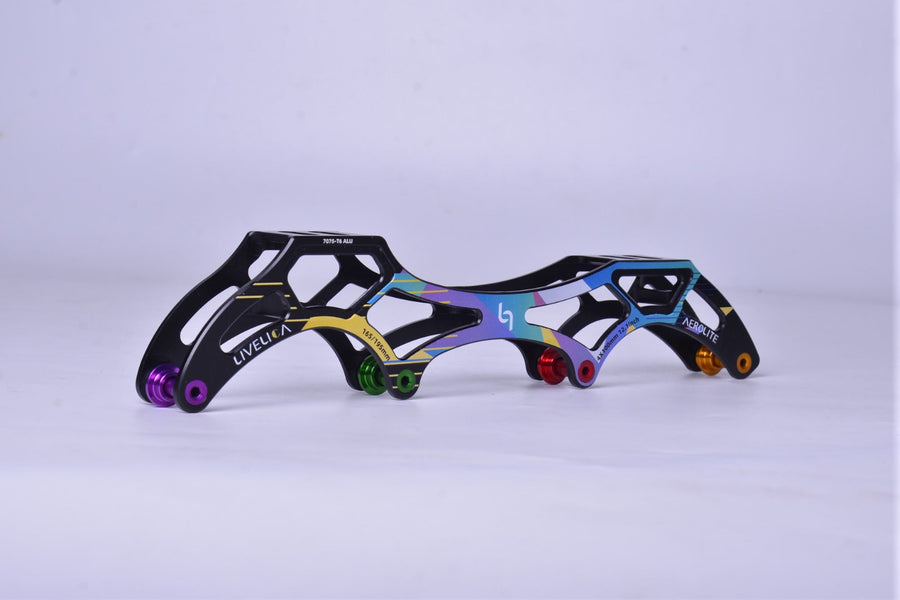
The second reason is matching the platform to your skating. A low, compact four wheel setup such as the Aerolite 4x90 runs a 10.86 inch platform at 124 grams and keeps you grounded for track and technical skating. The Aerolite 4x100 sits at 12.1 inches and 148 grams and is the do it all choice for skaters who train, tour and race in the same week. Both are machined from 7075 T6 aircraft grade aluminium and both arrive with an Allen key, spacers and axles in the box. A package picks one of those for you. Building lets you pick the one that matches the racing you are actually doing.
What carries over when you upgrade, and what does not
This is the part that almost nobody explains, and it is the strongest argument for thinking in components even if your first skate comes in a box.
Boots wear out. Liners pack down, shells take a set, and feet change. Frames do not wear out in any meaningful way, and a good one outlives several boots. Wheels are consumable and bearings are nearly immortal if you clean them. So the sensible long term plan is to put durable money into the frame and bearings and accept that the boot is the part you will replace.
There is one condition attached to that plan, and it is the mounting standard. Speed boots are drilled either 165mm or 195mm between the mounting bolts. A frame drilled for only one of those standards ties you to one family of boots forever. Every frame in the LiveLica Aerolite range is drilled for both 165mm and 195mm, which is precisely why it survives a boot change. Check this before you buy anything, because it is the single most common ordering mistake in the sport.
Put durable money into the frame and bearings, treat the boot as the part you replace, and make sure the frame is drilled for both mounting standards.
Costing it out without guessing
We do not stock inline boots at LiveLica, so we cannot and will not quote you a boot price. What we can give you honestly is what the rest of a build costs here, which is the half of the sum most guides leave vague.
Every frame in the Aerolite line, from the 4x90 through the 4x100, 4x110, 90x3, 3x125 and the Hi Lo, is 25,000 rupees. Bearings start at 9,080 rupees for a set of Power Bearings Red, which is precision steel and the set we point most first season racers toward. A standard pair of four wheel inline speed skates needs sixteen bearings, so check the count on the page before ordering. Wheels begin at 17,000 rupees for a set of eight MPC Black Magic and 17,500 rupees for a set of eight JUNK Voodoo, and a bottle of Speedslick Pro bearing oil is 500 rupees.
Add those up and you can see the shape of the decision clearly. Compare that running total against the price of a package, then ask the only question that matters: for the difference, does the package give you a boot that fits you better than the one you would choose yourself? If yes, buy the package. If no, build.
Knowing what the parts cost turns a vague argument into simple arithmetic. Work out the component total, then judge the package against it.
A simple decision rule
If you have never owned a speed skate and have no idea of your foot shape, buy a complete skate in the size a measured foot length tells you, and spend your first season learning. If you already know your foot, or you have been skating on a package and you can feel where it limits you, build. And if you fall between the two, buy the boot you know fits and build underneath it one part at a time.
If you buy a complete skate, check these five things
- Measure your foot in millimetres and buy to the manufacturer's own length chart rather than your street shoe size.
- Ask which mounting standard the boot uses, 165mm or 195mm, because that decides every future frame.
- Find out whether the frame is bolted or riveted. A riveted frame cannot be upgraded.
- Check the bearing size. Inline speed runs 608 with an 8mm bore, while many quads run 627 with a 7mm bore, and they do not swap.
- Assume the stock bearings and wheels are the cheapest part of the package, and plan their replacement as your first upgrade.
If you build your own, build in this order
- Boot first, always. Fit decides more than every other choice combined.
- Frame second, matched to your skating and drilled for both mounting standards so it survives your next boot.
- Wheels third, chosen for your surface. Browse the wheels collection and pick grip you can trust over the hardest compound on the shelf.
- Bearings fourth, from the Power Bearings range, with a bottle of thin skate oil bought at the same time.
- Change one thing at a time afterwards, so you learn what each part actually did for you.
Mistakes we see every season
The most expensive mistake is buying a package for the frame. Skaters see a big wheel setup in a photograph, buy it, and discover that the boot pinches at the fifth kilometre. You cannot skate a frame. You skate a boot.
The second is buying a frame before confirming the mounting. It is a thirty second measurement between the centres of the two bolts under your boot, and skipping it is how people end up with an expensive piece of aluminium that will not bolt to anything they own.
The third is building a beautiful setup and then neglecting the bearings. Sixteen neglected bearings will undo a frame, a wheel set and a season of training. Clean them, oil them lightly, and they will stay fast for years.
Frequently asked questions
Is it cheaper to build your own inline speed skates?
Not usually at the first purchase, because a package is sold as a single bundle and often prices the components lower than buying them one by one. Building becomes cheaper over time, because a frame bought once can carry three boots, and good bearings can last far longer than the skate they were fitted to.
Can I put a speed frame on the skates I already own?
Only if the frame is bolted rather than riveted, and only if you know the bolt spacing. Turn the skate over. If you can see two bolts, measure the distance between their centres. Close to 165mm or close to 195mm and you have a frame you can change. If there are rivets, the frame is permanent.
Should a beginner build their own setup?
A beginner who knows their foot shape and has someone to help with the mounting absolutely can. A beginner with no reference point at all is usually better served skating a package for a season first, then building once they can describe what they want to change.
What is the first thing to upgrade on a complete skate?
Bearings, almost always. They are the cheapest part of the skate to replace and the one most likely to have been fitted to a price. A clean set of decent steel bearings and a drop of proper oil is the most speed per rupee available anywhere on the skate.
Will one frame really fit my next boot?
If it is drilled for both 165mm and 195mm, very probably yes, because those two standards cover the majority of speed and fitness boots. That is the whole reason the Aerolite frames are drilled for both.
How many wheels and bearings do I need for one pair of skates?
A pair of four wheel skates takes eight wheels and sixteen bearings, two per wheel. A pair of three wheel skates takes six wheels and twelve bearings. Wheel sets of eight are sized for a four wheel pair.
The short version
Buying a complete inline speed skate is a reasonable way to start, and building your own is a better way to continue. The boot decides whether you enjoy skating at all, so let fit make that choice. The frame decides what kind of skater you can be and, if it is drilled for both mounting standards, it is the one part that follows you through every boot you will ever own. Wheels and bearings are where you tune and where you will spend small amounts regularly for the rest of your skating life. Work out what the parts cost, hold the package price against that number, and the right answer for you stops being a matter of opinion.