Buying your first pair of proper short track boots is one of those moments that changes how the sport feels. You step off the club hire skates, or off a stiff recreational boot that was never built for a 111 metre track, and suddenly the ice talks back to you. Every gram of pressure you put through your foot goes somewhere useful. The catch is that a high end short track boot only works when it fits, and fit in this sport is a craft, not a shoe size. Get it right and the boot disappears under you. Get it wrong and you will spend your season fighting lace bite, heel lift and numb toes instead of chasing lap times.
This guide walks through how we think about sizing, fitting and heat moulding the EHS Short Track Boots that we stock at LiveLica. It is written for the skater who is about to spend real money and wants to spend it once, properly. We will cover how to measure your foot, what the size range actually means, what happens during a heat mould, how to break the boot in without ruining it, and how the boot, the mounting cups and the blade fit together into one working skate.
What Makes a Short Track Boot Different
A short track boot is not a stiffer version of a fitness skate. It is a completely different tool. Short track is a sport of deep lean angles, violent crossovers and corners that never really let go of you. The boot has to hold your ankle in a very specific position while transmitting a lateral push cleanly into the blade, and it has to do that for forty five minutes of intervals without collapsing or bruising you.
The EHS Short Track Boots are built around a combination of carbon fibre and Diolene. That pairing is what gives the boot its strength without the bulk. Carbon fibre gives you the rigid shell that refuses to twist when you load a corner, and the composite construction keeps the overall weight down so your leg is not swinging extra mass through every recovery. The practical result on ice is what skaters describe as power transfer, which is a slightly grand way of saying that when you push, the skate goes, and none of the effort gets lost in a flexing shell.
The Anatomical Last
Every EHS boot is built on lasts developed specifically for short track skating. A last is the foot shaped form the boot is constructed around, and it is the single biggest factor in whether a boot suits your foot. Short track specific lasts support optimal ankle positioning and heel stability, which matters enormously because your heel is the anchor point for everything else. If the heel moves, your whole push leaks energy and your ankle does compensating work it was never meant to do.
This is also why you cannot reason about short track boots using running shoe logic. A running shoe wants to accommodate a foot that swells and splays. A short track boot wants to lock a foot into one position and keep it there.
The Shell and the Tongue
The EHS carbon shell uses thermoplastic epoxy resin along with Rhenoflex reinforcement, and that resin chemistry is what makes the boot heat mouldable. It means the shell can be softened with controlled heat and then reshaped around your actual foot, rather than the average foot the last was designed from. We will come back to this in detail because it is the heart of getting a good fit.
The tongue is pre shaped to follow the natural curvature of the foot. This sounds like a small detail until you have spent a season with lace bite, which is the sharp bruised pain across the top of the foot that comes from a flat tongue folding under tight laces. A contoured tongue spreads that pressure out. Combined with the high grade simulated leathers used on the outer shell and the inner liner, which resist abrasion from the constant contact short track puts on the boot, you end up with something that stays comfortable and keeps its shape well past the first few months.
Getting the Size Right Before You Order
The EHS Short Track Boots are available in sizes 32 to 48, which covers young athletes right through to seasoned adults. That is a wide range, but the number on the box is only a starting point. Every size also carries the same price, Rs 48,000 at the time of this update in September 2026, so there is nothing to be saved by going up or down a size. Buy the size that fits.
Measure Your Foot Properly
Do this at the end of the day when your feet are at their largest, and do it standing with weight on the foot. Put a sheet of paper against a wall, stand with your heel touching the wall, and mark the tip of your longest toe. That distance in millimetres is your working number. Measure both feet, because almost nobody has two identical feet, and work from the larger one.
Also measure the width across the ball of your foot at its widest point. Width is where most fit problems actually live. A skater with a broad forefoot in a boot sized purely on length will feel pressure on the fifth metatarsal within ten minutes, and a skater with a narrow foot will find their heel floating no matter how hard they pull the laces.
How Snug Is Snug
A short track boot should feel snug in a way that a street shoe never does. Your toes should just brush the front when you stand upright, and pull back off the end when you flex into a skating position. There should be no daylight around the heel. If you can lift your heel more than a couple of millimetres with the boot laced, the boot is too big or the wrong shape for you, and no amount of lace tension will fix that.
A well fitted boot locks the heel, stays firm across the midfoot and lets the toes brush the front, then pull back when you bend into a skating position.
Skaters commonly buy a boot half a size too large because a properly fitted boot feels alarming in the shop. Resist that. A boot with room in it will feel great for a week and then cost you an entire season of clean edges.
A Quick Pre Order Checklist
Before you place the order, run through this list. It takes ten minutes and saves most of the sizing conversations we have after a boot has already arrived.
- Measure both feet standing, at the end of the day, heel against a wall, and note the longer length in millimetres.
- Measure the width across the ball of each foot and note whether you consider your feet narrow, average or broad.
- Write down any known problem spots, such as a prominent ankle bone, a high instep or a bunion, because these are what the heat mould has to solve.
- Have the socks you actually skate in ready, since those are the socks you will mould and fit in.
- If you are between two sizes, or your numbers do not sit neatly in one size, message us with your measurements before ordering rather than guessing.
Sizing for Growing Skaters
Parents ask us constantly whether to buy up a size for a junior. Our answer is that a boot bought a size large is a boot that teaches bad technique, because the skater compensates for the loose heel by gripping with their toes and skating on a foot that is never really connected to the blade. If a junior is between sizes and growing fast, the more sensible compromise is to take the smaller size and accept a shorter service life. The skating they learn in a boot that fits is worth more than the extra season you might squeeze out of one that does not.
Heat Moulding: What It Does and How to Approach It
Heat moulding is the step that turns a very good boot into your boot. Because the EHS carbon shell is engineered with thermoplastic epoxy resin for full customisation, the shell can be warmed until it becomes pliable, laced onto your foot, and then allowed to cool into a shape that matches your anatomy. The reinforcement holds that new shape once it sets.
Why It Matters More Than You Think
Most feet have at least one feature that no mass produced last accommodates. A prominent navicular bone. A high instep. A bunion. An ankle bone that sits lower than average. In an unmoulded boot each of these becomes a hot spot, and a hot spot in a rigid carbon shell does not fade with time, it just becomes a blister and then a callus and then a reason you stop enjoying training. Moulding lets the shell relax outward exactly where your foot needs room and stay tight everywhere else.
The moulding sequence in four steps, warm the shell, lace it onto your foot, hold a skating posture, then let it cool completely before you take the boot off.
Practical Guidance
If you have never moulded a carbon boot, have it done by someone who has. This is not a step to learn on a boot you have just paid for, because overheating a carbon shell can damage the resin permanently and there is no undo. A competent fitter will control the temperature and the time, get the boot onto your foot quickly, hold your foot in a proper skating position while it cools, and check the result before letting you leave.
Some general principles worth knowing regardless of who does the work:
- Wear the exact socks you will race in. A thicker sock changes the mould and then you are stuck with it.
- Stand and hold a skating posture while the boot cools, with the knee driven forward. Moulding in a relaxed standing position gives you a boot shaped for standing, not skating.
- Do not over tighten the laces during the mould. You want the shell to take your shape, not to be crushed into a shape that only works at maximum lace tension.
- Let the boot cool completely before you take it off. Rushing this is the most common way people end up with a mediocre mould.
- A second mould is possible if the first is not right, but every heat cycle is a small cost to the shell, so treat the first attempt seriously.
Breaking In and Living With the Boot
A well moulded carbon boot does not need the long painful break in period that people associate with older leather boots, but it does need a sensible introduction. Skate a few shorter sessions before you throw a full interval set at it. Pay attention to where the boot talks to you in the first three sessions, because those are the spots a fitter can address while the problem is still small.
Every pair of EHS boots ships with Canadian waxed laces, which hold their tension through a session instead of creeping loose the way unwaxed laces do. Lace them with intent. Most short track skaters run the laces firm over the midfoot and slightly relaxed over the ankle flex point, but this is personal and worth experimenting with over a few weeks.
The boots also come with mounting hardware, specifically four hexagon M6 by 16 bolts and four M6 rings. Be clear about what that hardware does and does not cover, though. That hardware is for fixing your blade to the boot chassis, but between the boot and the blade sits a set of mounting cups, and the cups are a separate purchase. Budget for a set of cups alongside the boot and blade, otherwise you will have everything except the part that joins them.
Pairing the Boot With the Rest of Your Setup
A boot is one part of a system. The cups, the blade under them and the protection on your hands decide how the whole thing behaves.
Mounting Cups: The Link Between Boot and Blade
Short track blades mount to the boot through small aluminium cups, two per boot, and the cup height sets how far the blade sits from the sole. The StayBent Short Track Mounting Cups are machined from 6061 aluminium billet, sold as a set of four (a full pair of skates), and come in 12 heights in 1 mm steps from minus 1 to plus 10. More height gives you a deeper lean angle and more clearance through the corner, while less height feels more stable and direct. If you are new to short track, start in the middle of the range and change in small steps, giving yourself a few sessions to adapt each time. Skaters who need the taller end of the range can look at the PRO cups, which run from 0 to plus 12.
A complete short track skate is three parts. The boot bolts to a pair of mounting cups, and the cups hold the blade, with cup height setting how much lean clearance you have in the corner.
Choosing the Blade
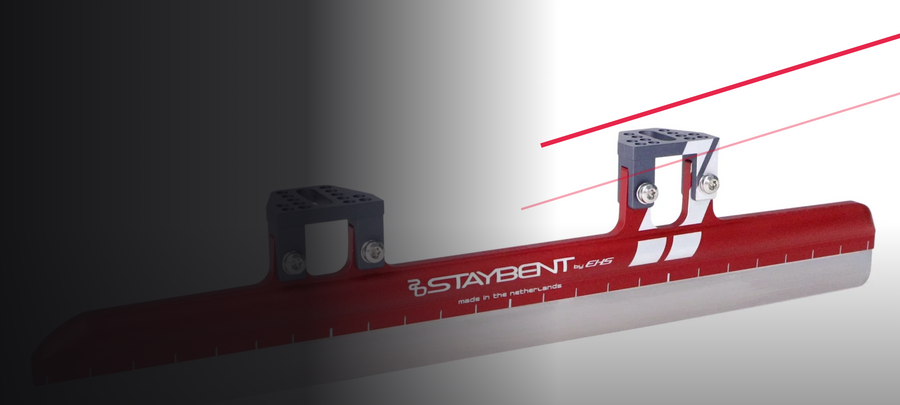
On the blade side, what you choose depends on how you skate. The StayBent JaeBee is the most flexible blade in the StayBent range, with highly flexible lips and a tube that tapers from the centre toward the ends to create a progressive flex pattern. That gives the tips more give and rewards skaters who want feel and a natural glide through technical corners. The StayBent QCS uses the same tube as the Quantum with a thin pillar design and even stiffness along the full length, and it exists specifically to give developing athletes that Q family feel at a more accessible price. Both are offered in bimetal at 62 HRC or full PM at 64 HRC, so you can match the steel to how often you train and sharpen.
Protecting Your Hands
Do not treat gloves as an afterthought. Short track puts your hand on the ice at speed, on a surface being carved by other people's steel. StayBent Cut Resistant Gloves add that protective layer for training and racing, come in sizes XS to XL, and are also the gloves to wear whenever you sharpen or handle your blades. If you are building a complete kit from scratch, the short track setup collection gathers the boots, cups, blades and protection in one place.
Frequently Asked Questions
Do I need to heat mould EHS boots, or can I just skate them?
You can skate them unmoulded, and some skaters with average shaped feet get on fine. But the shell is engineered for moulding, and you are leaving the main benefit of the boot on the table if you skip it. If you have any unusual foot feature at all, mould them.
What size should I order if I am between two sizes?
Take the smaller one, assuming your toes are not jammed against the front while standing. A short track boot that is slightly snug will settle after moulding. One that is slightly large will never get smaller.
Are these boots suitable for a beginner?
Yes, if the beginner is committed to short track specifically. The EHS boots are designed to offer value for skaters at both ends of the range, from those just starting structured training to elite athletes. What makes a boot unsuitable for a beginner is not stiffness, it is poor fit.
Do the boots come with blades?
No. The boots, the mounting cups and the blades are separate purchases, which is standard at this level because skaters want to pair a specific blade and cup height with a specific boot. The M6 bolts and rings used for mounting are included with the boots.
How long will a pair last?
That depends entirely on your hours, your body weight and how you look after them. The synthetic upper and liner are chosen for abrasion resistance, which helps, but a boot skated six days a week by a heavy adult will not last as long as one skated twice a week by a junior. Dry them properly after every session and they will repay you.
The Short Version
Measure your foot properly, take the snug size, get the boot moulded by someone competent, budget for a set of mounting cups, and lace it with intention. Do those things and the EHS Short Track Boots will feel like an extension of your leg rather than a piece of equipment you are wearing. Skip them and you will have spent good money on a very expensive way to be uncomfortable. If you are unsure about sizing, talk to us before you order. We would much rather have that conversation now than after a boot has been moulded to the wrong foot.