Buying a good pair of short track blades is only half the job. How you mount them, how much rocker and bend you set, and how carefully you align them under the boot will decide whether those blades actually feel fast or fight you in every corner. Two skaters can ride the exact same blade and have completely different experiences, purely because of setup. This guide walks through the whole process in plain language, from first mount to fine tuning on the ice, so you can get the most out of a serious blade like the StayBent JaeBee or the StayBent QCS.
None of this is guesswork or magic. Short track setup is a small number of adjustments, each with a clear job, and once you understand what each one does you can dial your feel with confidence. Take your time, change one thing at a time, and keep notes. That habit alone will make you a better skater.
The four setup variables that matter
When people talk about blade feel they are usually talking about four things working together. Understanding them separately makes the whole picture click into place.
Mounting position
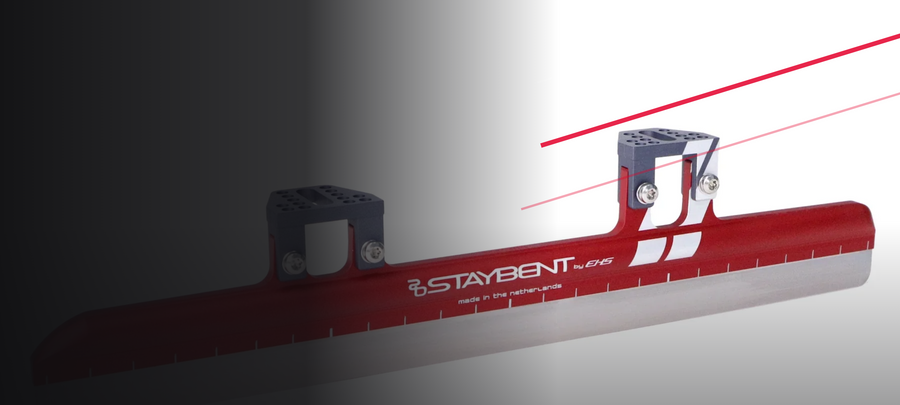
Mounting position is where the blade sits under the boot, both front to back and side to side. On short track the blades are deliberately offset to the left of centre so that you can lean hard into the corner without the boot touching the ice. Front to back position changes how the skate feels on entry and exit of a corner. A blade mounted slightly forward tends to feel quicker and more aggressive, while a blade set back feels more stable and forgiving. Most skaters start near the manufacturer reference marks and move in tiny steps from there.
Short track blades sit to the left of the boot centre line so the boot clears the ice when you lean deep into the corner.
Rocker
Rocker is the curve along the length of the blade from toe to heel. A blade is not flat. It sits on the ice on a small contact area, and the length of that contact patch changes how the skate behaves. More rocker, meaning a tighter curve, gives you a shorter contact patch, quicker turns and a more agile feel. Less rocker gives a longer contact patch, more glide and more straight line stability. Short track blades carry more rocker than long track blades because the corners are so tight and continuous.
More rocker gives a short contact patch and quicker, more agile turns. Less rocker gives a longer contact patch, more glide and more stability.
Bend
Bend, sometimes called the bank or the curve, is the sideways arc of the blade when you look down the length of it. Because short track is skated on a constant left curve, the blade is bent so that it naturally traces that arc. More bend carves a tighter circle and suits smaller lap times and tighter tracks, while less bend opens the line out. Bend and rocker work together, and changing one usually means you will want to revisit the other.
The blade is bent into a left arc so it naturally traces the corner. More bend carves a tighter circle, less bend opens the line out.
Pitch
Pitch is the forward or backward tilt of the blade, which decides where your weight sits over the steel. Too much forward pitch pushes you onto the balls of your feet and can feel twitchy. Too much backward pitch drops you onto your heels and kills your push. The right pitch lets you stand relaxed with pressure through the middle of the foot and drive cleanly from the whole blade.
Pitch tilts the blade so your weight sits forward on the balls of the feet, centred through the middle, or back on the heels.
Mounting your blades step by step
Whether you are setting up a fresh pair of short track blades or moving cups from an old boot, a careful first mount saves hours of frustration later.
- Start by finding the centre line of your boot at the heel and the ball of the foot, and mark it clearly.
- Set the blade with the correct left offset so the tube clears the ice when you are deep in a lean.
- Hand tighten the mounting bolts first, then check the blade lines up with your intended position before you fully torque anything.
- Sit into your skating stance and feel whether the blade tracks straight under a normal push. Your body will tell you a great deal here.
- Only once it feels right should you tighten fully, and always in stages rather than one bolt at a time.
If you are unsure, mount conservatively near the reference marks first. You can always shift the setup once you have skated on it. Chasing a pro skater's exact numbers rarely works, because their setup suits their body, their technique and their track.
Dialling in rocker and bend on the ice
Rocker and bend are usually ground into a blade by the maker, and premium blades arrive with a well judged profile out of the box. The StayBent XC Flex Weapon is a good example of a blade designed with a considered profile so most skaters can ride it happily with only small tweaks. Your job as a skater is to test it, notice what the blade wants to do, and make careful adjustments over time rather than all at once.
If the skate feels twitchy and hard to hold through the apex, you may have more rocker or bend than you can control at your current speed. If it feels sluggish and refuses to carve, you may want a touch more. These are usually small changes, and they are best made by an experienced sharpener rather than by hand on your first attempt.
Keeping your edges honest
Even a perfectly set up blade will feel wrong if the edges are dull or uneven. A blade that is beautifully mounted but poorly sharpened will still slip in the corner and knock your confidence. This is why setup and sharpening go hand in hand. A dedicated jig such as the EHS Short Track and Long Track sharpening jig holds the blade square and lets you keep both edges even, which is exactly what you need once your rocker and bend are where you want them.
Check your edges by hand before every session, feel for burrs, and give the steel a light stone if you brushed a barrier or stepped off the ice on a hard floor. Consistent edges make your setup repeatable, and repeatable is what lets you actually feel the difference when you change something.
Recording your setup so you can repeat it
The single most useful habit in blade setup is writing things down. Note your mounting position, any reference marks you used, your rocker and bend if you know them, and how the skate felt that day. When you find a setup that clicks, you will be able to recreate it after a regrind or when you move to a new pair. Without notes you are starting from scratch every time, and you lose all the learning you paid for in ice time.
Browse the full range of blades and setup tools in the StayBent short track collection if you are still deciding which blade suits your level and goals.
Frequently asked questions
How often should I change my blade setup?
Rarely, and never in a rush. Once you find a mounting position and profile that suits you, leave it alone through a season so your body can adapt. Constant changes stop you from building the muscle memory that real speed depends on.
Should beginners set aggressive rocker and bend?
No. Newer skaters are almost always better served by a milder, more stable setup that holds a line and builds confidence. Aggressive profiles reward skaters who already carry high corner speed and can load the blade hard.
Can I mount short track blades myself?
Yes, with patience and care. Take your time on the centre lines and offset, tighten in stages, and test in your skating stance before final torque. If you are ever unsure about the left offset or clearance, ask an experienced skater or coach to check before you skate hard.
Do rocker and bend change how I should sharpen?
They change how the blade sits on the stone, which is exactly why a proper jig matters. Keep your edges even and square to your profile, and sharpen little and often rather than grinding away lots of steel at once.
Get your setup right, keep your edges honest, and record what works, and a quality short track blade will reward you with corners that feel planted and straights that carry speed. That is the whole game.