Short track is one of the few sports where a junior wears almost exactly the same equipment as a senior international racer, only smaller. That is precisely what makes kitting out a young skater confusing. The catalogue does not change, the safety requirements do not soften, and yet the athlete in front of you is eleven years old, half a size bigger than last winter, and will be bigger again by spring.
This guide is written for parents, coaches and juniors themselves. It deals with the two questions that actually matter: what does a growing skater genuinely need, and how do you buy it so that the money is not wasted the moment the feet change. We see the same three mistakes over and over. Boots bought two sizes too large so they will last. Blades chosen by price rather than by length. Protection treated as an optional extra to be added later. All three cost more in the long run than doing it properly the first time, and the boot mistake actively holds a young skater back on the ice.
Start with the boot, because everything else follows from it
A short track boot is not footwear. It is the mechanical link between a skater's leg and a blade that has to hold an edge at high lean angles. Everything a coach asks a junior to do, sitting low, pressing through the outside edge, keeping the hips over the pushing skate, depends on the boot holding the foot still. A loose boot turns every instruction into a fight.
What a junior boot actually has to do
Three things. It has to lock the heel so the ankle can bend forward without the foot lifting. It has to be stiff enough laterally that when the skater leans, the boot leans with them rather than folding over. And it has to give a mounting platform rigid enough that the blade stays where it was set.
The EHS Short Track Boots we stock are built on lasts developed specifically for short track, using a combination of carbon fibre and Diolene, with a heat mouldable carbon shell. They come in sizes 32 to 48, which covers young athletes right through to seniors, and they ship with Canadian waxed laces plus the mounting hardware to fit a blade, namely four hexagon M6 by 16 bolts and four M6 rings.
The fit rules that do not change with age
A short track boot should feel snug everywhere and tight nowhere in particular. The longest toe should just brush the front when the skater stands upright, and pull back slightly when they bend into skating position. The heel should not lift when the knee drives forward. If a young skater can shuffle their foot back and forth inside a laced boot, the boot is too big, and no amount of extra socks will fix it.
Sizing a foot that is still growing
This is the hard one, and there is no comfortable answer. Buying a size up so a child can grow into it feels sensible and is the single most common reason juniors struggle with edges. In a boot that is too long, the ball of the foot sits behind the widest part of the boot, the heel floats, and the skater cannot load the blade properly. They then compensate with technique that has to be unlearned later.
The practical compromise most coaches accept is this. Measure the foot properly rather than guessing from shoe size, buy the size that fits now, and plan on replacing boots when the skater outgrows them rather than buying ahead. If a growth spurt is clearly under way, half a size of room is the maximum worth allowing, and even then only with a properly locked heel. Keep a note of the measurement so you can track how fast the foot is actually moving from season to season.
Heat moulding a junior boot
The EHS carbon shell is heat mouldable, which lets a fitter shape it around a narrow young foot, a prominent ankle bone or a high instep. Ask a qualified fitter to do the moulding rather than attempting it at home. A boot moulded once, properly, to a foot that fits it will be more comfortable and more responsive than a bigger boot padded out with socks, and it is the difference between a skater who wants to train and a skater who is counting the minutes until they can take their skates off.
A boot bought a size or two large leaves the foot floating, so the heel lifts and the edge pressure never reaches the blade.
Choosing blade length for a lighter, shorter skater
Blade length is the second decision, and juniors are genuinely different here, not just scaled down. A shorter blade is easier to turn, easier to keep under the body, and far less likely to clip the other skate during a crossover. A young skater on a blade meant for an adult will trip themselves, and will also be carrying steel they are not heavy enough to bend into the ice.
Why the available lengths matter when you shop
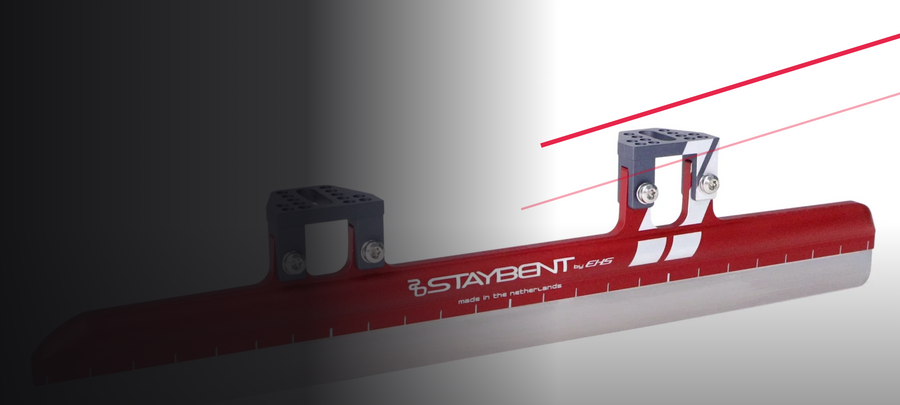
This is where the catalogue makes the decision for you. The StayBent JaeBee is offered in lengths from 14.5 all the way up to 18, so it covers the small sizes that junior skaters need. Longer options in the range start at 16.5, which means for a genuinely small skater the shorter blade lengths are the realistic choice. If you are buying for a child under roughly boot size 36, check the length options before you fall in love with a particular model.
Matching blade length to boot length
The blade should sit under the boot with a sensible amount of tail behind the heel and nose in front of the toe. Too long, and the tail catches on the push of the other skate and the skater feels like they are steering a boat through the corner. Too short, and there is no stability at all when they land on an edge. As a rule of thumb, keep the blade proportionate to the boot rather than buying long in the hope of future proofing, exactly the same logic as the boot itself.
Set it up, then leave it alone
Once a junior blade is mounted, resist the urge to keep changing the position. Young skaters are still building the movement pattern, and a setup that moves every week gives them nothing consistent to learn from. Mount it centrally to begin with, let the coach watch a few sessions, then make one small change at a time. You can browse blades, mounting hardware and accessories in the short track setup collection.
A blade that is too long for the skater shows up as clipped boots in crossovers and a heavy, reluctant feeling through the corner.
Protection is not the optional part of the kit
Short track puts skaters in a pack, at speed, with sharpened steel, on a hard surface. Protection is the entry ticket, not an upgrade, and most clubs and competitions will not let a junior on the ice without it. Buy it at the same time as the boots, not later.
The base layer
The cut resistant layer goes on next to the skin, under everything else. Our Level 3 cut resistant Kevlar undersuit is made in junior sizes as well as adult, running Jr S, Jr M, Jr L, Jr XL and Jr XXL before the adult sizes begin, which means a young skater can get a proper close fit rather than swimming in an adult small. A base layer that fits closely is also more comfortable to skate in, so juniors actually keep it on.
Hands, neck and ankles
Hands touch the ice on every corner, so cut resistant gloves are essential, and they come in sizes XS through XL so small hands are covered. Ankles are the classic short track injury site because that is where a blade travels at boot height, so cut resistant ankle socks belong in every junior bag. A cut resistant neck guard completes the set and is required at most competitions. None of these three items is expensive relative to boots and blades, and none of them should be skipped.
The race suit on top
Over the protective base goes the skinsuit. Our short track lycra suit is available in youth sizes 4, 6, 8, 10, 12, 14 and 16 as well as adult sizes, which makes it one of the easier pieces to buy for a growing skater. Sizing up modestly here is far less harmful than sizing up in a boot, because a slightly loose suit costs a little aerodynamic drag rather than control of the skate.
The protective layer goes closest to the skin and the race suit sits over it, with gloves, neck guard and ankle socks covering the parts a blade reaches first.
What to buy first, and what can wait
If the budget has to be staged, this is the order we suggest. Protection and a certified helmet come first, because without them a junior cannot train at all. Boots that fit come next, because they determine whether the training is any good. Blades follow, chosen by length. Then the race suit, which matters on competition day but not much in a Tuesday session. Sharpening tools, spare guards and soakers can be shared within a family or club at the start and bought properly later.
What should never be staged is fit. A cheaper item that fits beats an expensive item that does not, every single time, at every age.
Buying for a growing skater without wasting money
A few habits make the whole thing much less painful over three or four seasons.
- Measure the foot every few months and write the number down, so you can see how quickly the skater is actually growing rather than guessing.
- Look after the boots properly, because a boot that is dried after every session and kept away from radiators holds its value and can be passed on.
- Keep the blades rust free with guards for walking and soakers for the bag, so the steel outlasts several skaters rather than one.
- Buy protection in the correct size rather than adult sizes to grow into, since a loose cut resistant layer moves around and is far more annoying to wear.
- Talk to the club before every purchase, because clubs often run informal chains of outgrown boots and blades that solve the problem for a season.
- Expect blades to outlast boots by a wide margin, so it is reasonable to spend proportionally more on steel that stays with the skater.
A junior short track kit checklist
- Boots that fit today, heat moulded by a qualified fitter
- Blades in a length that suits the skater, mounted centrally and left alone at first
- Cut resistant undersuit in a junior size
- Cut resistant gloves that fit the skater's hand, not a parent's hand
- Cut resistant ankle socks and a neck guard
- A certified helmet fitted to the head as it is now
- Blade guards for walking and soakers for storing
- A race suit for competition day
Frequently asked questions
Should I buy boots a size bigger so they last longer?
No. A boot that is too long lets the heel lift and stops the skater loading the blade, which teaches poor habits that take a long time to correct. Buy the size that fits now and plan to replace it. Half a size of room is the most that is worth allowing, and only if the heel is still locked down.
Which blade length is right for a young skater?
Shorter than you think. Shorter blades are easier to turn and much less likely to clip the other skate. Check the available lengths before choosing a model, since the shorter sizes are not offered across every blade in the range.
Is cut resistant protection really needed at club level?
Yes. Most clubs and all competitions require it, and the reason is simple: in a pack, at speed, a blade can reach a neighbouring skater's ankles, hands and neck. It is the least negotiable part of a junior kit.
Can a junior inherit used boots from an older skater?
Sometimes, if the size genuinely fits and the shell is undamaged. A heat mouldable carbon shell can often be reshaped by a fitter for the new foot. What does not work is inheriting a boot that is simply too big and hoping the skater grows into it during the season.
How often will we be replacing kit?
Boots follow the feet, so during fast growth years expect a change every season or so. Blades last far longer, since they can be remounted onto new boots and sharpened many times before the useful steel runs out. Protection lasts until it is outgrown or damaged.
The short version
Fit first, protection always, and blades chosen by length rather than ambition. A junior on kit that actually fits will learn faster, enjoy training more and get more seasons out of every purchase than one who spends two winters growing into a boot. If you are unsure about a size, message us with the foot measurement and the skater's age and we will help you work it out, because getting this right at the start is far cheaper than fixing it later.