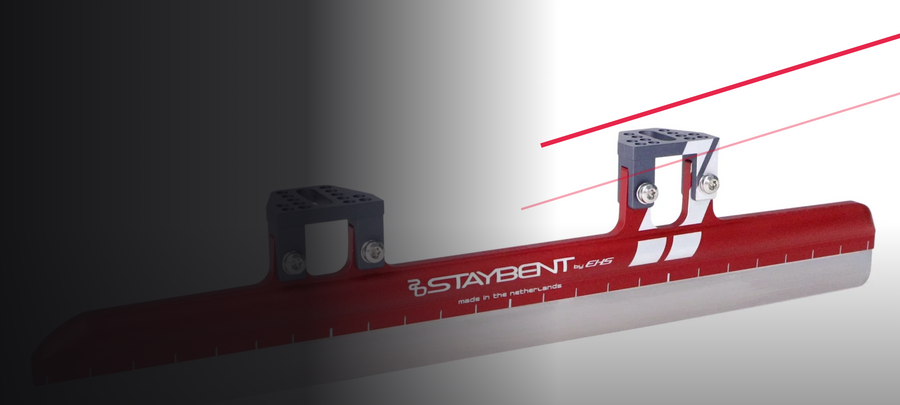
Walk into a rink where both disciplines share the ice and you will see two very different pieces of steel bolted under the boots. From a distance a short track blade and a long track blade look like cousins. Both are long, thin runners, both are held away from the boot on a tube, and both are designed to hold an edge on ice at speed. Get closer and the family resemblance falls apart. The two sports ask completely different questions of a skater, and the blades are the answers.
This guide walks through every meaningful difference, in the order that actually matters to a skater standing in a shop trying to work out what they need. It also answers the question we get asked most often at LiveLica, which is whether a set of long track blades can be pressed into service for short track, or the other way round. The short answer is no. The long answer is more interesting, and it will make you a better judge of your own setup.
The quick answer, if you only read one paragraph
Short track blades are permanently bent into a curve, sit off centre under the boot, carry a pronounced rocker, and are fixed rigidly to the boot at both ends. Long track blades are straight, sit closer to the centre line of the boot, are far flatter along their length, and on a modern racing skate the heel is not attached at all because the blade pivots on a hinge at the front. Every one of those choices comes from the shape of the track and the way the race is skated.
The bend is the biggest single difference
If you take away only one thing, take away the bend. A short track blade is not straight. It is bent into a shallow arc so that it curves toward the inside of the corner, which for almost every skater means it curves to the left. This is not damage and it is not a manufacturing quirk. It is deliberate, it is set with a bending tool, and it is one of the main things a skater tunes as they develop.
Why short track blades are bent
A short track lap is one hundred and eleven point twelve metres around a small oval, and the corners are tight and continuous. To carry speed through them a skater leans hard into the turn, sometimes far enough that the inside hand brushes the ice. A straight blade in that situation would want to travel in a straight line while the skater is trying to travel in a circle, which means fighting the equipment on every stroke. A bent blade already describes an arc, so when you set it on edge it naturally wants to follow a curved path. The tighter the bend, the tighter the arc it wants to carve.
The bend also protects you from the boot touching down. When you lean far enough over, something has to stop the cup or the boot from grounding out before the blade loses grip. A bend, combined with mounting the blade slightly to the left of the boot centre line, keeps the steel underneath you for longer as the lean angle increases.
Why long track blades are straight
The long track oval is four hundred metres, the corners are wide and gentle, and long straights make up a large part of every lap. A straight blade glides with the least possible resistance in a straight line, which is exactly what you want when a substantial share of the race is spent going straight ahead. Long track skaters do lean into the corners, but the radius is far larger and the lean is nothing like as extreme, so the blade does not need to be pre curved to follow the line.
The bend is the difference you can see from directly above. A short track blade already describes the arc you want to skate.
Rocker, or how much steel is actually on the ice
Rocker is the gentle curve along the bottom edge of the blade when you look at it from the side. A blade with more rocker touches the ice over a shorter length, which makes it quicker to turn and easier to pivot on. A flatter blade touches over a longer length, which makes it more stable and better at holding a line, and it usually glides better because more edge is in contact and the load is spread out.
Short track blades carry a noticeable rocker, because agility, quick line changes and the ability to load the front or the back of the blade all matter enormously in a pack race. Long track blades are far flatter, because the priority is holding speed in a straight line with minimum drag. This is why a long track blade feels like it wants to run away in a straight line and a short track blade feels alive underfoot.
Rocker decides how much steel is on the ice at any moment, which is why one blade feels agile and the other feels planted.
The clap hinge, and why short track does not use one
Modern long track racing is done on a clap skate. The blade is hinged near the ball of the foot and the heel of the blade is not fixed to the boot at all. At the end of the push the heel lifts away from the blade, the blade stays flat on the ice for longer, and a spring snaps it back into place with an audible clap. It adds meaningful push length and it is the reason long track times dropped so sharply after it was adopted.
Short track has never gone down that road. In a pack race you need instant, predictable response when you change edge, when someone forces you to shorten a stride, or when you push off the block into a first corner. A rigid, fully fixed platform gives you that. It also has to survive contact, other skaters, and the constant loading of a deep lean. Short track blades are therefore bolted to the boot at both ends through mounting cups, and the whole assembly behaves as one rigid unit. If you want the detail on how that mount is set up, our guides on cups and adapters cover it, and you can see the hardware in the StayBent short track accessories collection.
The clap mechanism buys push length on the long oval. Short track trades that away for a platform that never surprises you mid corner.
Length, and why the numbers are not comparable
Both disciplines quote blade length in inches, which tempts skaters into thinking a sixteen and a half is a sixteen and a half. It is not, because the length is doing a different job in each sport. In short track the length is matched to your boot and your racing style, and it changes how quick and how stable the skate feels. Shorter blades feel quicker and more agile, and longer blades track straighter and carry more speed on the straights.
You can see how the ranges are laid out across our own blades. The StayBent JaeBee comes in eight lengths from 14.5 up to 18, the StayBent QCS runs 15, 15.5, 16, 16.5, 17, 17.5 and 18, and the StayBent XC Flex Weapon is offered in 16.5, 16.75, 17.0, 17.25, 17.5, 17.75 and 18.0. Those half and quarter steps exist because the fit between boot size and blade length in short track is genuinely fine grained. If you are unsure, send us your boot size and we will help you pick.
The tube, the lips and how the blade flexes
Short track blade design has become a study in controlled flex. The lips are the parts that hold the tube to the cups, and how much they give changes how the skate moves with your push. The JaeBee uses highly flexible lips, even more flexible than the QCS, and its tube tapers down from the centre toward each end to create a progressive flex pattern, so the tips have more give than the middle. The QCS uses the same tube as the Quantum with a thin pillar design and even stiffness along the full length for stability. The XC Flex Weapon is built around StayBent Precise Bend Technology and premium Dutch aluminium with lightweight cups available in multiple heights.
Long track blades are built around a different priority, which is a stiff, efficient platform to transmit a long push in a straight line. Neither approach is better. They are simply solving different problems, and that is exactly why a blade optimised for one is compromised in the other.
Steel and hardness
Steel choice is one area where the thinking does carry across. Harder steel holds an edge longer between sharpenings and slightly softer steel is easier and more forgiving to sharpen. In the StayBent range you can choose bimetal at 62 HRC, which is a little softer and easy to sharpen, or full PM at 64 HRC, which is a harder powder metallurgy steel that holds an edge longer and suits skaters who train most days. Both options are available on the JaeBee and the QCS, and the XC Flex Weapon uses hand selected premium bimetal or full PM steel runners.
So can you skate short track on long track blades?
Not sensibly, and here is why. A straight, flat, long blade will not follow the arc of a short track corner, so you will be fighting it every lap. It is far more likely to ground out or wash out at the lean angles short track demands. The clap mechanism will feel unpredictable in a pack. And the mounting is different, so it will not simply bolt onto a short track boot in the first place.
Going the other way is just as unhappy. A bent, heavily rockered short track blade on a four hundred metre oval will pull you into a curve you do not want, will offer less contact length on the straights, and will cost you the very efficiency that long track is built around. Blades are cheaper than a wasted season. Skate the blade the sport was designed around.
The one place the two worlds overlap
Sharpening. The routine, the tools and the standard of care are close enough that good equipment serves both. Our EHS Short Track and Long Track Sharpening Jig is a portable, CNC machined bench designed for both short track and long track blades. It comes apart and reassembles in about five minutes using four central screw knobs, and the point of it is precise, straight clamping, because a blade held perfectly straight sharpens to an even edge along its length while any twist in the clamp shows up as an uneven edge. Whichever discipline you skate, wear cut resistant gloves while you work.
Frequently asked questions
Is the bend on a short track blade adjustable?
Yes. Bend is set with a bending tool and skaters adjust it as their technique develops and as they get a feel for the ice they race on. It is one of the reasons short track setup is such a personal thing.
Why is a short track blade mounted off centre?
Mounting the blade slightly to the left of the boot centre line keeps steel underneath you as you lean further into the corner, and it helps stop the cup or boot from grounding out.
Do short track blades have a clap mechanism?
No. Short track blades are fixed rigidly to the boot at both ends through mounting cups, so the whole skate behaves as one solid platform.
Can I use the same sharpening jig for both?
Yes, if the jig is designed for it. The EHS jig in our range is built for both short track and long track blades and holds the blade straight for an even edge.
Which StayBent blade should I start with?
The QCS is a strong choice for developing athletes who want Q family feel at a more accessible price. The JaeBee suits technical skaters who want maximum flex and feel, and the XC Flex Weapon is a flagship race blade for committed racers with a settled technique.
The takeaway
Bend, rocker, length, offset and the way the blade attaches to the boot are not small differences. They are the whole design brief of each discipline expressed in aluminium and steel. Understanding why your blade is shaped the way it is makes you better at setting it up, better at spotting when something has gone wrong, and much better at choosing the next one. If you are picking a short track blade and want a second opinion, tell us your boot size and how you like to skate a corner, and we will talk it through with you.