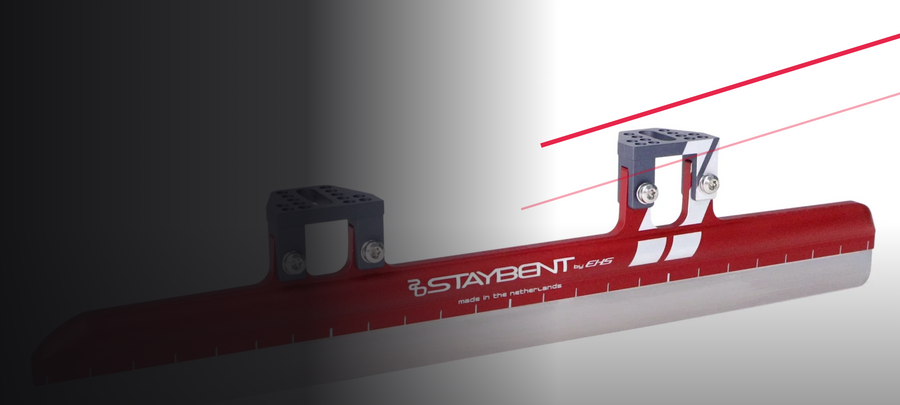
Every short track skater eventually has the same thought. The blades feel dull, the nearest speed skating coach is several states away, and there is an ice hockey rink down the road with a sharpening machine humming in the corner. So can a hockey shop sharpen short track blades? For the great majority of shops the honest answer is no, and the reason has nothing to do with the skill of the person operating the machine. It is geometry. A hockey machine exists to cut a curved groove into a blade. A short track blade needs the exact opposite of that, and once the groove is in the steel there is no undoing it.
This guide explains what a hockey sharpening machine actually does, what it would do to your speed steel, how to tell whether a shop is genuinely equipped to help, and what almost every short track skater does instead. If you have already decided to look after your own edges, our full guide to sharpening short track blades walks through the routine itself. This post is about the decision that comes before it.
The Short Answer, Before the Detail
- A standard hockey machine grinds a hollow, which is a curved groove running down the middle of the blade. A short track blade is flat across the bottom with two square corners.
- Putting a hollow on speed steel destroys the geometry you paid for, removes far more material than a hand sharpen, and cannot be reversed.
- Most hockey machines cannot hold a short track blade properly in the first place, because the blade is bent along its length and lives in a tube rather than in a boot mounted holder.
- A skater with a jig, a stone and ten quiet minutes produces a better edge than any hollow grinding machine can.
- Specialist speed skating grinders do exist, mostly in long track programmes. They are not what sits behind the counter at a hockey rink.
Hollow Ground and Flat Ground, the Difference That Matters
This is the whole article in one idea, so it is worth slowing down for. Hockey skates and short track blades are sharpened to two completely different shapes, because they are asked to do two completely different jobs.
What a Hockey Machine Is Doing
A hockey sharpening machine spins an abrasive wheel that has been dressed to a curve. It passes that curved wheel along the bottom of the blade and leaves a concave channel behind, which the trade calls the radius of hollow. The deeper the curve, the more aggressively the two resulting edges dig in. Hockey players want that bite because the game is built on stopping, turning sharply and accelerating from a standstill in a very small space.
What a Short Track Blade Needs
A short track blade is not trying to dig in. It is trying to hold a long, committed lean through a corner and then glide with as little friction as possible down the straight. That calls for a flat bottom surface with two crisp, square corners where the flat meets the side. You sharpen by removing a very small amount of steel from that flat until the corners are clean again. Nothing about the process is meant to leave a channel.
The hollow on the left is the point of a hockey sharpen. On a short track blade it is the damage.
What Would Actually Happen to Your Blades
Suppose a shop agrees to try. Several things go wrong at once, and they compound.
The first is the obvious one. The flat bottom becomes concave, so the surface that was supposed to glide is now a groove that no longer touches the ice evenly. The blade will feel oddly grippy for one session, which some skaters mistake for a good sharpen, and then feel unpredictable on lean because the corners are standing on nothing.
The second is steel loss. A hand sharpen on a stone takes off a whisker. A grinding wheel cutting a fresh hollow removes many times that, and a short track blade has a finite life measured in how much material still sits above the mounting cups. One machine pass can cost you a season of normal sharpening. Our guide on reading blade wear and knowing when to replace explains why that budget matters.
The third is heat. A dry grinding wheel puts real heat into a narrow strip of steel. Speed blades are thin, and several are built as bimetal, which means a hard steel runner joined to a lighter carrier. Heat is not a friend of any of that.
The fourth is the one nobody thinks about until the blade is in the carriage. It will not sit right.
The Bend and the Rocker Are the Real Dealbreakers
A hockey blade is a fairly short, symmetrical runner held in a plastic holder that clips neatly into a machine carriage. A short track blade is a long runner in a tube, bent sideways so it carves a circle, and rockered along its length so it is not straight from front to back either. That means two curves working at once in different planes.
A hollow grinding machine expects a straight blade presented square to the wheel. Give it a bent, rockered runner in a tube and the contact point moves as the carriage travels. Some of the length gets ground hard, some barely gets touched, and the rocker you carefully set up ends up flattened in the middle. That is not a machine calibration problem you can talk your way around. It is the machine doing exactly what it was built to do, to a blade it was never built for.
A short track blade is rockered along its length and bent sideways. A machine built for a straight runner cannot follow either curve.
How to Tell Whether a Shop Can Genuinely Help
A small number of shops, usually ones that already serve a long track or speed club, can do proper work on speed blades. You can find out in about ninety seconds with three questions.
- Do you sharpen speed skating blades flat, with no hollow? If the answer involves a radius in inches, the conversation is over politely.
- How would you hold a bent, rockered blade in a tube? A shop that does this properly will describe a speed skating jig and hand work with stones, not a carriage.
- Will you remove the burr and polish the running surface afterwards? A sharpen that stops before deburring leaves a fragile lip that catches, and an unpolished surface is slow even when it is sharp.
If any answer sounds vague, keep your blades in your bag. A skater who has never sharpened is still less dangerous to a blade than a confident machine.
What Experienced Skaters Do Instead
The reason so few short track skaters use shops is not stubbornness. It is that the home routine is genuinely simple, it takes about ten minutes, and it keeps you in control of your own equipment. Four tools cover the whole job.
- A jig to hold both blades dead straight and level while you work. The EHS Short Track and Long Track Sharpening Jig is CNC machined in the Netherlands from solid aluminium with precise mounting points, and it comes apart in about five minutes using four screw knobs, so it travels to competitions.
- A flat stone to cut the edge. The Zandstra Foss Combination Stone is silicon carbide, 250 by 75 by 20 mm, with a coarse side for cutting and a fine side for smoothing. It is flattened after production, which is exactly why a flat ground blade needs it.
- A deburr stone to knock off the lip the stone leaves behind. The StayBent Diamond Deburr Stone is a handheld diamond stone sized for the palm, and a few light passes down each side are all it asks for.
- A polishing tool for the gliding surface. The Zandstra 3M Polishing Triangle is a 25 cm aluminium triangle carrying 3M lapping film, supplied with three grades already fitted, and the whole polish takes roughly three to five minutes.
No machine anywhere in this sequence. Four hand tools, in this order, every time.
If you want the full detail on pressure, stroke length and how to check your work under a light, read the sharpening guide, and our deburring and polishing guide covers the two steps club skaters most often rush. Wear cut resistant gloves while you work. A freshly finished blade is far sharper than the one you sat down with.
Figure Skating and Long Track Shops
Figure skate sharpening is also hollow ground, and figure blades carry a toe pick and a very different rocker, so a figure skating technician is in the same position as a hockey one. Long track is closer to home, because long track blades are flat ground too, and a technician who sharpens long track will understand what square edges and a flat running surface mean. The catch is that long track blades are straight and enormously longer, so the fixtures and habits still do not transfer directly to a bent short track runner. Treat a long track contact as a good person to talk to rather than a drop off service.
If the Blades Have Already Been on a Machine
It happens, usually to a skater who inherited second hand skates. Do not panic, and do not skate on them without a look first. Sight down the running surface under a bright light. A hollow shows up as a dark line down the centre with two bright lines either side of it. Then check whether the rocker still looks like a smooth continuous curve or has a flat patch in the middle.
A light hollow can often be worked back out over several careful sessions on the coarse side of a flat stone, accepting that you are spending steel to recover geometry. A deep one, or a rocker that has been visibly flattened, usually means the blade is finished as a racing blade even if it is still perfectly good for practising on. Judging what is left is the same skill as judging any used blade, which our guide to buying second hand short track gear goes through in detail.
Travelling, Competitions and Who Sharpens Where
One more reason skaters own their own kit: at a competition there is no shop. There is a corridor, a bench if you are lucky, and forty minutes before your heat. This is why a jig that comes apart and goes in a bag matters more than it sounds, and why most experienced skaters carry a stone and a deburr stone to every event. Pack the sharp things properly and check the rules for your flight, which our guide on travelling and flying with short track skates and blades covers, and build the rest of the kit gradually using our blade care kit list. Everything mentioned here sits in the StayBent short track accessories collection.
Frequently Asked Questions
Can a hockey shop sharpen short track blades at all?
Almost never usefully. A standard hockey machine grinds a curved hollow, and a short track blade needs a flat bottom with square corners. A very small number of shops with speed skating experience work by hand with a jig and stones, and those are worth finding.
What is a radius of hollow, and does a short track blade have one?
The radius of hollow describes how deep the curved groove in a hockey blade is. A short track blade has no hollow at all. Its running surface is flat, which is why a hollow is damage rather than a setting.
Can you machine sharpen speed skating blades ever?
There are purpose built speed skating grinders in some long track programmes, set up to work flat and to respect the blade. They are rare, expensive and not what a local hockey rink has. For short track, hand sharpening in a jig is the normal method, not a compromise.
How much steel does a machine take off compared with a stone?
Far more. A fine stone pass removes a whisker, which is why you can sharpen frequently for years. A grinding wheel cutting a new profile removes enough material in one visit to matter to the life of the blade.
My blades were machine sharpened and now feel grabby. Why?
Because a hollow gives you two proud edges standing over a channel. That bites hard in a straight line and then lets go unpredictably when you lean, which is the worst possible combination in a corner.
Is it hard to learn to sharpen my own blades?
Less hard than most skaters expect. The jig does the difficult part by holding the blade true. Your job is even pressure and patience, and the skill comes within a handful of sessions. Practise on an older pair if you have one.
Do I still need the polishing step if I sharpen by hand?
If you race, yes. Sharpening gives you grip on the corners and polishing gives you glide on the straights. They are two different jobs, and the polish is the one most club skaters skip.
The Short Version
Hockey machines cut hollows. Short track blades are flat. That single sentence is why the shop down the road, however friendly and however competent with hockey skates, is the wrong answer for your speed steel. Buy a jig, a flat stone, a deburr stone and a polishing tool once, learn the routine in an evening, and you will never again stand at a counter hoping somebody understands what your blades need. If you are unsure what to buy first or whether a blade has already been damaged, message us with a photo taken down the running surface under a good light. We would rather talk you through it than watch a decent pair of blades get ground into a practice pair.