Most short track skaters know how to train hard. Far fewer know how to stop training hard at the right moment. Ask a squad what they did in the ten days before their best ever race and you will get a dozen different answers, and at least half of them will describe a week of panic sessions that left them heavy on the start line. Learning how to taper before a short track speed skating competition is one of the cheapest improvements available to you, because it costs nothing, needs no new kit, and works on the fitness you have already built.
A taper is the planned reduction of training load in the final stretch before a competition, designed so that you arrive fresh without arriving rusty. It is not a holiday and it is not a last chance to cram. This guide walks through how long a short track taper should be, what happens to volume and intensity inside it, what to do with your blades, boots and race kit while it runs, and how to handle the strange restless feeling that a good taper always produces. It is written for skaters racing club meets, state and national competitions, where you often have several rounds in one day rather than a single effort.
What a taper actually does
Training makes you slower before it makes you faster. Every hard session leaves behind fatigue that sits on top of the fitness it built, and for a while the fatigue is the bigger of the two. Adaptation happens in the recovery afterwards, not during the session itself. In normal training you never fully clear that fatigue, because the next block starts before you have absorbed the last one. That is fine, and it is how fitness accumulates across a season.
A taper simply lets the fatigue drain away faster than the fitness does. Fitness is slow to build and slow to lose. Fatigue is quick to build and quick to lose. If you cut the load for a week or two, fatigue falls off sharply while fitness barely moves, and the gap between the two opens up. That gap is what people mean when they talk about feeling sharp. Nothing new has been created. You are simply finally able to use what you already had.
This matters more in short track than in most sports, because short track is decided by things that fatigue destroys first. The explosive first four steps off the line, the willingness to commit to a tight corner, the reaction to a gap opening on the inside, and the ability to make a good decision on the last lap with a heart rate at maximum. Endurance survives a tired week reasonably well. Sharpness does not.
The shape of every good taper is the same. You take away the quantity and keep the quality, so the legs stay switched on while the fatigue drains out.
How long should a short track taper be
There is no single correct length, but there is a sensible range, and your training history decides where you sit inside it.
If you skate two or three times a week alongside school, college or a job, you are not carrying much accumulated fatigue in the first place. Five to seven days is enough, and a longer taper will leave you flat and fidgety. If you train five or six times a week with a proper strength programme running alongside, ten to fourteen days is closer to right, because there is far more fatigue to shed. Juniors generally need less than adults, since younger skaters clear fatigue quickly, and a long taper mostly gives them time to worry.
One rule holds at every level. A taper can only reveal fitness, never create it. If the training block behind you was thin, no amount of clever tapering will fix that, and the honest move is to treat the competition as a hard training day and start the next block properly. The skaters who benefit most from a two week taper are the ones who earned it with eight or twelve weeks of consistent work.
The two week taper, day by day
Here is a practical shape for a skater training five or six times a week with a single target competition. Compress it into seven or eight days if you train less often, keeping the same order of events.
Days 14 to 8, the last real load
This is the final week where you still do genuinely demanding work, but you cut the total by roughly a fifth to a quarter. Keep your two hardest ice sessions and your race pace repeats. Drop the third easy volume session, or shorten it badly. Keep strength work but reduce the sets, and stop adding weight to anything. Nothing new goes into the programme from here on. If you have never done a particular drill, this is not the fortnight to learn it.
End this week with your last hard effort. Many coaches place a short simulation here, for example three or four flat out 500 metre efforts with full recovery, so that your body remembers what race speed feels like while there is still time to absorb it.
Days 7 to 4, sharpen the legs
Volume now drops hard, to roughly half of a normal week. Intensity stays. A typical session is a full warm up, a handful of short flat out efforts of ten to twenty seconds with long recovery, some starts, and then you stop while you still feel good. The temptation to add one more set is the single most common way skaters wreck a taper. Leave the ice wanting more.
Strength work becomes light and fast rather than heavy and slow. Jumps, short bounds and a few explosive movements keep the nervous system awake without tearing anything down. Anything that leaves you sore two days later has no place in this window.
Days 3 to 1, protect the freshness
Now you are guarding what you have. One short session on each of these days at most, and one of them should be complete rest or a gentle walk. The session you keep should include a proper warm up, a few starts, two or three very short accelerations, and nothing else. The purpose is to keep the timing of your stride and your start intact, not to train.
Travel usually lands here, and travel is fatigue too. A long bus or train journey the day before a meet costs you more than most skaters allow for. Build the rest day around the travel day rather than pretending the travel does not exist.
Fixing the last hard session and the sharpening day on a calendar stops the taper drifting, which is how most of them fall apart.
Volume drops, intensity does not
The mistake almost everybody makes on a first taper is to reduce everything at the same rate, so the last fortnight becomes two weeks of easy skating. That produces a skater who is rested and blunt. Easy skating for a week teaches your legs to move slowly, and then you ask them to produce the fastest four steps of your life on a Saturday morning.
Keep the top end. Cut the middle and the bottom. In practice that means your flat out efforts stay flat out, they simply become fewer and shorter with longer recoveries. Your steady aerobic laps are the first thing to disappear, because they are the part of your programme that creates the most fatigue for the least short track specific return in a race week.
A simple way to hold yourself to this: write down the number of hard efforts you did in a normal week and the speed of them. In the taper, the speed column must not change. Only the number does.
What to change and what to leave alone
A taper is the worst possible time to introduce a new variable. Your body is already adapting to a change in load, and stacking a second change on top of that makes it impossible to tell what is going on when something feels wrong on race morning.
Everything on the left maintains what you have. Everything on the right introduces an unknown at the exact moment you can least afford one.
The kit calendar inside a taper
Your equipment has its own taper, and it runs on the same principle. Settle it early, then leave it alone.
Blades and sharpening
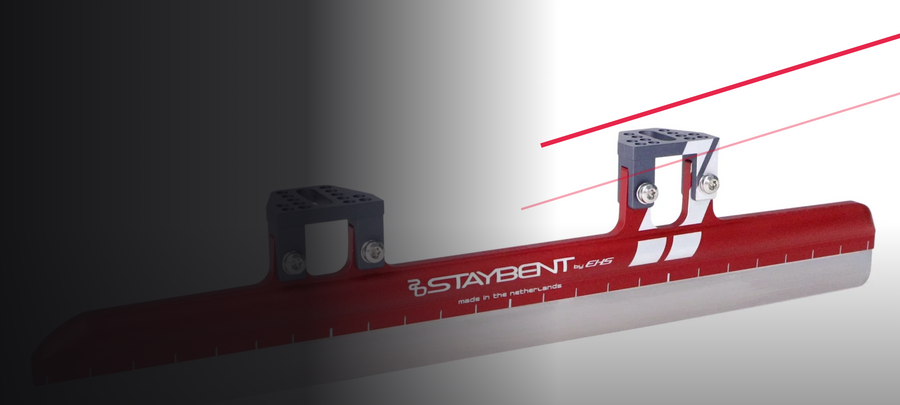
If you are planning to move to a different blade, do it before the taper starts, not inside it. A new blade changes your bend, your pitch and the feel of your corner, and you need weeks of skating to trust it. Browse the StayBent blade range in the off season or early in a training block, not in race week.
Sharpening is different, because it is maintenance rather than change. Sharpen on your usual schedule and aim to put your last full sharpen three to five days before the first heat, so that you get at least one session on the fresh edge before it matters. Clamp the blades straight in a jig such as the EHS sharpening jig, which is CNC machined and holds the runner straight so the edge comes out even along its length. A combination stone like the Zandstra Foss 7205 gives you a coarse side for cutting the edge and a fine side for polishing it, so you can finish the job with one block. Sharpening on race morning is a gamble: you have no session left to discover that the edge is not right.
Storage and rust through the quiet days
A taper means your skates sit in the bag more than usual, and steel that sits damp is steel that rusts. Wipe the blades down the moment you step off the ice, then fit soakers over the runners for transport and storage. A pair of StayBent blade soakers uses an absorbent terry cloth interior to draw the remaining moisture off the steel in the bag, which is a different job from the hard guards you walk in. Let both the soakers and the blades dry fully between sessions, because a permanently damp soaker holds water against the blade instead of pulling it away.
Suit and race kit
Wear everything you will race in at least once during the taper, in a real session, on ice. That includes the suit, the cut resistant layers, the neck guard, the gloves and the socks. A race suit that holds you in a low position is an advantage only if you have skated a full warm up in it and know how it sits through a deep corner. Finding out on the start line that a seam catches when you reach for the ice is a needless way to lose a heat.
Sleep, food and the parts that are not training
The taper hands you back several hours a week. What you do with them decides how much of the benefit you actually collect.
Sleep is the single largest lever, and the useful nights are the ones from about a week out, not the night before. The night before a big meet is often broken no matter what you do, so bank the sleep earlier and treat a restless night before racing as normal rather than a disaster.
Eating deserves one specific warning. When training volume falls, appetite usually does not, and many skaters arrive at a competition a little heavier and a little sluggish. The opposite error is worse: cutting food sharply because you are training less leaves you short of the fuel a multi round race day demands. Eat roughly as you always do, keep the carbohydrate going in the final two or three days, and keep drinking properly, especially if you are training in a warm city and racing in a cold rink.
How a taper feels, and why that worries people
Almost every skater has a bad patch somewhere in the middle of a taper. Legs feel heavy, easy speeds feel hard, and the brain concludes that all the fitness has vanished. This is so common that coaches expect it. It is the fatigue leaving unevenly, and it usually resolves in the last few days.
The danger is what skaters do about it. Feeling flat on day five and responding with a huge session to prove you are still fit undoes the entire fortnight and leaves you tired on race day as well. Trust the plan you made when you were thinking clearly. The other common feeling is restlessness, an itch to do something, and the cure for that is to spend the energy on preparation rather than training: pack the bag, check the bolts, clean the kit, read the schedule, walk.
Tapering for a one day meet with several rounds
Short track rarely asks for one effort. A typical meet stacks heats, semi finals and finals across distances into a single day, and your taper should account for that. Skaters who taper as if they are peaking for one 500 metre effort often skate a brilliant first heat and fade badly by the final.
Two adjustments help. First, keep a slightly higher share of repeated efforts in the days 7 to 4 window, for example three sets of two short efforts with a realistic gap between them, so your body rehearses recovering and going again. Second, rehearse the between rounds routine itself: how you stay warm, what you eat, how long you sit, and how you handle your blades between races. A taper that produces one fast heat is only a third of a good race day.
Common tapering mistakes
- Cutting intensity as well as volume, which leaves you rested but slow off the line.
- Panicking in the middle of the taper and inserting a big session to prove you are still fit.
- Starting the taper too early, so you arrive at the meet undertrained and twitchy.
- Changing blades, boots or mounting inside the taper window.
- Sharpening on the morning of the first heat, with no session left to test the edge.
- Treating travel as free, then wondering why the legs are flat after eight hours on a bus.
- Skating a full session in your race suit for the first time on race day.
- Letting sleep slip in the final week because there is suddenly free time in the evenings.
Frequently asked questions
How long should a short track taper be?
Five to seven days if you train two or three times a week, ten to fourteen days if you train five or six times a week with strength work alongside. The more fatigue you have accumulated, the longer the taper that repays you.
Should I stop training completely before a competition?
No. Complete rest for several days makes most skaters feel heavy and slow. Keep short, fast sessions going right up to the day before, and take one or two full rest days inside the final week rather than a whole week off.
Why do I feel worse during my taper?
Because fatigue leaves unevenly, and a flat patch in the middle of a taper is normal. It usually clears in the last few days. The important thing is not to react to it with an extra hard session.
When should I sharpen my blades before a race?
Aim for three to five days before the first heat, so you get at least one session on the fresh edge before it counts. Deburr and polish after each session in that window rather than doing a second full sharpen.
Can I taper if I only train twice a week?
Yes, but keep it short. Reduce the total work in your last two sessions, keep the fast parts fast, and give yourself one clear rest day before the meet. A long taper on a light training load simply makes you stale.
Do juniors need the same taper as adults?
Usually less. Younger skaters clear fatigue quickly, so three to five easier days is often enough, and a long taper mostly gives them time to become nervous. Keep the routine familiar and the sessions short and enjoyable.
Should I change anything about my equipment during a taper?
Maintain, do not change. Sharpening, deburring, drying and bolt checks are all fine. New blades, a new bend, new boots or a remount belong in a training block where you have weeks to adapt to them.
The short version
Cut the volume, keep the speed, and stop changing things. Put your last hard session about a week out, your last full sharpen three to five days out, and your rest day next to your travel day. Expect a flat patch in the middle and do not react to it. Sleep more, eat as usual, and spend the restless energy on packing rather than on one more set. A taper cannot build fitness you never earned, but done properly it will let you use every bit of the fitness you did.
If you are unsure how to fit a taper around your rink schedule or which sharpening routine suits your blades, message the LiveLica team and tell us what your competition calendar looks like.