Almost every inline speed skater in India started on a pair of fitness or recreational skates. They are what the shop had, they are what the club lent you, and for the first few months they do the job. Then someone at the rink turns up on a low carbon boot with a long aluminium frame and big wheels, glides past you without appearing to try, and you start wondering what exactly is different. The honest answer is that almost everything is different, but not all of it matters equally, and you do not need to replace all of it at once. This guide walks through what actually changes when you move from a fitness skate to a speed setup, part by part, so you understand where the speed comes from and can spend your money in the right order.
The short answer
A fitness skate is built to be comfortable, forgiving and safe for someone who is still learning to balance. A speed skate is built to transfer as much of your push as possible into forward motion. Those two goals pull in opposite directions. Comfort means padding, a tall cuff and a soft flex, and every one of those absorbs energy. Speed means a stiff shell, a low cut boot and a rigid frame, and every one of those demands better technique. The four things that change are the boot, the frame, the wheels and the bearings, and we will take them in that order because that is roughly the order of how much difference each one makes.
The boot: from a tall padded cuff to a low stiff shell
The most visible difference is the height of the boot. A fitness skate has a tall cuff that wraps around your shin and usually a buckle at the top. That cuff does your balancing for you. It stops your ankle rolling inward and outward, which is exactly what a beginner needs, but it also stops your ankle doing anything useful. A speed boot is cut low, at or just above the ankle bone, so the ankle is free to flex and to set an edge. The trade is that your ankle now has to be strong enough to hold the skate upright on its own.
The second difference is stiffness. Fitness boots use a soft liner inside a plastic or fabric shell, and both flex when you push. Speed boots use a carbon or fibreglass shell with a thin liner, so when you drive sideways the boot moves with your foot instead of squashing under it. The third difference is the heel. Speed boots are shaped to lock the heel down, because a heel that lifts on every stride wastes the end of the push. If you have ever felt your heel move inside a fitness skate, you already know the feeling a speed boot is designed to remove.
A fitness skate holds your ankle with a tall soft cuff, while a speed boot is cut low and stiff so the ankle can flex and set an edge on its own.
The frame: longer, lower and far more rigid
Under a fitness skate you will usually find a short frame, often plastic or a light extruded aluminium, holding four wheels of a modest size. It is short so the skate turns easily and it is often a little flexible so it feels soft over rough ground. A speed frame is the opposite in every respect. It is machined from a solid billet of aluminium so it does not twist when you push, and it is long so the wheels spread your weight over a bigger platform that tracks straight and stays calm at speed.
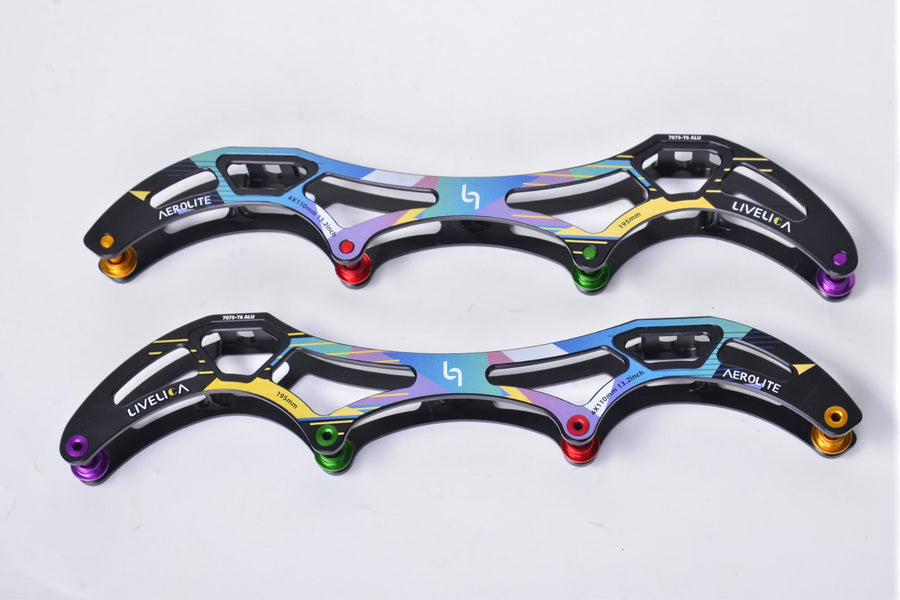
To give you real numbers rather than vague words, the LiveLica Aerolite 4x100 is a four wheel frame for 100mm wheels on a 12.1 inch (307mm) platform, machined from 7075 T6 aircraft grade aluminium and weighing 148 grams. The Aerolite 4x90 is the low, compact version at 10.86 inches (276mm) and 124 grams, and the Aerolite 4x110 stretches to 13.2 inches (335mm) at 159 grams. Every one of them is drilled for both 165mm and 195mm mounting. That last detail matters more than it sounds, because a speed boot uses one of those two mounting standards, and a frame that supports both will follow you if you change boots later. You can compare the whole range in the LiveLica AI frames collection.
Speed frames are longer than a fitness frame so your weight is spread over a bigger platform that tracks straight, and they are machined from solid aluminium so they stay rigid under a hard push.
The wheels: bigger, harder and shaped to roll
Fitness wheels are on the small side, they are soft so they soak up vibration, and they have a rounded profile so the skate feels easy to turn. Each of those is a comfort choice that costs you speed. Speed wheels are bigger, which means each rotation covers more ground and the wheel rolls over small bumps instead of dropping into them. They are harder, which means less of your push is lost to the urethane squashing and rebounding. And they have a narrower, more elliptical profile that reduces the contact patch and rolling resistance.
A race wheel such as the JUNK Voodoo XFirm is a good example of what changes. It comes in 90mm, 100mm and 110mm, it is moulded with no pigment in the hub or urethane so nothing dilutes the material, and the XFirm compound sits at 84 to 86A hardness, which is far firmer than a typical fitness wheel and is chosen to hold on hard, smooth, dry surfaces while still rolling fast. It is sold as a set of eight, which is a full set for a pair of four wheel frames, and the bearings are bought separately. The first time you skate a proper race wheel after a soft fitness wheel, the difference in how far you glide between pushes is the single most obvious change in the whole upgrade.
A soft rounded fitness wheel flattens into a wide contact patch that drags, while a hard elliptical speed wheel keeps a narrow patch that rolls freely.
The bearings: the cheapest real upgrade
The bearings fitted to a fitness skate are usually a basic sealed steel bearing packed with grease. Grease is chosen because it needs no maintenance, and it costs you spin for exactly that reason. A racing bearing is built to tighter tolerances and is run with a thin oil, so the wheel spins freely and keeps spinning. This is the one part of a speed setup that will fit straight into your existing fitness skate, because most inline wheels use the same 608 bearing size, 8mm bore by 22mm outer by 7mm wide.
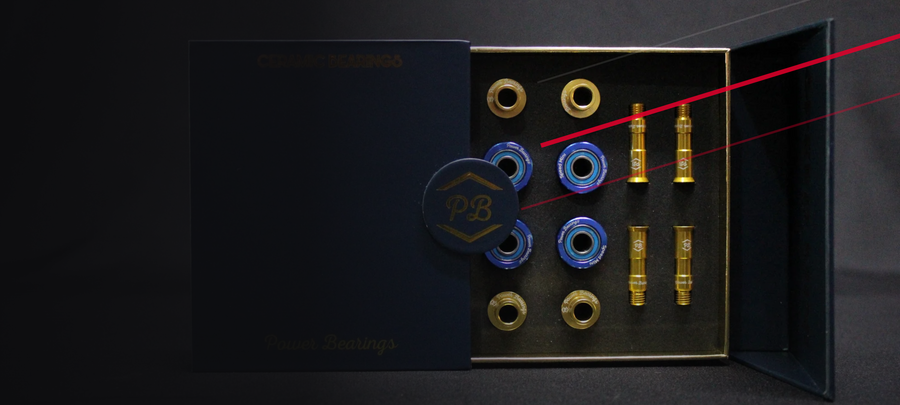
That makes bearings the right first purchase for a skater on a budget. A set such as Power Bearings Red is a precision steel 608 bearing that is the entry point of the range and is priced at Rs 9,080 for the set at the time of writing. Drop sixteen of them into your fitness wheels, keep them clean and lightly oiled, and you will feel a real difference before you have spent a rupee on a frame. Everything in the range is in the speed bearings collection, and the bearing sizes are the same whether they end up in a fitness wheel today or a race wheel next year.
Can you race on fitness skates?
Yes, and you should, at least for your first club races. Nobody needs a full race setup to find out whether they enjoy the sport, and a fitness skate with good bearings and a clean pair of wheels will happily get you round a local circuit. Where the limits show up is in three places. In the corners, the tall cuff stops you leaning as far as the skaters around you, so you have to scrub speed to hold the line. On the straights, the soft wheels and short frame mean every push gives you less glide, so you take more strokes for the same distance and tire earlier. And at the start, the flex in the boot and frame soaks up the sharp drive that a sprint needs. None of those will stop you racing. All of them will stop you winning once you start to get good.
A sensible upgrade order
Because the parts are separate, you can move to a speed setup in stages, and the stages are not in the order most people expect. Bearings come first because they fit what you already own and cost the least. Wheels come second, but only if your fitness frame will take a bigger size, and many will not go above 80 or 84mm, so check the maximum wheel size stamped on your frame before ordering anything. If your frame will not take bigger wheels, skip straight to the boot and frame together, because a speed frame needs a boot with a 165mm or 195mm mounting and a fitness boot does not have one. The boot and frame are where the bulk of the money goes, and they are also where the bulk of the speed comes from.
Start with bearings because they fit your current skates, then move to the boot and frame together, and save full size race wheels until you have a frame built for them.
What the move actually costs
To put numbers on it from our own shelves, a set of Power Bearings Red is Rs 9,080, each Aerolite frame is Rs 25,000, and a set of eight JUNK Voodoo XFirm wheels runs from Rs 17,500 in 90mm to Rs 19,500 in 110mm, all at the time of writing. The boot is the part you will need to source and fit carefully, and it is worth reading our separate guide on choosing and sizing an inline speed boot before you buy, because a boot that does not fit will undo everything else. Spread across a season, moving in stages is far more affordable than it looks on a single receipt, and each stage makes you faster on its own.
Frequently asked questions
Will speed skates make me faster straight away?
Bearings and wheels will, almost immediately. A low boot and a long stiff frame will feel unstable for the first few sessions, because the support you were leaning on is gone, and you get faster as your ankles and technique catch up. Give a new speed boot a couple of weeks before judging it.
Can I put a speed frame on my fitness boot?
Almost never. Speed frames mount on a 165mm or 195mm bolt pattern and fitness boots use their own fixed or riveted frame. When you move to a speed frame, plan on a speed boot at the same time.
Do I need 110mm wheels to race?
No. Plenty of skaters race and win on 90mm and 100mm, and a lower frame is easier to control on a tight track. Choose the wheel size to suit your track and your ankle strength, not to match the fastest skater at the club.
Are speed skates harder to stop on?
Yes, because there is no heel brake. You will need to learn a T stop or a plough stop before you skate anywhere with traffic, and it is worth practising on your fitness skates before the switch.
Is it worth upgrading the bearings in a fitness skate?
It is the best value upgrade you can make. The 608 bearings carry across to a race wheel later, so nothing is wasted.
The bottom line
A fitness skate and a speed skate share a shape and nothing else. The speed skate gives up padding, cuff support and easy turning to get a stiff low boot, a long rigid frame, big hard wheels and free spinning bearings, and every one of those changes turns more of your effort into distance. You do not have to buy it all at once. Start with bearings, race what you have, and move to a boot and frame when the limits of your fitness skate start to hold you back rather than before.