Most speed skaters in India train on public roads, because outside a handful of cities there is simply nowhere else to put in the kilometres. So the question that comes up again and again in club groups is how to skate safely on roads in India, where traffic is dense and unpredictable, the surface changes every fifty metres, and almost nobody driving expects to meet a skater travelling at thirty kilometres an hour. This guide is about that problem. Not about technique, and not about how to fall, but about the decisions you make before and during a road session that decide whether you ever need those skills at all.
Road safety for skaters is mostly planning. Where you skate, when you skate, where you sit on the road, and whether drivers can see you in time are worth far more than reflexes. Get those four right and road skating in India becomes a manageable, repeatable part of your training week. Get them wrong and no amount of skill saves you, because you are relying on other people to solve a problem you created.
Why skating on the road needs its own set of rules
A speed skater on the road occupies an awkward place in traffic. You move far faster than a pedestrian, often as fast as a cycle, but you cannot stop like either of them. You have no brake, your stopping distance is long, and your lateral swing is wide, because a proper stride takes your skate well outside the line of your body. Drivers judge your speed from your body position, and a skater in a low tuck reads to most people as somebody moving slowly. They pull out accordingly.
On top of that, your wheels care about the surface in a way that tyres do not. A 110 mm wheel drops into a gap that a car would never notice. Loose gravel, wet paint, a smear of diesel, a patch of sand blown off a construction site, all of these change from grip to nothing in the space of one stride. So the rules that follow are not the rules for cyclists with a skater badge stuck on. They are their own thing.
Choosing a route you can actually skate
Route choice is the single highest value safety decision you make, and most skaters make it lazily, by skating out of the front door and seeing what happens.
What a good training route looks like
A good road route has a smooth and continuous surface, light traffic, few junctions, good sight lines and somewhere to bail out. Wide service lanes beside main roads are often ideal, because they carry slow local traffic and give you space. Long stretches inside planned townships, industrial areas on a Sunday, campus roads, and closed or lightly used stadium perimeter roads are all worth scouting. So are the approach roads to sports complexes, where drivers are at least used to athletes.
Scout a new route on foot or on a two wheeler before you skate it, and do it at the same time of day you intend to train. A road that looks perfect at noon can be a parking free for all at six in the evening. Note the surface changes, the drain covers, the speed breakers and the places where the tarmac gives way to gravel at the edge.
Places to avoid until you are very experienced
Some roads are not worth learning on, however tempting the surface looks. Avoid highways and any road with a posted speed that the traffic actually uses, because the speed difference between you and the vehicles is the thing that kills. Avoid roads without a shoulder or service lane. Avoid market streets and anywhere with continuous parking on both sides, because you will spend the whole session in the swing zone of opening doors. Avoid steep unfamiliar descents until you know the road, and avoid any route where the only way home is a road you would not skate outbound.
Loops beat point to point
Build your training around a loop rather than an out and back or a long line. A loop you have skated fifty times is a route you know intimately: you know which corner has sand on it, which gate opens without warning, and where the light goes bad first in the evening. Knowing the road is a genuine safety feature, and it also means you are never far from your starting point if a wheel, a bearing or a body part decides it has had enough.
When to skate, and when to stay at home
Timing matters as much as the road itself. Early morning, roughly between five and seven, is the best window in most Indian cities. Traffic is thin, the air is cooler, and the people who are out tend to be walkers and cyclists who are used to sharing space. The trade off is light, so early morning skating needs the visibility setup described below.
Late evening after the traffic peak can work on a quiet loop, but it stacks two risks together: tired drivers and poor light. Midday is usually free of traffic pressure but brutal on heat, and heat makes you sloppy in the last twenty minutes, which is exactly when concentration matters most.
Some conditions are simply a no. Skate nothing in rain or on a road that is still drying, because a wet surface takes away the grip your wheels depend on and takes away drivers' stopping distance at the same time. Skip the session in fog. Skip it in the hour after a heavy shower when the oil and dust on the road has turned to a film. There is no training session valuable enough to justify skating a slick road with no brake.
Where to sit on the road
Position yourself with the flow of traffic, keeping to the left, in the same place a confident cyclist would ride. Do not skate against the traffic. The instinct to face oncoming vehicles comes from walking, and it is wrong on wheels, because a closing speed of your speed plus their speed leaves nobody any time to react.
The specific line matters. Hugging the kerb feels safer and is not, because it puts you in the strip where all the gravel, glass and broken edge collects, it leaves you nowhere to move if something appears, and it invites drivers to squeeze past you inside the lane instead of moving out. Sit roughly one metre out from the kerb or from parked vehicles, holding a straight predictable line, and remember that your stride takes your skate a further half metre or so beyond your shoulder on each push.
The line about a metre out from the kerb keeps you clear of edge debris, gives you somewhere to move, and makes drivers overtake properly instead of squeezing past inside the lane.
Hold that line and resist the urge to swing in and out around every parked car. Weaving makes you unpredictable, and a driver who cannot guess where you will be in two seconds cannot give you space. If a row of parked vehicles forces you out, move out early, smoothly and once, then hold the new line until the row ends.
Being seen is most of the job
Nearly every near miss a road skater has comes down to somebody not seeing them, or seeing them and misjudging their speed. You cannot control the second problem completely, but you can absolutely control the first, and it costs very little.
Nothing about the skater changes except what a driver can pick out. Being seen early is what turns a squeeze into a normal, unremarkable overtake.
Colour, reflectives and lights
Wear something bright on your upper body, and put reflective material where it moves. A reflective band on the ankle or the calf is worth far more than a static patch on your back, because the human eye locks onto moving light long before it registers a shape. In low light, run a small red blinking light clipped at the back of your waistband or your hydration belt, and a white one at the front if you are out before sunrise.
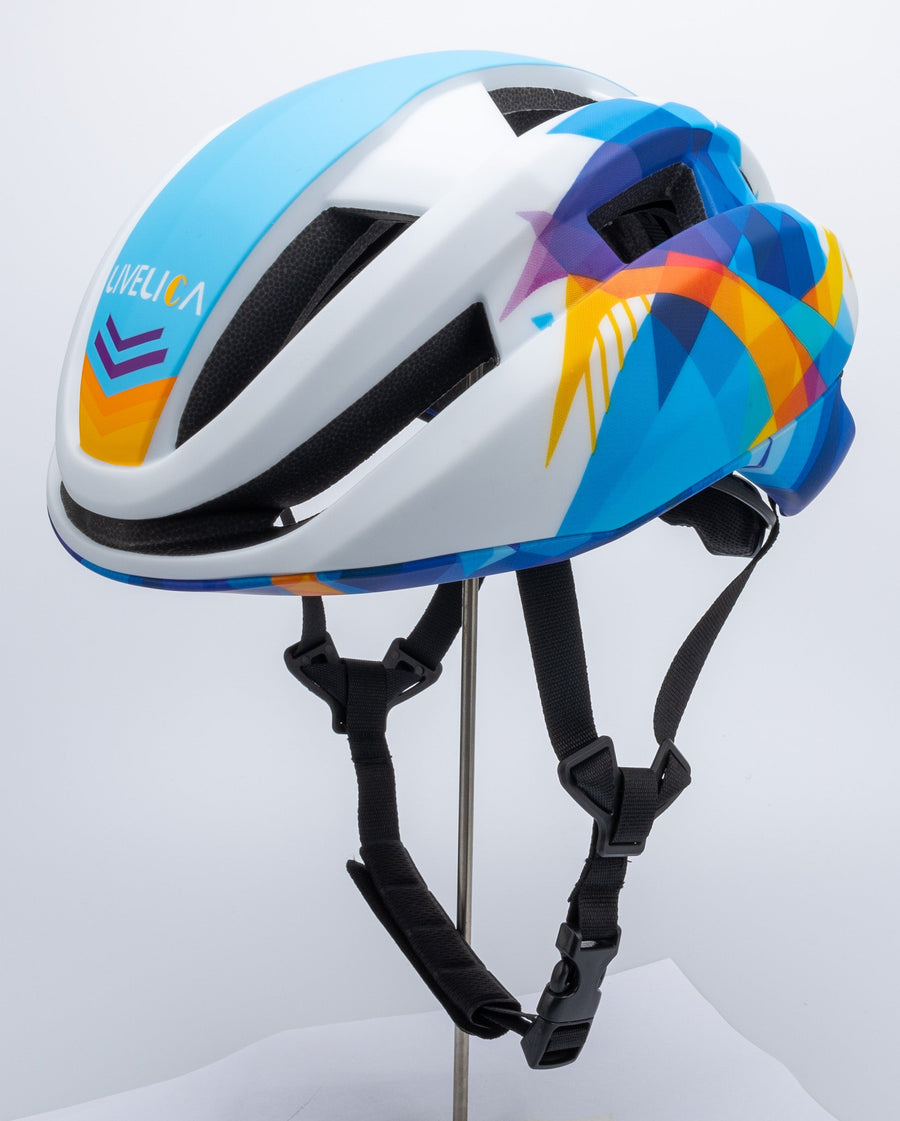
Colour choice extends to your helmet. If you are choosing between finishes with road training in mind, a white or light shell such as the LiveLica Ventilated Skate Helmet is easier to pick out in poor light than a dark one. It carries CE EN1078 certification, the European standard for skate and cycle helmets, weighs 250 grams and uses a rear dial fit system so you can set it snug in a couple of seconds. The matte finish is white, which is exactly what you want at six in the morning. The same helmet is offered in matte black if you skate mainly in good light and prefer the look.
Be predictable, and make contact
Visibility is not only about being lit, it is about being readable. Look over your shoulder before you change your line, and do it in an obvious way, because the head turn itself signals to a driver that you are about to move. Where you can, catch the eye of a driver waiting at a side road. A driver who has looked at you is a driver who has counted you, and it is the ones who glance and dismiss you as slow moving who pull out.
Reading traffic like a skater
The specific hazards on Indian roads are not mysterious, they are just constant, so build a scanning habit that runs on a loop: far ahead for the surface, middle distance for what is about to cross your path, and a shoulder check before anything you do.
Junctions, gates and driveways
Most conflicts happen where a vehicle crosses your line rather than travelling along it. Approaching a side road, a shop entrance, a petrol pump or a society gate, come up out of your deepest tuck so you are visible, cover your options, and be ready to go straight past behind a vehicle rather than in front of it. Assume nobody has seen you until they have clearly slowed for you.
Parked vehicles and doors
A door opening in front of a skater is an emergency, because you cannot stop in the distance available. The answer is geometry, not reflexes. Hold your line a full door width away from any parked row, and if that is not possible, slow right down before you enter the row rather than hoping.
Two wheelers, autos and buses
Two wheelers will overtake you closely and cut back in, so expect it and leave yourself lateral room. Autos stop without warning wherever a passenger raises a hand, so treat an auto ahead of you as a vehicle about to brake. Buses pull in and out of the kerb lane and create a wall of blind spots, so never sit alongside one, and never try to squeeze between a bus and the kerb.
Skating in a group on public roads
Group sessions are safer in one way, because a group is far easier to see, and more dangerous in another, because a group takes up more road and hides hazards from the skaters behind. A few habits make the difference.
- Skate single file on any road with live traffic, and keep two abreast only for wide, quiet stretches where you can see a long way behind.
- Leave a clear gap of roughly two skater lengths so you can see the road surface ahead and not just the back of the skater in front.
- Call and point hazards down the line, because the skaters behind you are blind to the potholes you are stepping over.
- Nominate somebody to call vehicles coming from behind, and agree what the call means before you set off.
- Never overtake inside the group toward the traffic side, and never sprint for a town sign in the middle of a session.
- Regroup at a safe, wide spot rather than at a junction, and step fully off the road when you stop.
Single file with real spacing is not slower, it just looks less impressive. It is the shape that lets a driver pass you cleanly and lets every skater read the surface for themselves.
The gear that changes the outcome
Road skating asks for less equipment than people expect, but the few pieces that matter, matter a lot.
A certified helmet is not negotiable on a road, and certification is the part to check rather than the styling. Both LiveLica helmets carry CE EN1078, use a high density EPS foam liner inside a tough polycarbonate outer shell bonded with in mold construction, and weigh 250 grams, which is light enough that you stop noticing it. They fit head circumferences of 55 to 58 cm and the inner padding lifts out for washing, which matters more than it sounds in Indian heat.
Gloves are the other piece almost everybody skips and then regrets. Hands go down first in a road fall and tarmac is unforgiving. The LiveLica Skate Gloves use a breathable polyester fabric with a lightly padded palm, which is enough to take the sting out of a slide without making the glove bulky, and they come in XS, S and L. They are comfort and training gloves rather than cut resistant gloves, which is exactly the right tool for the road.
Wheel choice is a safety decision too, not only a speed one. On rough, dusty or patchy Indian tarmac a slightly softer compound gives you more grip and soaks up more of the buzz, which keeps your feet fresher and your edges more predictable. You can compare hardness options across the JUNK wheels collection and match the compound to the surface you actually skate rather than the one you wish you had.
What to carry, and what to do after
Carry your phone, some money, water, and an emergency contact written or saved somewhere obvious. On a long loop, carry the one tool that fits your axles. That is enough. A skater walking home in socks because a wheel worked loose at kilometre twelve is a preventable story.
When you get back, the road has left something behind. Fine dust works its way into everything, and grit that sits in a bearing overnight grinds a little more each session. Wipe the frames and wheels down while they are still in front of you, check the axles, and keep your bearings on a maintenance rhythm rather than waiting until they sound rough. A single drop of Speedslick Pro Bearing Oil per bearing after a clean is the normal dose, and you can see the full range in the speed bearings collection. Bearings that run smoothly are a safety item as much as a speed item, because a wheel that binds unexpectedly at speed is genuinely dangerous.
Frequently asked questions
Should I skate with the traffic or against it?
With it, keeping to the left. Skating against traffic doubles the closing speed and removes the reaction time that both you and the driver need. The pedestrian instinct to face oncoming vehicles does not transfer to wheels.
Is it safe to skate on Indian roads at all?
It is manageable if you treat route choice and timing as part of the training rather than an afterthought. A known quiet loop at six in the morning with a certified helmet, bright clothing and a rear light is a very different activity from an unplanned evening skate on a busy main road, even though both count as road skating.
What should I wear to be seen in the early morning?
Something bright on the upper body, reflective material on a moving part such as the ankle or calf, and a small blinking red light at the back. A light coloured helmet helps too, because it sits at the height a driver is scanning.
How much space should I leave from parked cars?
A full door width, every time. If the road is too narrow to allow that, slow down before you enter the row instead of trusting your reactions, because you cannot stop in the distance an opening door gives you.
Can I skate on the road in the rain?
No. A wet surface removes the grip your wheels rely on, water carries dirt into bearings, and drivers need more distance to stop at exactly the moment you need them to have it. Move the session indoors, do a dryland session, or take the rest day.
Is it safer to train in a group?
Usually yes, because a group is much easier to see, but only if the group skates single file with real spacing and calls hazards. A bunched group on a narrow road is more dangerous than one skater, because the skaters at the back cannot see the road.
The habit that keeps you skating
Nobody remembers the sessions where nothing happened, which is a shame, because those are the ones the planning bought you. Pick a loop you know. Go early. Wear the helmet, wear something bright, put a light on your back. Sit a metre off the kerb and hold your line. Look before you move, and assume you have not been seen. None of it is dramatic, and all of it compounds over a season into a lot of safe kilometres and a training block you actually finish.