Most Indian skaters learn to race on a flat surface. A flat outdoor rink, a sports complex track, a school ground with cones. Everything you know about how a skate behaves in a corner comes from that world, where the only thing holding you in the turn is the grip between eight small patches of urethane and the floor.
Then you get to a banked track for the first time and almost nothing transfers cleanly. The corner is tilted toward you. The track does part of the work your wheels used to do on their own. The line you spent years perfecting is suddenly the slow way around. Skaters usually describe the first session on a banked oval as feeling both easier and more frightening, which is exactly right, because the physics has changed underneath them.
This guide covers what actually changes when the track tilts, and what that means for your wheels, your frame, your bearings and your racing line. It is written for the skater making the jump for the first time, and for the skater who has done one banked event and came home with a list of questions.
What a banked track actually does for you
On a flat track, every bit of cornering force has to come from the wheels resisting sideways slide. Your lean angle is limited by how much grip the urethane can generate. Push past that limit and the skate washes out from under you, which is why flat track skaters obsess over wheel hardness, surface temperature and cleanliness.
On a banked track, the surface itself is tilted inward through the corner, so a good part of the force that keeps you in the turn is being supplied by the track pushing back against the bottom of your wheels rather than by grip alone. That has a chain of consequences. You can carry more speed through the corner. You can stay lower and more compact. Your wheels are being pressed into the surface harder rather than being dragged sideways across it. And crucially, the skate feels more planted, which tempts less experienced skaters into carrying far more speed than their technique can handle on the straight that follows.
A simplified cross section. On the flat, the wheels do all the work. On the bank, the tilted surface takes a share of it and the skater can stay lower and faster.
Wheels: why banked racing rewards a harder compound
This is the single biggest setup change, and it goes in the direction most skaters do not expect. Because the bank supplies part of the cornering force, you need less pure grip from the urethane than you do on the flat, and a softer wheel that felt reassuring on a rough outdoor surface now just feels vague and slow.
The reason is deflection. A soft wheel under heavy load squashes at the contact patch, and that squashing is energy leaving your legs and turning into heat in the urethane. On a banked track the load through the corner is higher, so a soft wheel deflects more, more often, for a longer part of the lap. You feel it as a mushy, sluggish corner and a wheel that gets hot to the touch after a few laps.
A firmer compound holds its shape under that load, rolls with less energy lost, and gives you a much more direct feel from the surface. It is the reason experienced banked track racers usually run the firmer option in a wheel range, such as the JUNK Road Reaper 110 XXFirm or the MPC Black Magic XXFirm, and keep the softer compound for rough road surfaces and cold outdoor sessions. If you are still deciding where you sit on that scale, our guide comparing XFirm and XXFirm hardness goes through the trade offs in detail.
The exception worth knowing
Banked track surfaces are not all the same. A smooth, well maintained indoor bank rewards the firmest wheel you can control. A weathered outdoor bank with a coarse surface, or a cold morning session where the urethane never comes up to temperature, can make the very firmest option feel skittish. If you are travelling to an unfamiliar venue, bring both sets if you possibly can. A spare set of wheels is a far cheaper insurance policy than a bad race.
Contact patch under cornering load, exaggerated for clarity. The higher loads of a banked corner make the difference between compounds much easier to feel.
Frames: length, wheel size and how much you value stability
On a flat track, a shorter frame or a smaller wheel setup is often chosen because it turns more willingly and lets you fight for position in a tight pack. On a bank, the corner is doing more of the steering for you, so the case for a long, stable, fast rolling frame gets stronger.
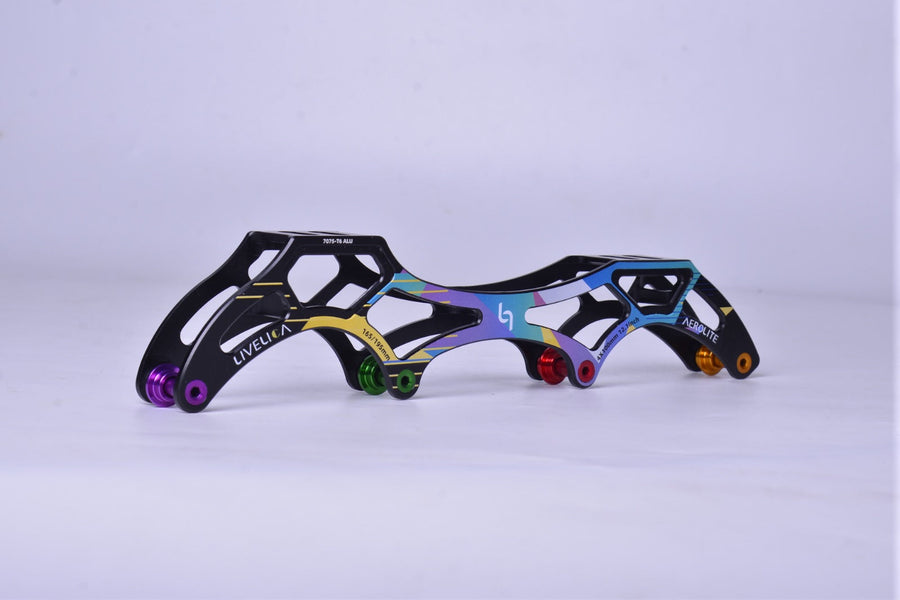
A four by one hundred and ten setup such as the LiveLica Aerolite 4x110 is the classic all round choice and works very well on a bank, with plenty of roll and a wheelbase that stays calm at speed. A three by one hundred and twenty five setup like the Aerolite 3x125 takes that further, with the largest wheels carrying the most speed once you are up to pace, at the cost of a little agility off the line and in traffic.
The honest advice for a first banked event is not to change frames at all. Race what you know. A skater who has never been on a bank has enough to learn without also learning a new wheelbase in the same weekend. If you are still choosing your first serious frame, our guide to frame length, wheel size and mounting lays out the full picture.
Bearings: why the bank exposes a weak set
Bearings matter everywhere, but a banked track is unusually good at showing up a tired set. Two reasons. First, average speeds are higher and stay high, so drag has more time to cost you. Second, the loads through the corner are higher and more consistently directed, which is exactly the condition under which a bearing with worn races, a bent cage or a stretched retainer starts to bind.
Practically, that means a banked event is a bad weekend to discover that half your bearings are gritty. Clean and oil the whole set before you travel, replace anything that feels rough when you spin it between two fingers, and keep a small spare set in the bag. If you are upgrading anyway, a high quality set such as the Power Bearings Swiss Ceramic holds up well under sustained load and stays smooth for a long time with basic care.
The racing line changes completely
On a flat oval, the fastest line is usually the tightest one you can hold without scrubbing speed. You want the shortest distance and you protect the inside. Cornering is about generating grip and getting off the corner cleanly, which we covered in detail in our guide to crossovers, lean and the apex.
On a bank, the shortest distance is not automatically the fastest, because the higher part of the track allows more speed. Many banked track racers enter the corner high, let the bank carry them, then release down toward the inside on exit so they arrive on the straight already moving. That descent adds free speed, in the same way a cyclist gains speed dropping down a velodrome bank. Fighting to hold the very bottom of the track all the way around often means arriving at the exit slower than the skater who went high and came down.
Two approaches to the same corner, seen from above. On a bank, height is speed you can spend later, so the longer path often wins.
What changes in your body position
Because the track is tilted toward you, your legs are effectively working against a surface that is closer to perpendicular to your body than it would be on the flat. Most skaters find they can sit lower and hold that low position for longer through the corner, and that the push feels stronger and more supported.
The trap is the transition. Coming off the bank onto the straight, the surface flattens out under you while you are still leaned over and loaded. Skaters who do not anticipate that get a sudden change in how the skate is being supported right at the moment they are trying to accelerate. The habit to build is a deliberate, early recovery of your upper body as you release down off the bank, so the flattening happens while you are already coming upright rather than after.
A first banked track weekend checklist
- Arrive with a clean, freshly oiled set of bearings and a spare set in the bag.
- Bring two sets of wheels if you own them, one firmer and one softer, and decide after your first practice laps.
- Race the frame you already know. Save frame experiments for a training block, not a competition.
- Do your first laps high on the bank at moderate speed to feel how the surface supports you before you commit to race pace.
- Practise the exit specifically. Getting off the bank cleanly is worth more than a perfect entry.
- Check axle tightness after your first session. Higher sustained loads find loose hardware quickly.
Frequently asked questions
Do I need different wheels for a banked track or can I use my road set?
You can race on your road set and plenty of people do. You will simply be leaving some speed behind, because a softer road compound deflects more under the higher loads a bank generates. If you have the budget for one extra set, a firmer set for smooth banked and indoor surfaces is a sensible second purchase.
Is a banked track safer or more dangerous than a flat track?
They present different risks rather than more or less risk. A bank gives you more grip and a more planted feeling, but speeds are higher, and a fall carries you down the slope. Full protective gear and a certified helmet matter at least as much as they do on the flat, and arguably more.
Will skating on a bank improve my flat track racing?
Usually yes, for a reason that has nothing to do with the bank itself. Banked sessions teach you to hold a low position at high speed and to be smooth through transitions, and both of those carry directly back to flat racing. Many skaters come back from a banked block noticeably more comfortable in fast flat corners.
How much of the difference is the setup and how much is the skater?
The skater, by a wide margin. Setup changes are worth having, but a rider who has learned to use the bank properly on ordinary wheels will beat a rider on ideal equipment who is still skating a flat track line. Spend your first banked sessions on the line and the exit, not on the workshop.
The short version
A banked track supplies part of the cornering force that your wheels have to generate on their own on the flat. That single change pushes you toward a firmer compound, rewards a longer and faster rolling frame, punishes tired bearings, and rewrites the racing line so that entering high and releasing low usually beats hugging the inside.
Change as little as you can for your first event, focus on the exit, and let the equipment questions answer themselves once you can feel what the track is actually giving you.