Corners are where inline speed races are won and lost. The straights let you build speed, but the corner is where you either carry that speed through and come out flying, or scrub it off and spend the next straight clawing it back. Good cornering looks effortless from the outside, yet it is built from a handful of specific skills stacked together: reading the line, crossing over cleanly, leaning your whole body rather than just your ankles, and staying relaxed while you do it. This guide breaks those skills down so you can turn corners into the fastest part of your lap rather than the scariest.
Why corners cost so much speed
Every time you turn, the ground has to push your body off its straight line and around a curve. That sideways push is grip, and grip has a budget. If you ask for more grip than your wheels and your technique can supply, the skate slides out. If you brace and stiffen to stay safe, you drag speed off without meaning to. The skill of cornering is spending that grip budget wisely, so you bend your path with the least possible loss. A skater who corners well is not braver than everyone else. They have simply learned to carry speed through the turn instead of surviving it.
Read the line before you read the corner
The fastest way through a bend is rarely the way it looks from the start. Diving straight for the inside kerb feels natural, but it forces a tight, sharp curve that you can only take slowly. The classic racing line does the opposite. You enter wide, cut in to clip the tightest point, called the apex, near the middle of the corner, then let yourself drift wide again on the way out. This turns one tight curve into a longer, gentler one, and a gentler curve can be taken faster for the same amount of grip.
Enter wide, clip the apex, exit wide, and one tight curve becomes a longer gentler one you can carry more speed through.
The crossover: your engine through the bend
On a curve you do not just glide, you keep pushing, and the way you push around a left corner is the crossover. Your left skate stays under you and pushes out to the side, while your right skate lifts, crosses over the top of the left, and sets down on the far side. Then the left comes out from underneath and steps across in turn. Done well, the crossover is a continuous, rolling motion that keeps power going into the ice through the whole corner rather than coasting and losing pace.
Two habits make crossovers work. First, cross fully, so the right skate lands well across the line of travel rather than tapping down next to the left. Second, keep your feet turning over quickly. A slow, lazy crossover wastes the corner. A crisp one accelerates you out of it.
The right skate lands well across the direction of travel, then the left steps out and across in turn, over and over.
Lean the whole body, not just the ankles
New skaters often try to turn by rolling their ankles inward while keeping the body upright. It does not work at speed, because it puts the skate on a harsh edge with your weight fighting against it. The fix is to lean your entire body into the corner as one unit, from the skates up through the hips and shoulders, so your centre of mass sits inside the curve. When you lean correctly, your body weight does the turning for you and the wheels simply follow, gripping instead of scrubbing. The tighter or faster the corner, the more you lean, always as one connected line rather than a bend at the waist.
Lean from the wheels up through the whole body so your weight sits inside the curve and the wheels grip.
Where your gear helps
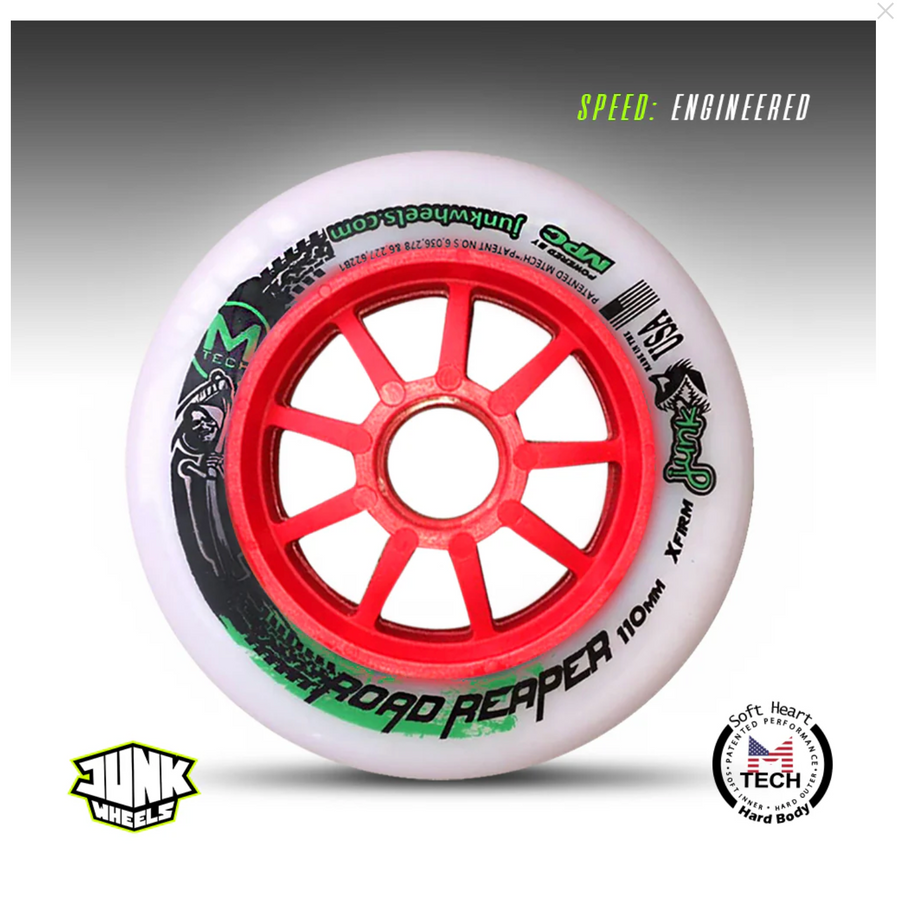
Technique comes first, but your setup decides how much grip and agility you have to work with. Wheel compound matters a great deal in the corner. A grippier compound holds the curve and lets you commit to a lean, which is why many racers reach for the firmer yet grippier options such as the JUNK Voodoo XFirm or the Killer JUNK XFirm when the surface is slick, while the harder compounds trade some grip for roll on very grippy floors. The MPC Black Magic XFirm is another proven race wheel worth a look. If you are unsure which way to go, grippier is usually the safer starting point while you build confidence in the corners.
Frame choice matters too. A shorter frame turns in quickly and rewards fast feet, which suits tight tracks and indoor corners. The LiveLica Aerolite 4x90 sits on a compact platform that flicks through crossovers, while the longer LiveLica Aerolite 4x100 trades a little agility for stability at speed on the road. Neither is a shortcut past good technique, but the right platform makes good technique easier to apply.
Common cornering mistakes and how to fix them
The first mistake is looking down at your feet. Where your eyes go, your body follows, so look through the corner to the exit and your line tidies up on its own. The second is stiffening up. Tension kills the smooth flow of a crossover, so drop your shoulders and stay loose. The third is standing tall, which we have already met, and the cure is always to commit to the lean rather than fighting it. The last is a lazy crossover that never fully crosses. Practise crossing all the way over at slow speed until the full motion becomes automatic, then bring the speed back.
Drills that build a better corner
You do not need a race to practise cornering. Skate slow circles in both directions, focusing on crossing fully and leaning as one line, until the motion feels natural on your weaker side as well as your strong one. Set two markers and skate a long oval, treating each end as a corner and each straight as a chance to reset. Film yourself from the front and the side and compare what you see against the ideas in this guide. Small, patient repetitions in training are what let you corner on instinct when the pace is high and there is no time to think.
Frequently asked questions
Should I always take the wide racing line?
In clear air, yes, the wide entry and exit lets you carry more speed. In a pack you sometimes hold a tighter line to defend your position, so read the situation as well as the corner.
Why do my wheels slide out in the corner?
Usually it is a mix of too little lean and a harder wheel than the surface wants. Commit more to leaning as one line, and try a grippier compound if the floor is slick.
How do I get better at crossing over on my weak side?
Skate slow circles in your weaker direction every session. The weak side improves fastest with patient, low speed repetition where you can focus on a full, clean crossover.
Do bigger wheels change how I corner?
Bigger wheels roll faster but take a touch more effort to flick across, so many skaters on large setups value a frame and technique that keep their feet quick through the bend.
The short version
Enter wide, clip the apex, exit wide, and keep pushing with full, quick crossovers the whole way through. Lean your body as one connected line so your weight grips the corner instead of fighting it, keep your eyes up and your shoulders loose, and back your technique with a grippy wheel and a frame that suits your track. Master the corner and it stops being the part of the lap you fear and becomes the part where you make up ground.