Six months of training, a new set of wheels, a cleaner stride, and still the same nagging doubt. So how do you know if you are getting faster at inline speed skating, rather than just getting more comfortable? Feeling fast is not evidence. Ice cool mornings feel fast. A fresh set of wheels feels fast. A tailwind on the back straight feels very fast indeed. None of that proves your engine or your technique has moved.
What proves it is a small set of repeatable tests, done the same way, on the same setup, written down. This guide gives you six of them, tells you exactly how to keep your equipment from lying to you, and shows you how to read the numbers so you do not celebrate noise or panic over a bad day. You do not need a coach, a lab or a timing system. A phone stopwatch, a measured stretch of track and a notebook will do.
Why your feeling in a session is a poor measuring instrument
Your sense of speed comes mostly from vibration, wind and effort. All three change for reasons that have nothing to do with fitness. Harder urethane buzzes more and feels quicker on smooth concrete. A warm afternoon softens your wheels, adds grip, and makes the same effort feel slower. Dirty bearings add drag you cannot feel at low speed but that costs you real seconds over a kilometre.
Perceived effort is just as unreliable. On a day when you slept badly, a 1000m at the same pace as last week will feel brutal. On a day when you are fresh and the surface is clean, a faster lap can feel easy. If you judge progress by feel, you will constantly misread both directions. Tests exist to replace that guesswork with a number you can compare.
The one rule that makes every test useful: control your setup
A test is only a test if the only thing that changed is you. If you time a flying 100m on new 110mm wheels this month and old worn 100mm wheels last month, you have measured your wheels, not your skating. Before you time anything, decide on a test setup and keep it for the whole season.
Control the green column and record the orange column. A test with an uncontrolled green column tells you nothing at all.
What a test setup looks like in practice
- One dedicated set of race wheels kept only for testing, so their diameter and hardness stay the same across the season. A set of JUNK race wheels set aside for tests will outlast a season of monthly timing.
- One set of bearings cleaned and freshly oiled the night before every test, so bearing drag is as close to identical as you can make it. A single drop per bearing of Speedslick Pro bearing oil is enough, and the point is to repeat exactly the same routine every time.
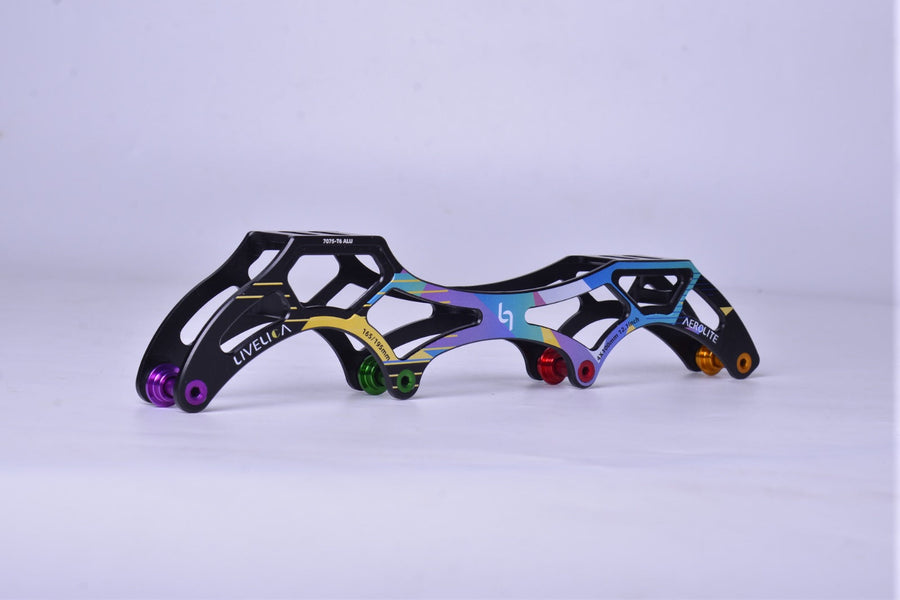
- One frame, mounted in the same position, with the same wheel order. If you run a LiveLica Aerolite frame, note which size you tested on, because a 4x110 and a 4x100 are two different measuring sticks.
- One measured stretch, marked with something that will still be there next month. Paint marks, a crack in the concrete or a permanent post all work better than cones you place by eye.
Six tests that tell the truth
You do not need all six every month. Pick the two or three that match what you are training for, and run the full set at the start and end of a training block.
The six tests cover different parts of your skating. Short and all out on the left, long and steady on the right.
Test 1: The flying 100m
Mark a 100m stretch. Build up over at least 80m before the first mark so you arrive already at full speed, then hold everything you have to the second mark. Rest five minutes and repeat twice more. Record your best time. This is the cleanest measure of top speed you can take without equipment, because it strips out your start entirely.
Look for changes of a tenth of a second or more across a training block. Anything smaller than that is within your own timing error if you are using a phone and a friend.
Test 2: The standing 200m
From a stationary start, with the same foot forward every time, sprint 200m. This one measures your start, your first ten strides and the acceleration that follows. Skaters who train starts specifically see this number move faster than any other, often within three weeks.
Keep your start position identical. If you start with a double push off one foot one month and a running start the next, you have changed the test.
Test 3: The 1000m time trial
One kilometre, flat out, from a standing start. This is the test most closely tied to racing, because it sits right where your aerobic and anaerobic systems overlap. Split it into four 250m sections and record each one, because the shape of your pacing tells you as much as the total.
A skater whose first 250m is far quicker than the last is losing time to pacing, not fitness. A skater whose sections are nearly even but whose total is slow needs more engine. Two different problems, two different training answers, and you cannot see either from the total alone.
Test 4: Strides per lap at a fixed pace
This is the efficiency test, and it is the one most skaters skip. Skate one lap of a known circuit at a set pace you can hit reliably, and count your strides. Fewer strides for the same lap time means you are getting more distance out of every push. That is technique improving, not fitness.
Count the same way every time, either both legs or one leg doubled. Write down the method next to the number so you do not forget which you used.
Test 5: The twenty minute steady effort
Skate hard but controlled for twenty minutes and record the distance covered. This is your aerobic base, the thing that makes everything else repeatable. It is also the test least affected by a bad night's sleep, which makes it a good anchor when your sprint numbers look confusing.
Test 6: The repeat drop off test
Six sprints of 200m with ninety seconds rest between them. Record all six. Your first time is your speed. The gap between your first and your sixth is your fatigue resistance. Two skaters can have identical first sprints and completely different race results, and this test is where that difference shows up.
Many skaters find their first time barely moves across a season while their drop off shrinks by a full second. That is real progress, and no single sprint test would have found it.
How to read your numbers without fooling yourself
Every number you record sits inside a band of normal variation. Phone timing, your own reaction, wind, surface temperature and how you slept all push the number around. On a flying 100m, that band is commonly two to three tenths of a second wide. If your time moves inside the band, nothing has happened. If it moves outside the band and stays there across two or three test days, something real has changed.
The orange line is what you actually record. The green dashed line is what is really happening. Judge progress over a block, never over one test day.
Three habits that keep your numbers honest
- Always test at the same point in your week, ideally two days after a rest day, never the morning after your hardest session.
- Always do three attempts at any sprint test and record all three, not just the best. The spread between them is information.
- Never test on new equipment. If you have just fitted fresh wheels or a new set of Power Bearings, skate them in first, then test. New urethane and bearings both change in the first few hours.
How often should you test
Every four to six weeks is plenty for the full set. Testing more often than that gives you noise and takes a hard session out of your week for no training benefit. Testing less often than every eight weeks means you find out too late that a training block was not working.
A workable pattern for a season: full test set at the start of the season, a short set of two tests every four weeks through the build, the full set again before your first big race, and one final set after the season ends so you know where you are starting from next year.
What to do when the numbers stop moving
A plateau is information, not failure. Work through it in this order.
- Check the equipment first. Spin each wheel and listen. Dirty or dry bearings can cost real time, and a drag you cannot feel at walking pace becomes several seconds over a kilometre.
- Check the test, not the skater. Did you move the marks? Change wheels? Test in a headwind this time and a tailwind last time?
- Look at your strides per lap. If your times are flat but your strides per lap are falling, you are getting more efficient and the speed will follow.
- Look at your drop off test. If your first sprint is flat but your sixth has improved, your race results will improve even though your top speed has not.
- Only after all of that, change the training. Usually the fix is a block of work on whichever test is weakest relative to the others, not more of everything.
Keep a log that takes thirty seconds
The log is the whole system. Without it you have feelings, not data. You do not need an app. A note on your phone with one line per test day is enough: date, test, times, wheels and bearings used, surface, wind, hours of sleep. Thirty seconds of writing turns a season of training into something you can actually read.
When you look back at that log a year later, the useful insight is rarely the fastest time. It is the pattern: which blocks moved which numbers, which conditions flattered you, and how long it took your body to respond to a change in training.
Frequently asked questions
Do I need a GPS watch to track progress?
No. A stopwatch and fixed marks are more accurate than consumer GPS over short distances, because GPS error over 100m can be larger than the improvement you are looking for. GPS is useful for the twenty minute test and for logging total volume, less useful for sprints.
Can I compare my times with another skater's?
Only loosely. Surfaces, wheel sizes, altitude and track layout all differ. Compare yourself against yourself, and use other skaters only as a rough sense of where the level sits.
Should I test on race wheels or training wheels?
Whichever you choose, keep it the same all season. Race wheels give times closer to your actual race pace. Training wheels keep your race set fresh. Both are valid, as long as you never mix them within a comparison.
My times got slower after I changed frames. Did I go backwards?
Probably not. A change in frame length or wheel size resets your baseline, because your stride timing and balance point both change. Treat the first test on a new frame as a new starting line rather than a continuation of the old series.
How much improvement is realistic in a season?
That depends entirely on your starting point, your training age and your hours on skates, so any single figure quoted at you is guesswork. What is consistent is the pattern: beginners improve fastest in efficiency and starts, experienced skaters improve mostly in fatigue resistance, and top speed is the slowest number to move for everybody.
Start this week
Pick two tests, mark your stretch, clean your bearings, and write down the date and your numbers. In six weeks you will know something about your skating that no amount of feeling fast could have told you. In a season you will have the one thing most skaters never build: a record of what actually worked.