Almost every skater knows how to warm up for inline speed skating in theory, and almost nobody actually does it. You arrive at the track, the session has already started, you lace up in a hurry and you are sprinting within four minutes of getting out of the car. It feels efficient. It is the reason your first ten minutes always feel heavy, your hips never let you sit as low as you can in the second hour, and your hamstring pulls in the one sprint that mattered. A warm up is not a ritual borrowed from other sports. On skates it does something very specific, and this guide explains what, then gives you a routine you can run at every session and a different one for race day.
If you already have a structured week and you are looking for the sessions themselves rather than the twenty minutes before them, our training plan guide covers the drills and intervals. This one covers everything that happens before the first hard push.
Why warming up matters more in speed skating than in most sports
Running warms you up as you go. You jog, you get warm, you speed up. Skating does not work like that, for three reasons.
The first is the position. A speed skating stance asks for deep knee bend, a flat back and a large amount of ankle range, all held while one leg supports your whole body weight. Cold hips and stiff ankles cannot produce that shape. What happens instead is that your body finds the shape somewhere else, usually by rounding the lower back or by skating tall with the hips high, and you spend the session grooving a position you do not want.
The second is the push direction. A good push goes sideways against the grip of the wheels, which means the hip has to open and the glute has to fire at an angle it rarely sees during the rest of your day. Muscles that have not been switched on will not do that job, so the quads take over, the push goes backwards, and you finish the session tired without going any faster.
The third is the surface. You are on wheels at speed with nothing to grab. The first corner of a session is the most likely place to crash, and a cold, uncoordinated body is slower to correct a small wobble. A warm up is a safety item as much as a performance one.
Each stage prepares the next. Heat makes tissue move, movement restores range, activation wakes the muscles that push sideways, and only then do you ask for speed.
Stage one, raise the pulse
Five to eight minutes of easy continuous movement off the skates. Jogging on the spot, skipping, easy cycling, a brisk walk with arm swings, anything that makes you slightly warm and slightly breathless without tiring you. You are looking for light sweat, not effort.
The point is temperature. Warm tissue is more elastic and warm joints move further, which is why every stretch you do in stage two works better after this than before it. In a cold early morning session in the north of India this stage matters far more than it does in Chennai in May, and you should lengthen it accordingly.
Stage two, open the hips and ankles
Move the joints through their range rather than holding long static stretches. Long holds before a session reduce the force a muscle can produce for a while afterwards, which is the opposite of what you want before sprints. Keep everything moving.
- Deep squat to stand, ten repetitions, sinking as low as you comfortably can and pausing briefly at the bottom.
- Ankle rocks, kneeling or standing with the foot flat, driving the knee forward over the toes, ten each side. This is the range that lets you sit low without your heels lifting.
- Leg swings forward and back, then across the body, ten each direction each leg, holding a wall or a pole.
- Hip openers, lifting the knee up, then out to the side and down in a slow circle, eight each way.
- Walking lunges with a gentle rotation of the torso over the front leg, six each side.
- Cat and camel or a few slow spinal rolls, because a flat back over bent knees asks a lot of the lower back.
Skaters who cannot get low usually blame their thighs. In most cases the limit is ankle range or hip range, not strength. If you find one of these movements much harder on one side, that is worth knowing, because a stiff left hip shows up as a scruffy left crossover long before it shows up as pain.
The low position is limited by ankle and hip range far more often than by leg strength. Four minutes of movement changes the shape you can reach.
Stage three, wake up the muscles that push sideways
Short, sharp and low volume. You are not training here, you are switching things on.
- Lateral bounds, jumping sideways from one foot to the other and landing softly under control, eight each side. This is the closest off skate movement to a skating push.
- Single leg balance for twenty seconds a side, ideally with your eyes closed for the last five, because most balance on skates is ankle control rather than vision.
- Glute bridges, twelve repetitions, then four held for five seconds each.
- Skater position holds against a wall for twenty seconds, twice, to remind the body what it is about to be asked to do.
- Four or five easy standing jumps, landing quietly, to bring the nervous system up to speed.
Total time, three or four minutes. If any of this leaves you breathing hard you have done too much.
Stage four, the on skate progression
Now put the skates on, and build in three steps rather than going straight to training pace.
Start with three to five minutes of very easy rolling, standing fairly tall, letting the ankles feel the wheels and the surface. Look at the ground you are on. Grit, damp patches and loose gravel are all easier to spot at walking pace than at speed.
Then spend three or four minutes gradually dropping into your position, a lap low and a lap tall, adding a few slow crossovers in both directions. This is where you notice whether the left corner feels as good as the right, and whether anything in the skate feels different from last time.
Finish with three or four build ups over roughly a hundred metres each, starting easy and finishing at about race pace for the last few strides, with easy rolling between. These are the repetitions that tell your body the hard work is coming. After them you are genuinely ready for a sprint session, and not before.
The gear check that belongs inside your warm up
The first easy laps are the best diagnostic you will get all day, so use them. A skater who notices a dragging wheel in lap two saves a session. A skater who notices it during the third sprint has already wasted the sprints.
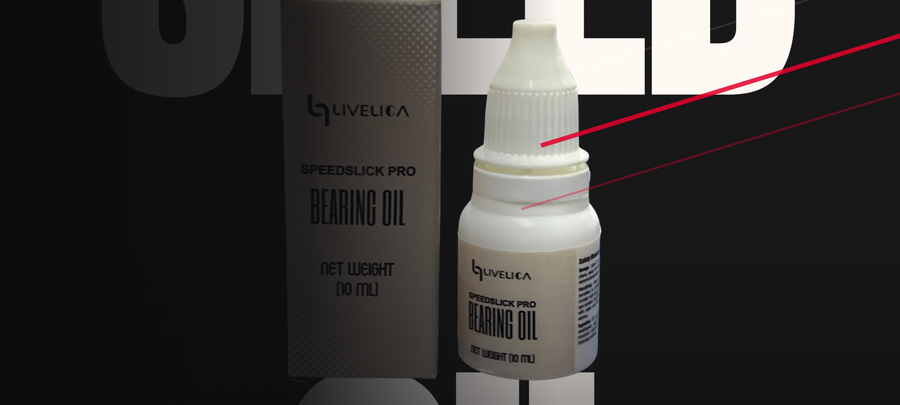
Before you roll, lift each skate, spin every wheel and listen. Wheels should spin freely and for a similar length of time. One that stops early is usually an over tightened axle or a spacer problem rather than a dead bearing. Rock each wheel sideways for play, check that the frame bolts are tight, and look at the wheel edges for the coning that changes how the skate behaves in a corner. If the roll sounds gritty after a dusty week, that is a cleaning job and a single drop of Speedslick Pro Bearing Oil per bearing, not something to skate through. If the wheels are worn unevenly and rotation no longer saves them, compare compounds in the JUNK wheels collection before the next block.
Then check yourself. Helmet on and buckled for every session, not only for races, because the build ups at the end of a warm up are exactly where a wheel finds a stone. A light certified lid such as the LiveLica Ventilated Skate Helmet is comfortable enough that you will not make excuses, and a pair of LiveLica Skate Gloves saves the palms that always hit first.
Race day is a different warm up
On race day the warm up has one extra job. It has to peak at the right minute and then hold, because you will almost certainly be standing around after it while officials do their work.
A race warm up is timed backwards from the start, and the last fifteen minutes are the part most skaters get wrong.
Two details are worth adding. Do your race warm up in the suit you will race in, because a race fit garment changes how the low position feels and you do not want that to be a surprise on the start line. A cut such as the LiveLica Pro Skin Suit is made for a deep aerodynamic position, and five minutes in it before the first heat is worth more than any last stretch. And keep a layer to pull on over it between the warm up and the call, because cooling down completely and then sprinting is the most reliable way to strain something.
Cooling down, and why skaters skip it
The cool down is the ten minutes nobody films. Roll easily for five to eight minutes at the end of the session, standing taller than your race position, letting the breathing settle. Then, off the skates, do the long static stretches you were told to avoid at the start. Now they are useful, because the session is over and there is nothing left to be explosive for. Calves, hip flexors, glutes, hamstrings and lower back, thirty seconds each.
Then look after the skates while you are still at the track, because that is the only time you reliably will. Wipe the frames and wheels down, especially after a dusty or wet session, and never put damp skates away sealed in a bag. Two minutes here is worth more than an hour of maintenance later.
Warming up in Indian conditions
Heat changes the arithmetic. In a hot afternoon session your tissue is already warm, so stage one can be shorter, but you will dehydrate during the warm up itself, which means drinking before you start and not only during the session. In an early winter morning in the north the opposite applies. Lengthen stage one, keep a layer on until the build ups, and accept that your first low laps will feel worse than they will in twenty minutes.
Monsoon sessions bring a different problem. A damp surface means less grip, so extend the on skate stage and take the first corners slower than usual, and give the bearings attention afterwards rather than before. Water sitting inside a bearing overnight does more harm than a month of hard skating.
Common warm up mistakes
- Long static stretching before skating, which reduces power output when you want it most.
- Treating the first hard effort as the warm up, which is how hamstrings and groins get pulled.
- Warming up well and then sitting on a kerb for twenty minutes waiting for the race.
- Skipping the on skate stage entirely and going from the car park to intervals.
- Doing the same fixed routine in every condition, rather than lengthening it when it is cold and shortening it when it is not.
- Making the warm up so long and hard that it becomes a session of its own.
Frequently asked questions
How long should a warm up for inline speed skating be?
About twenty minutes for a normal training session, split roughly as five to eight minutes of easy movement, four to five minutes of mobility, three to four minutes of activation and six to eight minutes on skates. For a race, build the same content into an hour so it peaks near the start.
Can I just skate a few easy laps instead?
Easy laps are the last stage, not the whole thing. They raise your temperature but they do very little for hip and ankle range, and nothing at all for switching on the muscles that push sideways. Adding six minutes off the skates before them changes how the session feels.
Should I stretch before skating?
Move rather than hold. Dynamic movements through a full range are what you want before a session. Save the long held stretches for after, when they help you recover and do not cost you any power.
Do I need a warm up for an easy session?
A shorter one, yes. Even an easy long ride is an hour in a deep position, and starting it with cold hips is how you finish it with a sore back. Ten minutes is enough on those days.
What should I do if the race is delayed?
Keep moving and stay covered. Walk, swing the legs, do a few squats, and put one more build up in when you hear your heat called. The thing to avoid is sitting down and going cold for half an hour.
Is a cool down really necessary?
It is the cheapest thing in the sport. Five to eight minutes of easy rolling and a few minutes of stretching leave you fresher for the next session, and it is the natural moment to wipe the skates down before they go in the bag.
The short version
Warm up for inline speed skating in four stages. Get warm, move the hips and ankles, wake up the muscles that push sideways, then build on the skates from easy rolling to a few efforts at race pace. Use the first laps to spin the wheels and listen to the bearings. On race day, time it backwards from the start and keep moving while you wait. Then cool down, stretch properly and wipe the skates before they go in the bag. It is twenty minutes, it costs nothing, and it is the difference between a session that starts well and one that never quite gets going.