Every skater reaches the same moment. You have been training for a season, you are starting to hold a decent pack, and you begin to wonder whether your kit is holding you back. Then you open a shop page, see bearings at four different price points, wheels in three compounds, frames in five layouts, and you freeze. Most skaters solve that paralysis badly. They buy the most expensive item in the category they happen to be reading about that evening, and six months later they own a flagship part bolted to a setup that cannot use it.
There is a better way, and it is not complicated. Speed on inline skates comes from a short list of things: how freely your wheels turn, how well your wheels grip and roll on the surface you actually skate, how efficiently your frame transfers a push, and how much air you drag behind you. Those four things are worth money in roughly that order, and each one has a cheap version of the same benefit that most skaters skip. This guide walks the ladder from the bottom, with honest notes on where the returns get small. We sell all of this, and we will still tell you when the answer is to spend nothing.
Height shows what you spend, not what you gain. The cheapest steps on the left are the ones most skaters skip.
Step zero: the free upgrade almost nobody does properly
Before you buy anything, take your wheels off and check how your bearings actually run. Spin each one by hand. A healthy bearing turns quietly for several seconds and stops smoothly. A tired one sounds gritty, stops abruptly, or feels notchy as it turns. If most of your bearings are in that second group, you do not have a bearing problem. You have a cleaning problem, and buying a faster set will simply give you a faster set that goes gritty in six weeks.
Clean them first, dry them fully, then re oil. This matters more in Indian conditions than almost anywhere, because dust is the real enemy. Oil binds to grit, so oiling a dirty bearing traps dust inside and makes it slower rather than faster. Speedslick Pro Bearing Oil is our own light skate oil, and the routine we recommend with it is deliberately simple: one drop per bearing, spin by hand for a few seconds to spread it, wipe away the excess, refit. One drop is the sweet spot. More oil is not faster, because a flooded bearing collects dust and drags. The bottle is 10 ml with a fine tip, and since a standard pair of four wheel skates uses sixteen bearings at one drop each, a single bottle services many full sets.
Re oil when the roll starts to feel short or the bearing sounds gritty, rather than on a fixed calendar. Skaters training on dusty roads will do this far more often than skaters on a clean indoor floor, and that is normal.
Upgrade one: bearings, and why they are first
Bearings are the first thing to buy because they are the cheapest part of your skate that touches every single rotation of every wheel. Sixteen of them are working on a standard four wheel pair, all the time, and the difference between stock bearings and a real racing set is something you feel in the first ten metres.
Where to start: Power Bearings Red
Power Bearings Red is the entry into the Power Bearings range and the best value for money set we stock. It is honest precision steel in the standard 608 size (8mm bore by 22mm outer by 7mm wide, 608RS sealed), which fits the majority of inline speed wheels. If you are still running the bearings that came fitted in your first skates, the jump in roll is immediately obvious, and a full set does not break the bank. This is the set we point most new racers toward, and there is no shame in staying on it for a couple of seasons.
The one set that does everything: Power Bearings Super
Power Bearings Super is the improved Red. Same sensible value, but faster, quieter, smoother and more durable, with an ABEC 9 rating and higher turning precision that lets it hold a cleaner roll. It is happy being trained on all week and raced at the weekend, and it stays fast for longer between cleans. If you want one set and you do not want to think about bearings again, this is the one.
One honest note on ratings. ABEC measures manufacturing tolerance, not speed. It is a sign of precision, not a promise of pace, and the smooth roll comes from the whole build rather than the number on the box. Treat ABEC as one input, never as the deciding factor.
When ceramic starts to make sense
Power Bearings Swiss Ceramic is the step for skaters whose own engine has become the limiting factor rather than their kit. It uses silicon nitride ceramic balls in a precision race. Ceramic balls are harder, rounder and lighter than steel, and they do not gall against steel races under heat the way steel on steel can, so the bearing runs cooler on long efforts and holds speed better in the second half of a race. According to the manufacturer, the Swiss Ceramic is 50 percent lighter than steel equivalents, 40 percent more robust, and saves 0.8 to 1.0 watts per bearing compared with typical precision steel. Across sixteen bearings over a long race, that adds up.
The catch is honesty about who benefits. If you are not yet training consistently, and if your bearings live in dust and rarely get cleaned, ceramic will not rescue you. Good steel plus a disciplined cleaning routine beats neglected ceramic every time.
Sixteen bearings on a standard pair, all working at once. That is why the smallest part earns the first upgrade.
Upgrade two: wheels, matched to the surface you actually skate
Wheels are the next step, and here the mistake is not buying cheap. It is buying the wrong compound for your surface. Urethane hardness is graded on the A scale, and every step up in hardness trades grip for roll efficiency. Harder is not automatically faster, because a wheel that skids in a corner costs you far more than it gains on the straight.
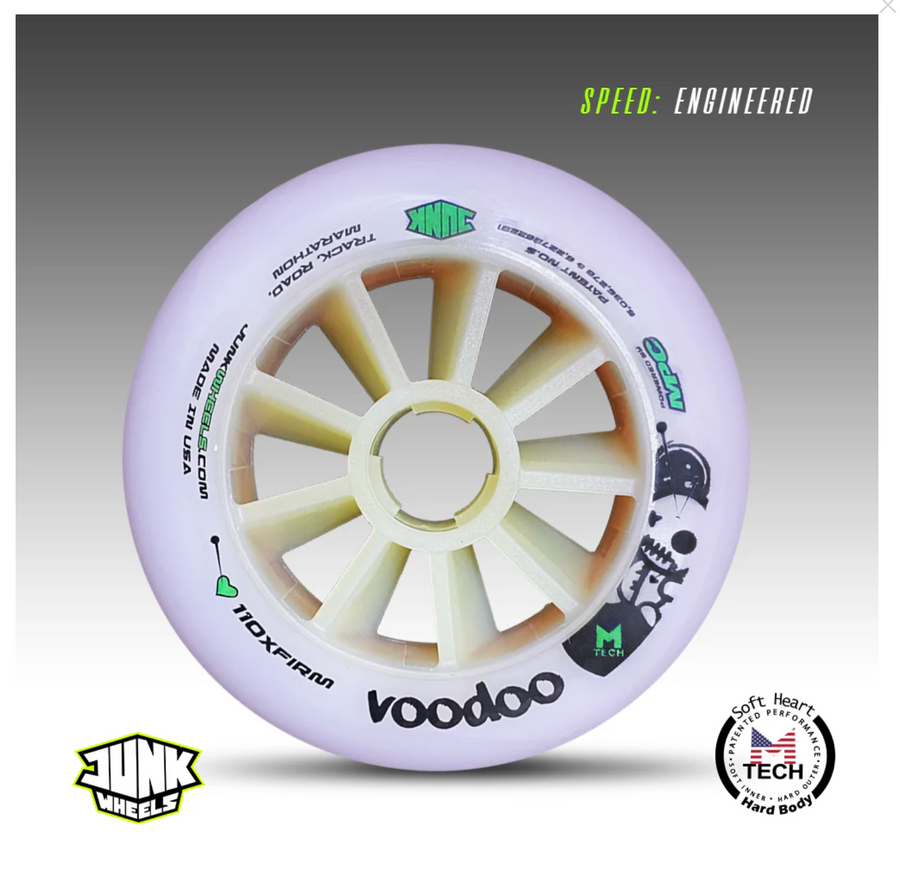
The JUNK wheels collection shows this clearly. The Voodoo comes in three firmness levels so you can match the wheel to the conditions. Firm is for challenging or slippery surfaces where you need grip. XFirm, at 84 to 86A, suits hard, smooth, dry surfaces and balances grip with roll. XXFirm gives the highest roll efficiency for outright speed. The Voodoo also runs a pigment free build, with no colouring in either the hub or the urethane, and JUNK moulds each wheel in a one cavity tool rather than the usual four cavity approach, which gives tighter consistency from wheel to wheel.
Pick by honest assessment of where you train. If your local surface is rough, dusty or damp for part of the year, a grippier compound will make you faster in practice than a harder one that slides. Remember too that wheels are sold on their own, so a new set of eight still needs sixteen 608 bearings and spacers.
Compound is a trade, not a ranking. A wheel that holds the corner beats a harder wheel that lets go.
Upgrade three: the frame
A frame upgrade is a bigger spend and it changes the character of your skate rather than just its speed. Two things matter: how stiff and light the frame is, and what wheel layout it carries.
The LiveLica Aerolite 4x110 is a useful example because its numbers are public. It is a 13.2 inch (335mm) platform in 7075 T6 aircraft grade aluminium weighing 159 grams, drilled for both 165mm and 195mm mounting so it fits a wide range of modern speed boots, and it ships with an Allen key, spacers and axles. The long platform tracks straight and stays composed at race pace, which is what road and marathon racing ask for. A shorter frame feels more agile and a big wheel triskate feels lighter and more playful, so the layout you choose should follow the racing you actually do.
Two cautions before you spend here. First, check your boot mounting standard before ordering anything. Second, a frame is only worth buying once your technique is settled enough to feel the difference, because a stiffer platform rewards a clean, powerful push and simply amplifies a sloppy one.
Upgrade four: your own aerodynamics
At racing speeds, most of the resistance you are fighting is air, and no bearing in the world moves as much air as your torso does. A proper race suit is therefore not vanity. It is the last cheap watt available to a skater who has already sorted the mechanical side. When you reach this stage, prioritise fit above everything else, because a loose suit gives back exactly the benefit it was bought for. A suit that is snug through the shoulders, chest and thighs, with no flapping fabric at the arms, is doing its job.
What to leave until much later
Our own flagship bearing makes the point better than any warning. The Power Bearings Speed Minimizer is a complete mini bearing racing system with nine ceramic balls, aluminium axles, one piece outer adaptors and in line spacers, built for competitive racers who have exhausted every other variable. It is not a sensible first upgrade, and we will happily talk you out of it if your money is better spent elsewhere. That is the honest position on every flagship part. Buy it when the rest of your setup and your training have run out of easier gains, not before.
A simple plan by skater level
- First season club skater: clean and oil what you own, then move to Power Bearings Red. Spend the rest on skating time and coaching.
- Second or third season racer: Power Bearings Super, then a wheel compound that matches your usual surface.
- Committed racer training most days: consider ceramic, and look at a frame that matches your event.
- Podium chasing racer: a properly fitted race suit, and only then the flagship parts.
Frequently asked questions
Will better bearings really make me faster?
They will make your skates roll more freely, which you feel most on long, steady efforts. What they will not do is fix technique or fitness. The honest framing is that a good bearing stops you losing speed you have already produced, so the gain is real but it is measured in efficiency rather than in seconds you did not earn.
How many bearings do I need to buy?
Sixteen for a standard pair of four wheel inline speed skates, two per wheel. Most sets are sold with this in mind, but check the quantity on the product page before ordering.
Should I upgrade wheels or bearings first?
Bearings, in almost every case. They cost less, they affect every rotation, and a fresh set on old wheels still feels quicker. Move to wheels once your bearings are sorted, or sooner if your current wheels are badly worn or coned, because worn wheels waste more speed than any bearing can recover.
Do ceramic bearings still need cleaning and oil?
Yes. Ceramic handles heat and water better than steel, but it still needs clean, light oil to spin freely and to protect the races. One drop per bearing, exactly as with steel.
Is a more expensive frame going to make a beginner faster?
Rarely. A light, stiff frame rewards a settled, powerful push, and if your stride is still developing you will not feel most of what you paid for. Put that money into bearings, wheels and coaching first, then buy the frame when you can tell the difference.