The corner is where short track races are won and lost. Anyone can push down a straight, but the skaters who carry speed through the bend, hold a tight line and come out ready to attack are the ones who move to the front. Cornering is built from body position, crossovers, edge control and the inside hand on the ice, and every part of it can be trained. This guide breaks the short track corner into its pieces, explains what your body should be doing at each stage, and shows how your blades, boots and gloves support the technique. It is written for skaters who can already skate the oval and want to corner faster and more safely.
Short track is skated anticlockwise on a tight 111.12 metre oval, so almost half of every lap is spent turning left. Strong left cornering is therefore not a nice extra, it is the core skill of the sport. Get it right and you save energy, hold your line under pressure and set up every pass. Get it wrong and you scrub speed, drift wide and leave the door open. Let us build the corner from the ground up.
Body position, the foundation of every corner
Good cornering starts with a low, balanced body position. Bend deeply at the knees and hips so your hips sit low over the ice, keep your chest calm and your head up, looking through the exit of the corner rather than down at your feet. Your weight leans into the centre of the turn, so your body and skates tip left together like a motorcycle taking a bend. The lean is what lets your edges bite. If you stay upright, your blades cannot grip and you slide wide, so commit to the lean and trust the edges to hold you.
Balance through the corner lives on the inside edges of your blades, which is why blade setup matters so much in short track. Your blades are bent to the left and rockered so they carve a smooth arc. A flagship race blade such as the StayBent XC Flex Weapon is engineered for extra grip and hold through the corner while keeping a smooth glide, and its Precise Bend Technology is StayBent's own process for producing accurate, repeatable bend radiuses so the blade behaves the same way in every turn. The blade does a lot of the work, but only if your body gives it the lean and pressure it needs to bite.
A front view of the lean. The whole body tips toward the centre of the turn so the inside edges can bite, while the head stays up and looks to the exit.
The crossover, how you carry speed round the bend
You do not coast through a short track corner, you power through it with crossovers. A crossover is a stride where the outside leg, your right leg on a left turn, crosses over the top of the left leg to plant on the far side, while the left leg pushes out from underneath. Done well, every crossover is a full power stroke, so you accelerate through the corner rather than simply surviving it. This is how skaters build speed on the bend and launch onto the straight.
The right leg crossover
The right foot lifts, travels across and over the left skate, and sets down on its inside edge to the left of your body. As it lands it takes your weight and begins its own push. The timing is everything. Cross too early and you tangle your feet, cross too late and you lose drive. Practise the movement slowly at first, feeling the right skate travel cleanly over the left, then build speed as the pattern becomes natural.
The left leg push
While the right leg crosses over, the left leg pushes outward and slightly back, driving off its inside edge, then recovers underneath your body ready for the next stroke. The left push is a genuine power stroke, not a passive glide, so think about pressing the whole blade into the ice and extending the leg fully. Two legs, two pushes, one continuous rhythm around the bend.
Looking down on the corner. The right skate crosses over the left and plants on its inside edge, while the left drives out and recovers underneath, so both legs push every stride.
The inside hand on the ice
Through the deepest part of the corner most short track skaters place the inside hand, the left hand, lightly on the ice. It is not there to hold you up, it is there for balance and reference, a light touch that tells you where the ice is and helps you commit to the lean with confidence. The key word is light. You are brushing the ice, not leaning on it, because pressing down scrubs speed and unsettles your line.
Timing matters as much as pressure. The hand comes down as you settle into the apex and lifts again as you begin to rise for the exit, so it trails just behind and inside your body rather than reaching out in front of you. Reaching forward pulls your shoulders round and opens your line, which is the opposite of what you want.
The hand touches down as you settle into the apex and lifts as you rise for the exit, so contact is light and only across the deepest part of the turn.
This is where your gloves matter. Bare fingers drag and grab on the ice, so short track skaters fit hard, low friction glove tips to the fingers they put down. The StayBent Quick Tips are shaped for each finger and bonded to your glove with CA glue, and because they slide instead of gripping you keep more of your speed through the turn. If you prefer a lighter tip with a carbon weave, the carbon fibre Quick Tips do the same job. Most skaters tip only the outer two or three fingers of the inside hand, since those are the ones that actually reach the ice.
Protection matters just as much, because your hands pass close to other skaters' blades in the pack. A pair of StayBent cut resistant gloves is built from fibres that resist a slicing edge far better than a normal glove, which is why many skaters treat them as basic kit for both racing and blade handling. They run in sizes XS to XL and take glove tips on the fingers you put down.
Entry, apex and exit
Think of the corner in three parts. On entry you set your line and drop into your low position before you reach the bend, so you arrive already leaning and balanced rather than adjusting mid corner. At the apex, the tightest point of the turn, you are at maximum lean with your crossovers flowing and your inside hand grazing the ice. On exit you rise slightly, direct your energy forward and accelerate onto the straight, eyes already up the track looking for your next move. The skater who nails all three parts carries the most speed onto the straight, which is where passes are finished.
The line through a corner. Set your entry early, hit the apex at maximum lean around the marker block, then rise and accelerate out onto the straight.
Common cornering mistakes and how to fix them
Most lost time in the corner comes from a short list of habits. Work through these one at a time rather than trying to fix everything in one session.
- Standing too tall. If your hips rise, your lean shrinks and the edges stop gripping. Fix it by holding a low position for one full corner at a time, even if it means skating slower.
- Looking down at your feet. Your body follows your eyes, so a dropped head pulls your shoulders in and closes your line. Fix it by picking a point at the exit of the corner and holding your gaze there.
- Leaning with the upper body only. Bending at the waist while your skates stay flat gives you the look of a lean without the edge angle. Fix it by tipping from the ankles and hips so body and blades tip together.
- Pressing hard on the inside hand. Weight on the hand is weight off the blades, and it scrubs speed. Fix it by skating corners with the hand hovering a few centimetres above the ice until light contact feels natural.
- Rising early on the exit. Standing up before the corner is finished throws away the speed you just built. Fix it by staying low until your skates are pointing down the straight.
- Crossing over too early. Feet tangle and the left leg never completes its push. Fix it by slowing the pattern down until each push finishes before the next foot travels.
Training your corner
Corners improve with focused, repeated practice, and the drills below build on each other. Give each one a few sessions before moving on.
- Slow controlled laps, concentrating only on a clean crossover pattern with no attempt to build speed.
- One corner low holds, staying in your deepest position from entry to exit without rising.
- Hand hover laps, tracing the arc of the corner with the inside hand just off the ice to train the timing.
- Light touch laps, adding real but gentle contact through the apex only.
- Exit acceleration laps, driving the first four strides onto the straight as hard as you can from a settled corner.
- Video review from the side and from above, since seeing your lean and foot placement tells you more than feel alone.
How your equipment supports your cornering
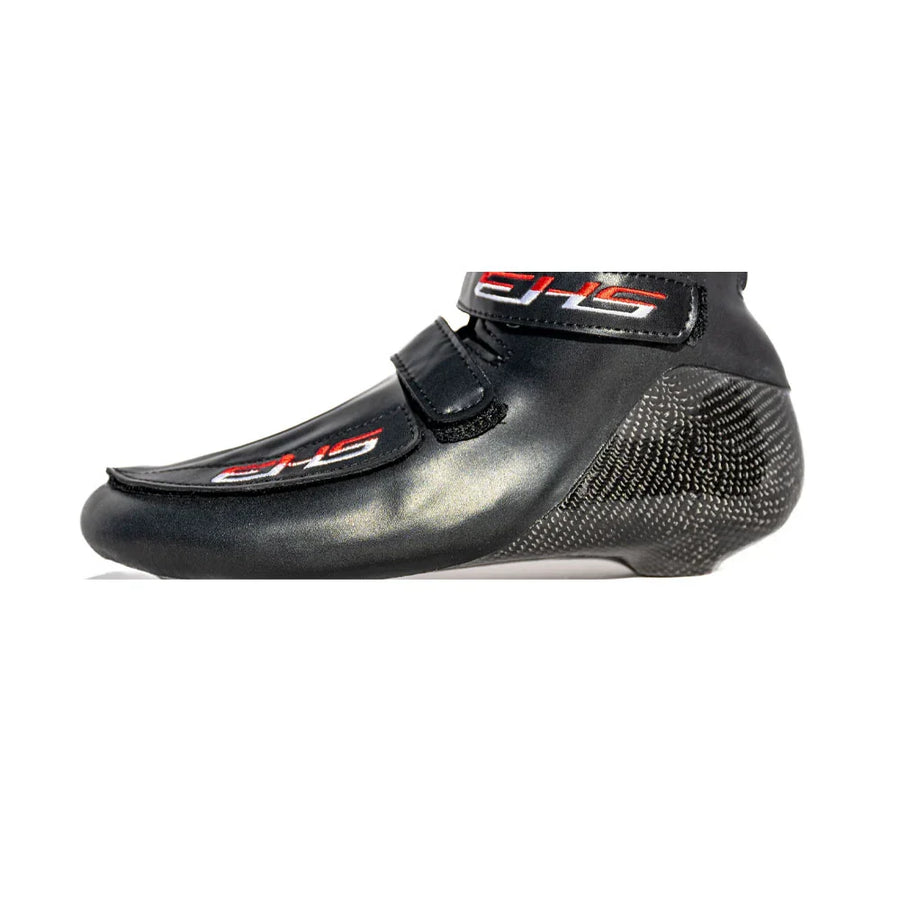
Technique comes first, but the right kit lets you commit to it. Your boots must hold your ankle and heel firmly so the lean you ask for actually reaches the ice, which is why a stiff, well fitted short track boot such as the EHS Short Track Boots makes such a difference to corner confidence. They are built on lasts developed specifically for short track, which support good ankle position and heel stability, and the heat mouldable carbon shell can be shaped to your foot by a qualified fitter so pressure points do not distract you mid corner. They run from size 32 to 48 and arrive with the mounting hardware you need for your blades.
Your blades must be set up and sharp so the edges bite when you load them, and blade length is part of the fit too. The XC Flex Weapon is offered from 16.5 through to 18.0, and as a general guide shorter blades feel quicker and more agile while longer blades track straighter and carry more speed on the straights. Your gloves need low friction tips for the hand down and cut resistance for the pack. None of this replaces good technique, but poor kit will limit even a good skater, so it is worth getting the setup right. You can browse blades, boots, gloves and tips together in the short track collection.
Frequently asked questions
Why do short track skaters put a hand on the ice?
The inside hand is used for balance and reference through the deepest part of the corner. It is a light touch, not a lean, that helps a skater commit to the lean angle with confidence. Low friction glove tips let the hand slide without scrubbing speed.
Do I need glove tips to corner?
You can corner without them, but bare fingers drag on the ice and cost you speed. Hard, low friction tips like the StayBent Quick Tips slide instead of grabbing, so most short track racers fit them to the fingers they place on the ice.
Which fingers should I fit tips to?
The fingers you actually put down through the corner. Many skaters tip the outer two or three fingers of the inside hand and leave the rest bare.
How do I stop sliding out on the corner?
Sliding wide usually means you are too upright, so your edges cannot grip. Bend lower, commit your lean into the centre of the turn and load your inside edges. A settled, sharp blade setup and a firm boot help the edges hold once your body gives them the lean.
Which leg does the pushing in a crossover?
Both. The right leg crosses over and plants, then pushes, while the left leg pushes out from underneath and recovers. Two power strokes per cycle are what carry your speed through the bend.
Why does cut resistance matter for cornering?
Cornering in a pack puts your hands near other skaters' blades. Cut resistant gloves are built from fibres that resist a slicing edge, which lowers the risk of a serious cut during racing and blade handling.