Short track has its own language, and nobody hands you a dictionary on your first session. A coach tells you to get lower in basic position, a club mate says your cups are too low, someone offers to knock the burr off your blades before the next heat, and you nod along while quietly wondering what half of it means. That is completely normal. Most of these words describe real parts, real angles and real habits that decide how fast and how safe you are on the ice, so learning them properly is not trivia. It is the difference between guessing at your setup and understanding it.
This glossary is written for skaters in India who are new to short track, for parents buying a first setup, and for inline skaters crossing over to ice who already know how to race but not what the ice specific parts are called. We have grouped the words the way you meet them: first the skate itself, then blade geometry, then steel, then the maintenance bench, then safety kit, and finally the words you hear during a race. Where a term relates to something we stock, we have linked it so you can see the real part rather than an abstract description.
The parts of a short track skate
A short track skate is not one object. It is a boot, a blade and a set of parts that join the two, and each of those can be changed independently. Once you can name them, conversations about setup suddenly make sense.
Boot
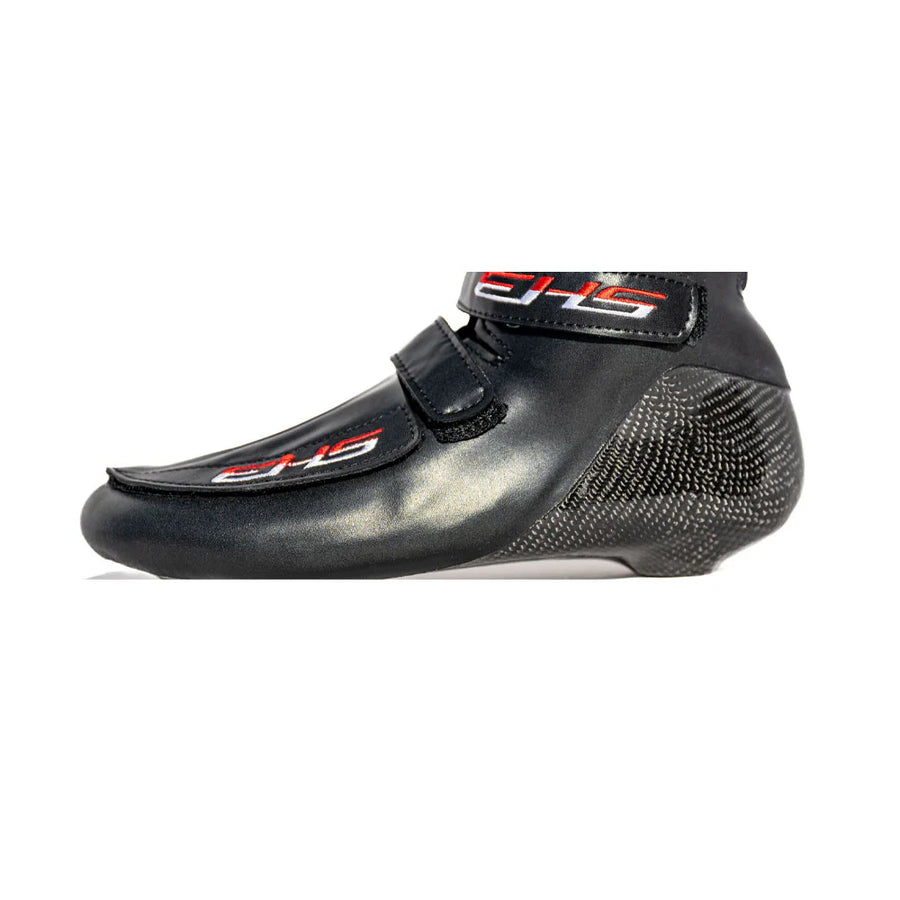
The rigid shell that holds your foot. Short track boots are built low around the ankle so you can lean far into a corner, and stiff so that your push goes into the ice rather than into flexing material. The EHS Short Track Boots we stock use a carbon fibre and Diolene shell that is heat moldable, which means a qualified fitter can warm the shell and shape it around the bumps of your own foot.
Runner or steel
The thin strip of hardened steel at the bottom of the blade that actually touches the ice. This is the part you sharpen, and it is the part that eventually wears out. Skaters often say steel when they mean the runner.
Tube
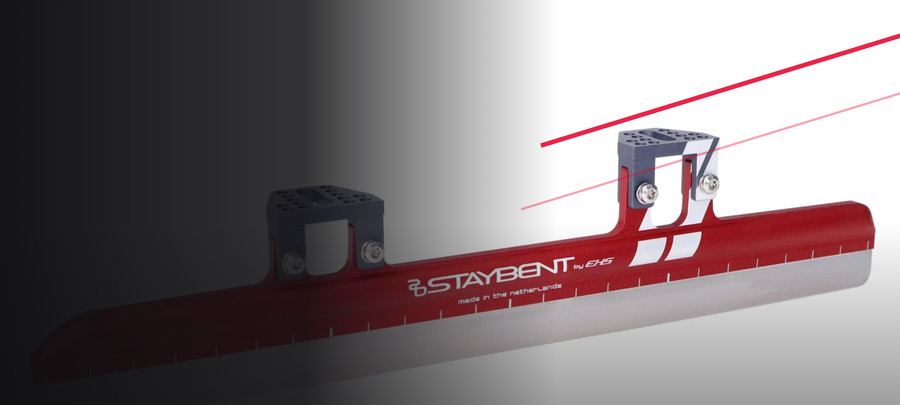
The aluminium body of the blade that holds the runner and gives the blade its stiffness. Tube design is where blade makers differ most. On the StayBent JaeBee, for example, the top of the tube tapers down from the centre toward each end, which creates a progressive flex pattern so the tips of the blade give more than the middle.
Lips
The parts of the blade that hold the tube to the cups. Flex in the lips lets the skate move with your push instead of fighting it. The JaeBee uses more flexible lips than the StayBent QCS, which is why the two blades feel so different underfoot even though both belong to the same family of smooth, flowing race blades.
Cups
The small aluminium blocks that bolt the blade to the sole of the boot, two per skate. They set how far the blade sits below your foot. The StayBent Short Track Mounting Cups come in twelve sizes in 1 mm steps, from minus 1 up to plus 10, and the size is engraved on the cup so you always know what is on your boot.
Blade height
How far the runner sits below the sole, decided by your cup size. More height gives a deeper lean angle and more clearance in the corner. Less height feels more stable and direct. Change it in single millimetre steps and give yourself a few sessions to adapt, because your whole balance point moves with it.
The five parts skaters name most often, from the boot down to the runner that meets the ice.
Blade geometry words
Geometry is where short track gets genuinely technical. These three words describe the shape of your blade, and together they decide how it turns.
Rocker
The gentle curve along the length of the blade when you look at it from the side. A blade is not flat like a knife. It sits on a long arc, so only a small section of steel is on the ice at any moment. A flatter rocker gives more contact and more straight line speed. A tighter rocker gives easier turning and a quicker feel.
Bend
The curve of the blade when you look down at it from above. Because short track corners always turn left, blades are bent to the left so the steel follows the arc of the corner rather than fighting it. StayBent calls its own process for producing accurate, smooth and repeatable bend radiuses Precise Bend Technology, and it is one of the headline features of the StayBent XC Flex Weapon.
Offset
How far the blade sits toward the inside or outside edge of the boot sole. Offset changes how much lean you can carry before the boot touches the ice, and it is set when you mount the blade rather than adjusted mid session.
Blade length
Measured in inches and matched to your boot and your racing style. As a general guide, shorter blades feel quicker and more agile while longer blades track straighter and carry more speed on the straights. The JaeBee is offered in eight lengths from 14.5 up to 18, and the QCS in seven lengths from 15 to 18, so there is a step for most feet.
Rocker is the curve you see from the side. Bend is the curve you see from above.
Steel and hardness words
Bimetal
A runner built from a hardened steel edge joined to a softer backing. In the StayBent range bimetal runs at 62 HRC, which is a little softer in use, easy to sharpen and forgiving day to day.
Full PM
Powder metallurgy steel, offered at 64 HRC in the same blades. It is harder, so it holds an edge longer between sharpenings, which suits skaters who train most days of the week.
HRC
Rockwell hardness on the C scale, the standard way to describe how hard a steel is. Higher numbers mean harder steel. Harder steel keeps an edge longer but asks more of your stones when you do sharpen it. Neither option is better in the abstract. The right one depends on how often you skate and how confident you are on a jig.
The maintenance bench
Jig
The clamp that holds both blades level and parallel so you can run a stone across them evenly. Sharpening short track blades by hand without a jig is how good steel gets ruined, because the blade is bent and rockered and your hand is not accurate enough to respect both curves.
Stone
The abrasive block you draw along the blade to cut a fresh edge. Coarser stones cut faster and are used to reset an edge. Finer stones refine and polish it.
Burr
The tiny lip of displaced metal left along the edge after sharpening. It feels sharp to the fingertip but it is fragile, and it drags on the ice until it breaks off unevenly.
Deburr
Removing that lip with a light pass of a fine or diamond stone, so what is left is a clean, square edge rather than a fold of soft metal. Skaters who deburr properly notice their blades feel consistent from the first lap rather than the third.
Guards and soakers
Hard plastic guards protect the edge when you walk. Soft fabric soakers absorb moisture and go on when the skates are packed away, never the other way round. The most common way skaters in humid Indian conditions ruin a set of runners is by leaving wet blades in hard guards overnight.
Safety and clothing words
Cut resistant
Fabric designed to resist a blade edge. Levels are graded, and short track kit is usually specified at level 3 or level 4 depending on the garment and the area of the body it protects.
Undersuit
The cut resistant layer worn underneath a race suit. It covers the areas most at risk in a fall while staying thin enough to skate in.
Neck guard
A cut resistant collar worn at the throat. It is mandatory in competition at every level and there is no sensible reason to train without one.
Quick tips
The hard tips glued to the fingers of your glove so your hand can touch the ice through the corner without wearing through the glove. The StayBent Carbon Fiber Quick Tips use a carbon fibre weave in resin for a hard, low friction surface, and they attach with CA glue on the fingers you actually put down, usually the outer fingers of the inside hand.
Race and track words
Basic position
The low, seated posture short track is skated in, with the chest forward, the hips down and the weight over the front of the blade. Everything else in your technique sits on top of this.
Crossover
The stride pattern through the corner where the outside foot crosses over the inside foot. Short track corners are skated almost entirely in crossovers.
Blocks
The rubber markers that define the corner. They mark the track and they move if you hit them, which is exactly why skaters clip them.
Apex
The tightest point of the corner, roughly beside the middle block. Where you place your apex decides whether you carry speed out of the corner or scrub it.
Inside hand down
Touching the ice with the gloved inside hand through the corner for balance and reference. It is not a rule that you must, but almost everyone does, which is why glove tips exist.
Slipstream
The pocket of lower resistance directly behind the skater in front. Sitting in it costs less energy, which is why short track races so often stay bunched until the final laps.
Blocks, apex and the racing line, seen from above. Every corner in short track turns to the left, which is why blades are bent.
Putting the words to work
The reason this vocabulary matters is that it lets you describe a problem precisely enough to fix it. Compare two sentences. The first is what most new skaters say: my skates feel weird in the corner. The second is what the same skater says a season later: my blade feels grabby at the apex and I think the cups are too high for how much lean I am carrying. The second sentence gets a useful answer from a coach or from us, because it names parts, geometry and a moment in the lap.
You do not need to memorise this page. Skim it, then come back to it the next time a word turns up that you cannot place. Within a few months the vocabulary stops being a list and becomes the way you think about your setup, which is exactly when your equipment starts working for you rather than against you.
Frequently asked questions
What is the difference between the tube and the runner?
The tube is the aluminium body that gives the blade its shape and stiffness. The runner is the strip of hardened steel at the bottom that touches the ice and gets sharpened. When a skater says their steel is finished, they mean the runner is worn down, not that the whole blade is scrap.
Do I really need to know what rocker and bend are as a beginner?
You do not need to set them yourself in your first season, but you should know they exist. Rocker and bend are the two curves that make a short track blade turn, and any sharpening you do must preserve both. That is the whole reason a jig is not optional.
Why do short track skaters put a hand on the ice?
For balance and for a reference point through the corner at deep lean angles. Because the glove drags on ice at speed, skaters glue hard tips onto the fingers that touch down, which is what quick tips are for.
Is bimetal or full PM steel better?
Neither is better in general. Bimetal at 62 HRC is easier to sharpen and more forgiving, which suits skaters who are still learning to use a jig. Full PM at 64 HRC is harder and holds its edge longer, which suits heavy training loads. Both are offered on the same StayBent blade designs, so the flex and geometry do not change with your choice.
How do I choose a blade length?
Match it to your boot size and your style. Shorter blades feel quicker and more agile, longer blades track straighter and carry more speed on the straights. If you are unsure, send us your boot size and we will help you narrow it down before you order.