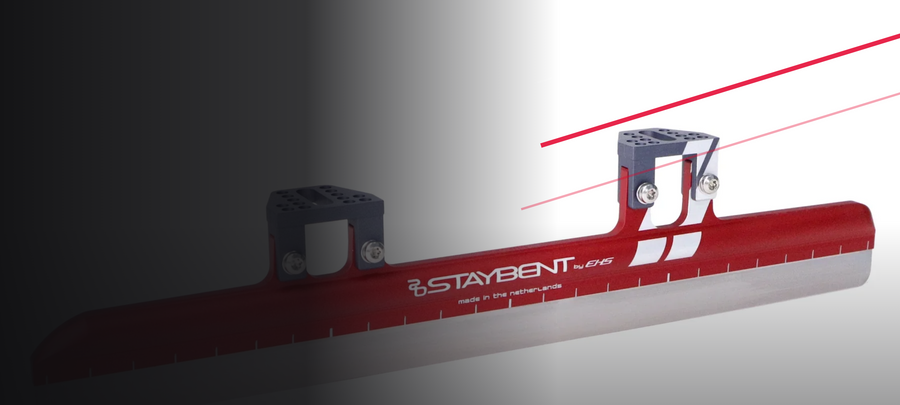
If you have decided to race short track on StayBent, you have already chosen well, and now comes the fun part. StayBent builds three blades that LiveLica stocks, the JaeBee, the QCS and the flagship XC Flex Weapon, and they are not simply cheaper and dearer versions of the same thing. Each one has a different personality on the ice. One is built for soft, intuitive feel through a corner. One is built for even, planted stability. One is a top level race weapon built for maximum grip and hold. This guide walks through how the three differ in flex, steel, lengths and price, so you can match the blade to the way you actually skate rather than to a spec sheet.
Everything below comes straight from the product listings for these three blades, so the flex descriptions, the steel hardness values, the length ranges and the prices are real figures rather than our guesses. Prices are the LiveLica listings at the time of writing and can move, so always check the product page before you order. If you would rather talk it through with a human, message the team with your boot size and your racing goals and we will point you at the right blade.
The short version, three blades at a glance
The StayBent JaeBee is the most flexible blade in the range. It uses very flexible lips, more flexible than the QCS, and a tapered tube that gives progressive flex, so the tips of the blade give more than the middle. It is built for skaters who read a corner and skate it with touch. The StayBent QCS carries the feel of the StayBent Q family, built on the same tube as the Quantum, but with even stiffness along the full length and a more cost effective steel, which keeps flagship money in your pocket while holding on to that Q family character. The StayBent XC Flex Weapon is the flagship, precision built in the Netherlands, engineered for extra grip through the corner and outright race performance. Think of them as feel, stability and flagship, in that order.
A simple side view of how give is spread along each tube. The JaeBee lets the tips move most, the QCS stays even end to end, and the XC Flex Weapon runs a stiff, precise platform.
StayBent JaeBee, the blade for feel and flow
The JaeBee is the softest, most forgiving blade in the StayBent short track range, and that is the whole point of it. It takes its inspiration from the Maple Gold, and the design is about flow and finesse rather than raw stiffness. The lips, which are the parts that hold the tube to the cups, are highly flexible, even more flexible than the QCS. More flex there lets the skate move freely with your push, so the blade follows your foot through the stride instead of fighting it. Many technical skaters describe that as a more connected, more intuitive feel on the ice.
What really sets the JaeBee apart is the tube. The top of the tube tapers down from the centre toward each end, which creates a progressive flex pattern along the length of the blade. In plain terms, the tips have more give than the middle. That gives you a varied, responsive feel depending on how and where you load the blade, so it stays smooth through technical corners and rewards creative race moments with soft, controlled transitions and good grip. If you are the sort of skater who likes to change lines, attack a corner with touch and keep the skate moving under you, this is the blade that speaks your language. If you prefer a firmer, more direct platform, one of the stiffer StayBent blades will suit you better.
One practical point that often decides the matter for younger and smaller skaters. The JaeBee is the only blade of the three that is stocked in a 14.5, and it is the only one that covers the whole run from 14.5 through to 18 in half steps. If your boot needs a short blade, the JaeBee is very likely your answer by default.
JaeBee at a glance
- Most flexible blade in the StayBent range, built for feel and flow
- Very flexible lips, more flexible than the QCS
- Tapered tube for progressive flex, tips softer than the middle
- Eight lengths in half steps, 14.5, 15, 15.5, 16, 16.5, 17, 17.5 and 18
- Offered in bimetal at 62 HRC or full PM at 64 HRC
- Listed at 70,000 rupees
You can see the full spec and choose your length on the StayBent JaeBee product page.
StayBent QCS, Q family feel without flagship money
The QCS answers a very common question, which is how to get the smooth, flexible skating that the StayBent Q family is loved for without paying flagship prices. It is built on the same tube as the Quantum, so it delivers the natural flex, grip and flow that make the Q family so popular. A thin pillar design keeps the skate light and responsive, while even stiffness along the full length of the tube gives you stability through every push. Where the JaeBee wants to move and flow, the QCS wants to stay planted and predictable, which many developing racers find easier to trust while they are still building their technique.
The clever part is how StayBent held the price down. The QCS uses the same hardness levels as the top options, full PM at 64 HRC and bimetal at 62 HRC, but the blade is built with a more cost effective material. You still get solid, Q level performance, just without investing in top tier steel. It comes in seven lengths, 15, 15.5, 16, 16.5, 17, 17.5 and 18, so there is room to match it to your boot as you grow into the sport.
Worth being blunt about one thing, because skaters regularly assume otherwise. At LiveLica the QCS and the JaeBee are both listed at 70,000 rupees. The saving on the QCS sits against StayBent's flagship Q family blades, not against the JaeBee. So when you are choosing between those two, choose on feel and on the length you need, not on budget.
QCS at a glance
- Same tube as the Quantum, true Q family feel
- Thin pillar design for a light, responsive blade
- Even full length stiffness for stability through the push
- Full PM at 64 HRC or bimetal at 62 HRC on a more cost effective material
- Seven lengths in half steps, 15 through to 18
- Listed at 70,000 rupees, the same as the JaeBee
The full detail and length options live on the StayBent QCS product page.
StayBent XC Flex Weapon, the flagship race blade
The XC Flex Weapon is one of StayBent's flagship blades, engineered for skaters chasing the ultimate in speed, control and cornering hold. It is precision built in the Netherlands, from start to finish, by the craftsmen at Hagen Techniek, and it is designed to give extra grip through the corner while keeping the smooth glide and turning feel that elite short track racers demand. The headline technology is Precise Bend Technology, StayBent's own process for highly accurate, smooth and repeatable bend radiuses, so the blade behaves consistently through every corner rather than surprising you mid turn.
The build reads like a flagship should. It uses premium Dutch aluminium chosen for stiffness and durability, hand selected steel runners in premium bimetal or full PM for a fast, long lasting edge, and lightweight, higher strength aluminium cups that add stiffness while cutting weight, available in multiple heights. It comes in seven lengths, 16.5, 16.75, 17.0, 17.25, 17.5, 17.75 and 18.0. Notice what those numbers mean in practice. The XC Flex Weapon is the only blade of the three offered in quarter steps, so a committed racer can dial in a length that sits exactly between the half sizes, but it is also the only one that does not go below 16.5. Smaller footed skaters simply cannot buy the flagship, and that is worth knowing before you set your heart on it.
XC Flex Weapon at a glance
- Flagship StayBent short track blade, precision built in the Netherlands
- Precise Bend Technology for accurate, repeatable bend radiuses
- Premium Dutch aluminium and lightweight aluminium cups in multiple heights
- Hand selected bimetal or full PM steel runners
- Seven lengths in quarter steps, 16.5 through to 18.0
- Listed at 100,000 rupees
See the flagship in full on the StayBent XC Flex Weapon product page.
Lengths and price side by side
Once you have a feel for the character of each blade, the practical shortlist is usually settled by two very unromantic things, what length your boot needs and what you are willing to spend. Here is where the three sit. The JaeBee covers eight lengths in half steps from 14.5 to 18 and is listed at 70,000 rupees. The QCS covers seven lengths in half steps from 15 to 18 and is also listed at 70,000 rupees. The XC Flex Weapon covers seven lengths in quarter steps from 16.5 to 18.0 and is listed at 100,000 rupees.
Read that as three practical rules. If you need anything shorter than a 15, the JaeBee is the only blade here that fits. If you need a length between 15 and 16, you are choosing between the JaeBee and the QCS at the same price, so it comes down purely to whether you want flow or stability. If you are at 16.5 or longer and you are chasing the last few percent of cornering grip, the flagship opens up, and the quarter steps let you tune the length far more finely than the other two allow.
The JaeBee is the only blade here that reaches 14.5, and the XC Flex Weapon is the only one offered in quarter steps, but it starts at 16.5.
Bimetal or full PM, choosing your steel
All three blades let you choose between two steels, and the choice is the same across the range, so it is worth understanding once. Bimetal at 62 HRC is a slightly softer running steel. It is easy to sharpen and forgiving day to day, which suits skaters who do their own edges or who are still learning to sharpen. Full PM at 64 HRC is a harder powder metallurgy steel that holds an edge longer between sharpenings, which pays off for skaters who train heavily and do not want to touch up their edges as often. Neither is better in the abstract. The right pick depends on how hard you skate and how often you are willing to sharpen.
Bimetal is the friendlier steel to sharpen, while full PM holds its edge longer for skaters who train most days.
Which StayBent blade is right for you
Start with how you like a corner to feel. If you love touch, flow and reading your lines, and you want a blade that moves with you, the JaeBee is the natural home. If you want that trusted Q family feel with even, planted stability under a technique you are still sharpening, the QCS is the one, and at the same price as the JaeBee it is a straight choice of character. If you are a committed racer with settled technique who wants the sharpest cornering grip, quarter step length tuning and flagship build quality, the XC Flex Weapon is the tool for the job. None of these is a beginner special. They are all real race blades, so a skater who is brand new to the sport may want to start on something firmer and more forgiving first, then step up. You can see all three together in the StayBent Blades collection.
A rough map of the range. The JaeBee and the QCS sit at the same price and differ in feel, while the XC Flex Weapon sits at the flagship, grip focused end.
Getting your length and setup right
Whichever blade you choose, length matters. As a general guide, shorter blades feel quicker and more agile, while longer blades track straighter and carry more speed on the straights. Match the length to your boot size and your racing style, and if you are unsure, send the team your boot size and we will help you choose. Remember that the blade is only half of a setup. You still need cups to mount it, and you will want to keep your edges consistent, so it is worth reading our guides on setting up and sharpening as you go. You can browse blades, cups, boots and tools together in the short track setup collection, and if you are still deciding on your first race blade at all, our short track blade buyer's guide covers the basics before you commit.
Frequently asked questions
What is the main difference between the JaeBee and the QCS?
The JaeBee has more flexible lips and a tapered tube for progressive flex, so it feels softer and more forgiving through a corner. The QCS has even stiffness along the full length for stability. Since both are listed at the same price, treat this as a choice of character rather than a choice of budget.
Do the JaeBee and the QCS really cost the same?
Yes. Both are listed at 70,000 rupees at LiveLica. The cost saving StayBent talks about on the QCS is against their flagship Q family blades, which use top tier steel, not against the JaeBee.
Is the XC Flex Weapon worth the step up?
If you are a committed racer with a settled technique who wants the sharpest cornering grip and a flagship build, yes. It is precision built in the Netherlands with Precise Bend Technology, premium Dutch aluminium and lightweight cups, and it is the only one of the three offered in quarter step lengths. It is listed at 100,000 rupees. If you are still developing, the QCS gives you Q family feel for a good deal less.
Which steel should I pick across these blades?
Bimetal at 62 HRC is easier to sharpen and forgiving, which suits skaters who sharpen their own blades or train lighter. Full PM at 64 HRC holds an edge longer, which suits skaters who train most days and want fewer sharpenings. The flex profile stays the same either way, so this choice is only about the edge.
I need a short blade. Which one should I look at?
The JaeBee. It is the only one of the three stocked in a 14.5, and the only one that covers everything from 14.5 upward. The QCS starts at 15 and the XC Flex Weapon starts at 16.5.
Are any of these good blades for a beginner?
They are all high level race blades built for skaters who already have a settled technique. A newer skater can absolutely skate them, but many start on a firmer, more forgiving blade first and step up once their technique is settled.