Bearings get all the conversation. Walk into any rink or track and you will hear skaters comparing ceramics, arguing about ABEC ratings and swapping opinions on oil. Meanwhile the four things actually touching the ground, the only parts of your setup that convert your effort into forward motion, are usually chosen because they were the ones in stock.
Wheels are the single biggest performance variable on an inline speed skate. They decide how much grip you get in a corner, how much rolling resistance you fight on the straight, how the skate feels over rough tarmac, and how many kilometres you get before you are shopping again. Get them right and everything else in your setup works better. Get them wrong and the best bearings in the world will not save you.
This is a full guide to choosing wheels: what the numbers mean, what actually changes when you move between them, and how the JUNK and MPC ranges we stock compare in practice.
Wheel size: what 90mm, 100mm and 110mm really change
Wheel diameter is the first decision, and it is more consequential than most skaters realise. Bigger is not simply better.
The case for large wheels
A larger wheel covers more ground per revolution. It also rolls over surface imperfections more easily, because the wheel meets a bump at a shallower angle. On a smooth track or a good road, a 110mm wheel carries speed beautifully and holds it with less effort once you are up to pace.
The costs are real though. Large wheels raise your ride height, which raises your centre of gravity and makes the skate feel less stable and less immediately responsive. They are heavier, so they take more work to accelerate and more work to swing through each stride. And they demand a frame that actually accommodates them.
A larger wheel meets the same bump at a shallower angle, so it rolls over rough tarmac more easily, but the axle sits higher and the skate feels less planted.
The case for smaller wheels
A 90mm or 100mm wheel accelerates faster, sits lower, and gives you a more connected, more controllable feel. On a tight indoor track with constant corners and constant acceleration out of them, this matters enormously. Many skaters who chase 110mm because it is what the top marathon skaters use end up slower on a technical track than they would be on 100mm.
Choosing honestly
Ask what you actually skate, not what you aspire to skate. Long, smooth, open road and marathon distances point to 110mm. Tight indoor tracks, technical banked circuits and lots of accelerating out of corners point to 100mm or 90mm. Rough road surfaces, where you are dealing with real world tarmac rather than a swept track, tend to reward the larger diameter simply because it survives the bumps better.
Your frame decides the ceiling. Check the maximum diameter your frame is rated for before you buy anything. This is not negotiable and it catches people out constantly.
Durometer: the firmness question
Durometer measures how hard the urethane is, on the A scale. The trade off it controls is the oldest one in skating: grip versus roll.
The basic physics
Softer urethane deforms more where it meets the ground. That deformation is grip, and it is also energy lost as heat. Firmer urethane deforms less, so it rolls with lower resistance and lasts longer, but it gives you less mechanical grip and transmits more vibration to your feet.
There is no universally correct answer. There is only the correct answer for your surface, your weight and your skating.
XFirm versus XXFirm in practice
Most of the race wheels we stock come in two firmness options. For the JUNK range, XFirm is rated 84 to 86A and XXFirm is rated 86 to 88A. Those two points of overlap are why skaters describe the difference as a shade rather than a step: XFirm holds a little more, XXFirm rolls a little further.
Choose XFirm when you want more grip, when the surface is slick or dusty, when the track is cool, when you are a lighter skater who does not load the wheel much, or when you are still developing your corner technique and want the wheel to help you rather than punish you.
Choose XXFirm when the surface has good natural grip, when the temperature is high (heat softens urethane, so a warm day effectively makes every wheel softer than its rating suggests), when you are a heavier or more powerful skater who can overwhelm a softer wheel, or when you want maximum roll and maximum life and you have the technique to manage the reduced grip.
XFirm and XXFirm overlap at 86A, so the difference is a shade of feel rather than a jump. Hot tarmac effectively softens whatever you fit.
Temperature matters more than the internet admits
This deserves its own mention for Indian conditions. Urethane firmness is temperature sensitive. A wheel that feels perfect in an early morning winter session can feel greasy and vague on hot afternoon tarmac in May or June. Skaters who race across seasons often keep two sets and swap them, and that is not overkill, it is just paying attention. September, with the monsoon easing and the heat still hanging around, is a good time to notice how your current set behaves before the cooler racing months arrive.
The JUNK range at LiveLica
We carry several JUNK options and they are aimed at different skaters.
Road Reaper 110
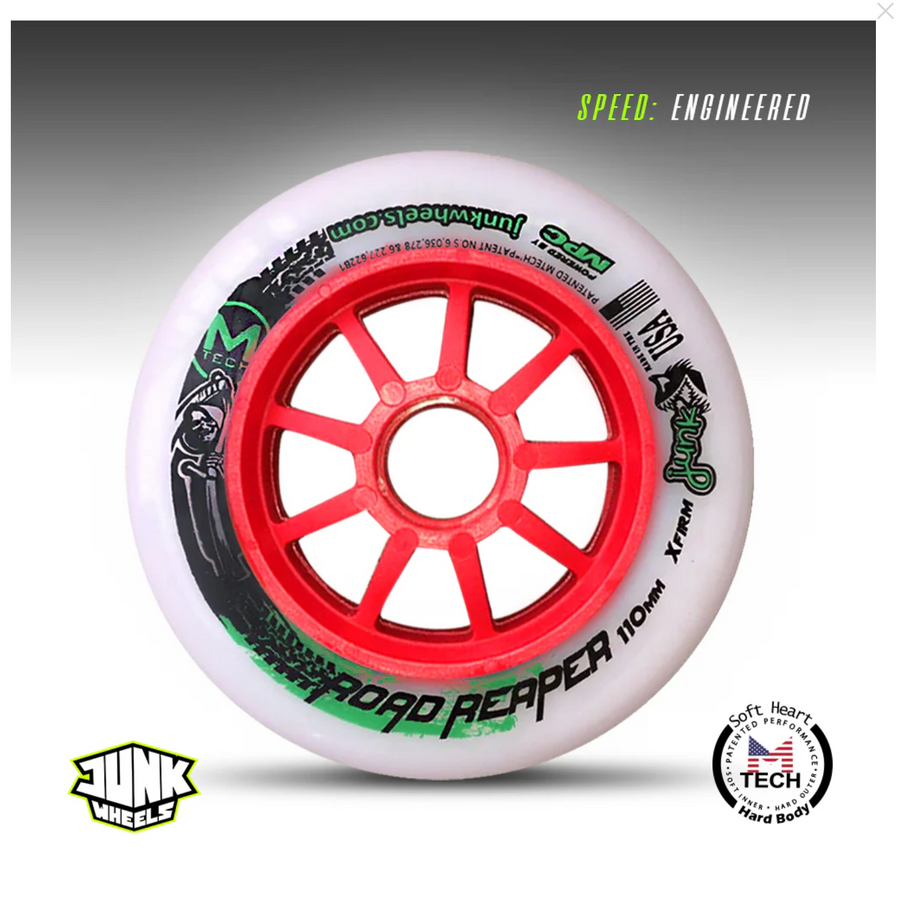
The JUNK Road Reaper 110 XFirm is one of the most decorated wheels in the sport. At the 2019 World Championships it won the Senior and Junior men's 100 metres, and Ioseba Fernandez set the 100m world record on Road Reapers at the 2018 World Championships. It is just as proven at distance, with Ken Kuwada taking the American Triple Crown on them. It is a 110mm road wheel, sold as a set of eight, built for skaters going long and going fast on hard, smooth, dry surfaces.
The Road Reaper 110 XXFirm is the same wheel in the firmer 86 to 88A compound. Same intent, less grip, more roll, longer life. If you are a powerful skater on a grippy road, this is your version.
Voodoo
The JUNK Voodoo XFirm takes a different approach: no pigment in the hub or the urethane at all. That is a deliberate choice in pursuit of raw performance, because pigment is an additive in urethane and leaving it out means the compound is exactly what the chemist intended and nothing else. JUNK also moulds each Voodoo in a one cavity tool rather than the usual four cavity approach, which tightens consistency from wheel to wheel. The Voodoo comes in 90mm, 100mm and 110mm, which makes it the most flexible option we carry for skaters who are not certain what size they want to settle on. There is a Voodoo XXFirm in the same three sizes for the firmer end of the range too.
Killer JUNK 110
The Killer JUNK 110 XFirm completes the JUNK line up at LiveLica. It is a 110mm wheel sold as a set of eight, available in XFirm and XXFirm, and it suits road and marathon skaters who want a second Road Reaper alternative to compare feel against.
The MPC range
The MPC Black Magic XFirm occupies a particular place in the sport. Black Magic broke the 300m world record at the 2013 World Championships in Oostende, going under 24 seconds for the first time, and at the 2018 World Championships in Heerde it won more podium places than all other wheel brands combined. The build is MPC's patented MTech design, described as Soft Heart, Hard Body: a softer inner ring sits inside a harder outer layer of urethane, so the wheel flexes for grip while the outer body keeps it rolling fast, all on a stiffer Black Turbo hub. It comes in 90mm, 100mm and 110mm, so it covers indoor and road applications, and there is a Black Magic XXFirm in the same sizes for skaters wanting the firmer compound.
The honest comparison between JUNK and MPC is not that one brand is faster than the other. Both make wheels that world class skaters win on. The difference is feel, and feel is personal. Skaters who have used both tend to have a preference they hold strongly and cannot fully articulate, which is exactly what you would expect from a subjective quality. If you have a chance to try a friend's set before committing, take it.
You can browse the full JUNK Wheels collection to compare what is in stock. Every set we sell is eight wheels, a full set for a pair of four wheel frames, and wheels are sold without bearings, so budget for sixteen 608 bearings and spacers if you are not reusing yours.
Rotation: the free speed most skaters ignore
Wheels do not wear evenly. They never have. Your inside edges take more punishment than your outside edges because that is where you push, and the wheels under your heel and toe wear differently from the ones in the middle because of how you load the skate.
Left alone, this produces a coned wheel with a sharp inside edge and a flat outside, and a coned wheel gives you inconsistent grip and a vague, unpredictable feel in the corner. Worse, it wastes urethane you paid for.
How to rotate
The standard approach is to swap each wheel to a different position and flip it so the worn side faces out. Which specific pattern you use matters less than doing it regularly and consistently. Set a schedule based on your training volume and stick to it. Every couple of weeks for a skater training seriously is a reasonable starting point.
Check as you go
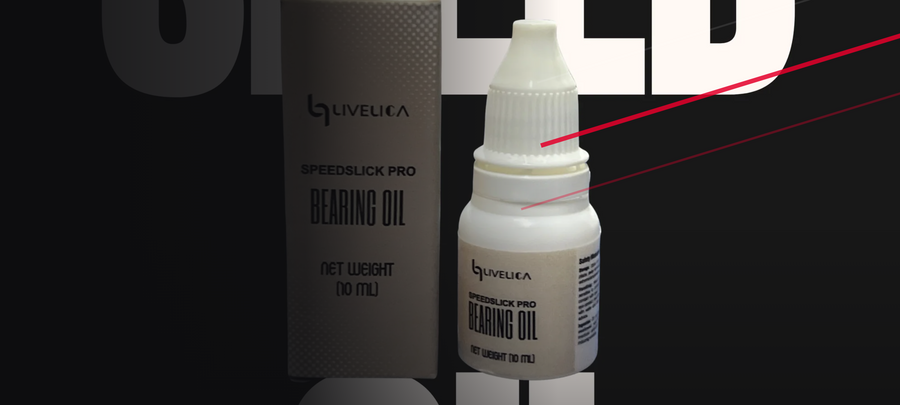
Rotation is also your inspection window. With the wheels off, look at the urethane for chunking or tearing, check the hubs for cracks, and spin each bearing to feel for grit. This is the natural moment to clean and re oil, and a drop of Speedslick Pro bearing oil at rotation time keeps the whole system honest. There is no point running excellent wheels on bearings full of road dust.
Getting more life out of a set
Wheels are a consumable. You cannot change that, but you can change how fast you burn through them.
Rotate on schedule, because it is the single biggest factor. Keep them clean, because grit embedded in urethane grinds it away. Store them somewhere cool and out of direct sun, because urethane ages and UV exposure does not help. Match the compound to your surface, because a wheel that is too soft for the conditions will disappear in front of your eyes. And skate with clean technique, because a skater who scrubs speed in every corner is turning urethane into heat and noise instead of forward motion.
Frequently asked questions
Should I go straight to 110mm wheels?
Only if your frame takes them and your skating suits them. Bigger wheels raise your ride height and slow your acceleration. If you skate a technical track with constant corners, 100mm may be faster for you. Match the wheel to the skating, not to the aspiration.
XFirm or XXFirm for a first proper set?
For most skaters, XFirm is the safer starting point. It gives you more grip while you are refining your corners, and it is more forgiving on cool or slick surfaces. Move to XXFirm when you know you want the extra roll and life and you can manage the reduced grip.
Can I mix wheel sizes on one frame?
Some frames are designed for it and some skaters use a hi lo setup deliberately. Do not improvise this. Check what your frame is designed to take.
How often should I rotate?
By condition rather than by calendar, but if you want a rule of thumb, every couple of weeks for a skater training several times a week. If you can feel a sharp lip on the inside edge with your thumb, you have left it too long.
How long should a set of wheels last?
Wildly variable. Surface roughness, your weight, your technique, the compound, the temperature and whether you rotate all change the answer by a large factor. Rough tarmac chews wheels far faster than a smooth track. Judge by wear, not by months.
Why do pigment free wheels like the Voodoo matter?
Pigment is an additive in the urethane. Leaving it out means the compound is closer to the pure formulation. Whether you can feel that difference is a question only you can answer on your own feet, but the reasoning behind it is sound.
The short version
Pick your diameter based on the surface and the type of skating you actually do, not on what you saw a marathon winner using. Pick your durometer based on your surface, your weight and the temperature you skate in. Rotate religiously. Keep the bearings clean while you are in there. Then go skate, and let the wheels do the job you chose them for.
Not sure which set suits your frame, your track or your weight? Message us. We skate too, and we would rather talk you into the right wheel than sell you the expensive one.