Ask most inline speed skaters what makes a fast wheel and they will talk about the urethane. Hardness, grip, roll, the compound printed on the side. All of that matters, but it is only half the wheel. Hidden inside every race wheel is a hub, also called the core, and it does a huge amount of the work that decides how the wheel feels, how it returns energy and how long it lasts. Two wheels with the same urethane and the same size can skate very differently because their hubs are built differently.
This guide opens the wheel up and explains the part you cannot see. You will learn what the hub actually does, how the leading race wheels we stock build their hubs, and how to read a hub so your next set of wheels suits the way you skate. Everything here is drawn from the wheels in our range, so the examples match what you can actually buy and ride.
What a race wheel is really made of
A speed wheel is two parts bonded into one. On the outside is the urethane, the tyre that touches the road and provides grip and roll. On the inside is the hub, a rigid core that holds the two bearing seats and gives the urethane something solid to be moulded around. When you push, your force travels through the axle, into the bearings, into the hub, and only then into the urethane that grips the ground. The hub is the backbone in that chain. If it flexes when it should stay firm, or stays dead when the wheel wants to rebound, the urethane cannot do its job properly.
The urethane grips the road, but the hub in the centre carries your force from the bearings out to the tyre.
What the hub actually does
The hub has three main jobs. First, it locates the bearings. The two bearing seats in the hub must hold your 608 bearings square and true so the wheel spins without wobble. Second, it supports the urethane. The hub sets how much urethane sits between the core and the road, and it anchors that urethane so it does not peel or distort under hard cornering loads. Third, and most interesting for feel, the hub controls stiffness. A stiff hub keeps the wheel firm and direct so your push turns into forward roll with little loss. A softer or more flexible core lets the wheel move a little, which can add grip and a more forgiving ride but bleeds off a touch of efficiency.
Because the hub decides stiffness, it decides a lot of what you feel through your feet. This is why brands invest so heavily in hub design and give their cores names, and why the same urethane on a different hub is effectively a different wheel.
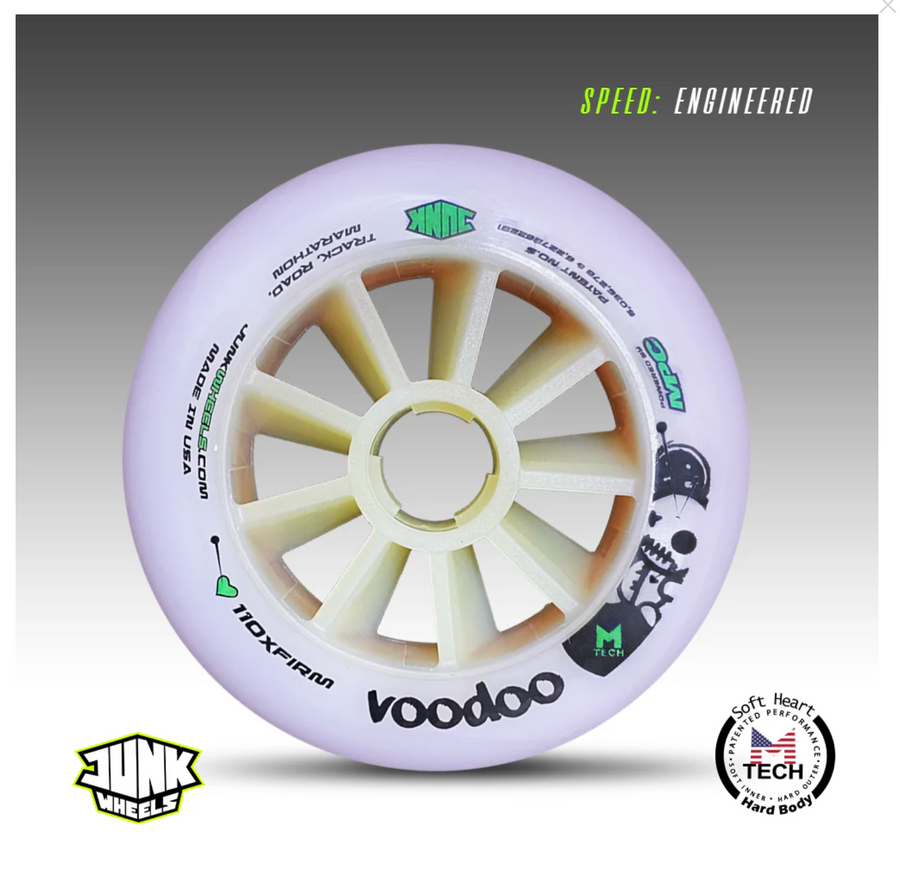
The pigment free natural hub, as on the JUNK Voodoo
The JUNK Voodoo is a clear example of hub thinking taken to an extreme. It runs a natural turbo hub that has been re engineered for efficiency, and the whole wheel is built with no pigment in either the hub or the urethane. JUNK leave the pigment out so that nothing is added that could compromise the natural qualities of the materials. In plain terms, colour dye is filler, and filler can change how a material behaves, so a pigment free hub and tyre keep the roll, grip and durability of the raw materials intact.
JUNK also mould each Voodoo using a one cavity tool rather than the usual four cavity approach. A one cavity mould makes one wheel at a time, which gives tighter quality control and more consistency from wheel to wheel. On a set of eight that consistency matters, because a wheel that is a fraction off from its neighbours is a wheel you feel at race pace. The same natural hub thinking sits behind the wider JUNK line, including the decorated JUNK Road Reaper 110 and the Killer JUNK 110.
The Black Turbo hub and MTech Soft Heart, Hard Body
The MPC Black Magic takes a different route to the same goal, and it is the best example of how the core changes a wheel. Black Magic uses MPC's patented MTech technology, known as Soft Heart, Hard Body. A softer inner ring is sandwiched inside a harder outer layer of MPC's Magic urethane. The soft heart flexes to find grip, while the hard body keeps the wheel rolling fast and lasting long. That is a clever answer to the oldest trade off in wheels, which is that grip usually costs you roll and roll usually costs you grip.
Underneath that construction sits a stiffer Black Turbo hub, which adds to the roll and the response. So the Black Magic layers a soft grippy heart, a hard fast body and a stiff core, each doing a different part of the job. That layered thinking is a large part of why Black Magic has such a record at the top of the sport, and it shows how much of a wheel's character lives below the surface of the urethane.
Each layer does one job, so the wheel can grip and roll at once instead of trading one for the other.
How hub stiffness changes what you feel
Think of the hub as the suspension of the wheel. A stiffer hub returns your energy quickly and directly, so the wheel feels lively and responsive and very little of your push is lost inside the wheel. This is what you want for sprinting and for holding pace on smooth, hard surfaces. A softer or more flexible core absorbs a little more, which can feel planted and forgiving and can add grip on a tricky surface, but that same absorption costs a small slice of roll efficiency. Neither is right or wrong. The best hub for you depends on your power, your surface and your event.
A stiffer hub sends more of your push straight into roll, a softer core trades a little roll for extra grip and comfort.
Hub size, spokes and where the urethane sits
Hubs also differ in diameter and in how much urethane wraps around them. A larger hub leaves a thinner ring of urethane, which tends to feel firmer and more direct and can roll well because there is less urethane to deform. A smaller hub leaves a thicker ring of urethane, which gives more cushioning and can add grip and comfort. On big race diameters such as 110mm, brands balance hub size carefully so the wheel stays fast without becoming harsh. The spoke pattern that joins the centre to the outer ring is part of the same balance, adding stiffness where the core needs it while keeping the wheel light.
Why consistency matters as much as the design
A brilliant hub design only helps if every wheel in the set is built the same. This is where a manufacturing choice like JUNK's one cavity moulding pays off, because building one wheel at a time keeps each core and each bond tightly consistent. When all eight wheels behave alike, your skate feels even, predictable and calm at speed. When they do not, you get subtle differences in roll and grip that show up exactly when you are pushing hardest. So when you judge a wheel, judge the promise of consistency as well as the headline hub technology.
Matching the hub to your skating
If you are a powerful sprinter on smooth, hard surfaces, lean toward stiff hubs and firmer overall builds that return your energy quickly, and pair them with a firm compound such as XFirm. If you skate longer road and marathon distances, a wheel that blends a responsive core with a little give, like the layered Black Magic, can keep you comfortable and gripped over the miles without giving up much roll. If your surfaces vary, the pigment free consistency of the JUNK line gives you a dependable baseline you can trust from wheel to wheel. Whatever you choose, remember the hub is the half of the wheel you cannot see but can absolutely feel.
A quick setup note
Race wheels are sold as a set of eight and the wheels come on their own, so you will also need sixteen 608 bearings and the correct spacers to run them. You can add those from our speed bearings collection, and you can browse the full wheel range in the JUNK wheels collection. Always confirm the wheel diameter your frame is built for before ordering, and message us if you are unsure.
Frequently asked questions
What is the hub or core of a skate wheel?
It is the rigid inner part of the wheel that holds the two bearings and supports the urethane. It carries your force from the bearings out to the road and sets how stiff or forgiving the wheel feels.
Does a stiffer hub make me faster?
A stiffer hub returns more of your push as forward roll, which helps on smooth, hard surfaces and for sprinting. A softer core trades a little roll for grip and comfort, so faster depends on your power, your surface and your event.
What is MTech Soft Heart, Hard Body?
It is MPC's patented build with a soft inner ring inside a harder outer urethane on a stiff Black Turbo hub. The soft heart flexes for grip while the hard body keeps the wheel rolling fast and lasting long.
Why does JUNK leave pigment out of the Voodoo?
Colour dye is effectively a filler that can change how the material behaves. By leaving pigment out of both the hub and the urethane, JUNK keep the natural roll, grip and durability of the raw materials.
Want help choosing between a stiff, direct wheel and a more layered, forgiving one? Browse the wheels collection and tell us your surface and event, and we will point you to the right hub for the way you skate.