Ask ten short track skaters how often they sharpen and you will get ten different answers. Some go to the stones before every session because it has become a ritual. Some skate for weeks on the same edge and wonder why they keep sliding out of the corner. Both habits cost you something. One eats your blades, the other eats your confidence. The honest answer is that there is no universal number of sessions, because sharpening frequency depends on how much ice time you get, what steel you run, how the rink treats your edges and how sensitive your technique is to a fresh edge.
This guide gives you a practical way to decide. Not a rule pulled out of the air, but a starting schedule you can adjust, a list of signals your blades give you before an edge goes bad, and a clear explanation of why sharpening too often is just as damaging as sharpening too little. If you already know the mechanics of putting an edge on, this is the piece that tells you when to actually do it.
The short answer, and why a fixed number does not work
For most club level short track skaters training two to four times a week, a sharpen every eight to twelve hours of ice is a sensible starting point. That usually lands somewhere between once a fortnight and once a month. Treat that as a first guess, not a law. A skater doing six sessions a week on hard, well maintained ice with a hard steel blade may go longer. A skater on a busy public rink with soft ice, debris and rubber matting between the changing room and the gate may need the stones far sooner.
The reason a fixed number fails is that an edge does not wear by the calendar. It wears by contact. Every push, every corner and every hard set down loads a very small strip of steel. Add rink grit, the occasional touch on a barrier or a marker, and a walk across a floor that is not properly matted, and the wear rate changes completely from rink to rink.
What actually takes an edge away
Ice hours under load
The single biggest factor is time on ice with real force going through the blade. Two hours of hard corner work will dull an edge more than two hours of easy laps. If you have just come off a heavy block of corner drills or a race weekend, count that ice time as heavier than normal training.
Ice hardness and temperature
Cold, hard ice is abrasive and takes the fine tip of the edge down steadily. Soft ice is gentler on the steel but far less forgiving of a dull edge, because you rely more on bite to hold a line. So hard ice wears the edge faster, and soft ice makes you notice a worn edge sooner. Either way you end up back at the stones.
Grit, dust and everything that is not ice
Rink dust, resurfacer debris and small particles frozen into the surface all take tiny bites out of your edge. So does any contact with concrete, tile or an unmatted floor. One careless step off the mats can do more damage in a second than an entire session on clean ice.
Rust, even the invisible kind
Moisture left on steel does not need to become visible orange rust to be a problem. A faint bloom of surface oxidation dulls the very tip of the edge and makes the first few laps feel vague. Wiping your blades dry the moment you step off, then storing them in soakers, protects far more edge life than most skaters expect.
Edge quality falls away steadily with loaded ice time. A harder steel sits higher on the same graph, so the same skater reaches the sharpening band later.
Steel hardness changes the interval
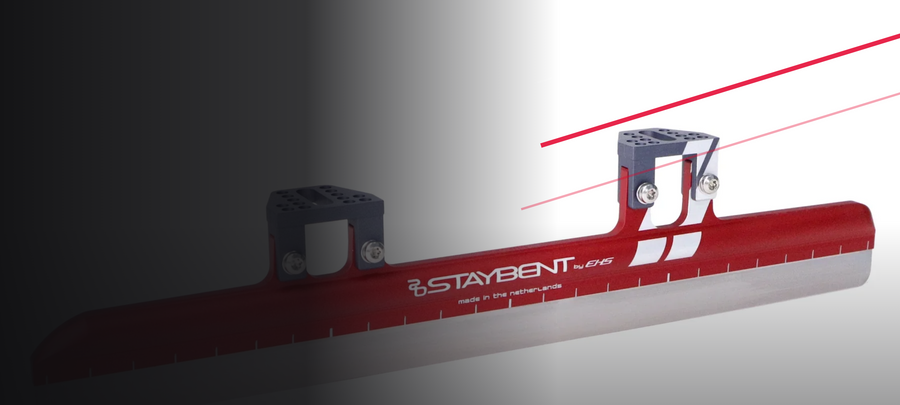
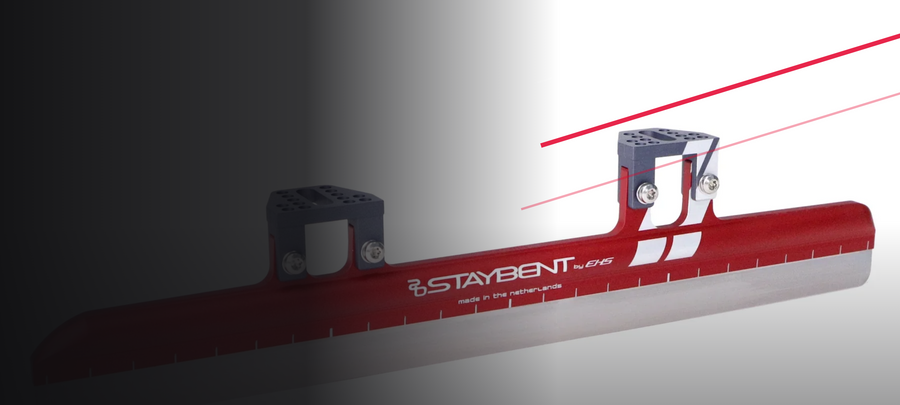
Blade steel is not all the same, and it is one of the few variables you can actually choose. The StayBent JaeBee is offered in two steels, and the difference tells you a lot about sharpening rhythm. The bimetal version runs at 62 HRC, a slightly softer steel that is easy to bring back on the stones and forgiving day to day. The full PM version runs at 64 HRC, a harder powder metallurgy steel that holds its edge longer between sharpenings.
What that means in practice is simple. If you train most days, a harder steel reduces how often you have to sit down with a jig, which is worth a great deal when your week is already full. If you skate a few times a week and enjoy maintaining your own kit, the softer bimetal comes back to a keen edge quickly and asks less of your stones. Neither is better. They just sit at different points on the same curve.
A starting schedule you can adjust
Two sessions a week, recreational or early club
Around once every three to four weeks is usually enough, or sooner if you feel the corner start to wash out. At this volume the bigger risks are rust and careless storage rather than genuine edge wear, so drying and soakers matter more than the stones.
Three to five sessions a week, competitive club skater
Roughly every two weeks, and always in the days before a competition rather than the night before. A fresh edge feels different underfoot, and you want at least one session to settle into it before you race on it.
Six or more sessions a week, serious training block
Weekly is common at this volume, and a harder steel earns its keep. Skaters at this level tend to move to a feel based schedule rather than a fixed one, because they get enough ice to read very small changes in grip.
The signals your blades give you before an edge fails
The best skaters do not sharpen on a schedule at all. They sharpen when the blade tells them to. These are the signals worth learning to read.
- The corner starts to wash out. You set the same lean you always set and the blade slides a fraction wider than it should.
- The set down feels vague. Instead of the blade biting and locking, there is a moment of uncertainty before it grips.
- You catch your fingernail differently. Draw a nail gently across the edge at several points along the blade. A fresh edge catches crisply and evenly. A dull edge lets the nail skate across.
- The edge looks shiny at the very tip. A worn edge reflects light along its corner. A fresh one shows almost no reflection there because a true corner has nothing to reflect from.
- You feel it in one blade and not the other. Uneven wear between left and right, or between the front and back of one blade, is a strong sign that it is time.
A fresh edge has true corners. A worn edge rounds off and washes wide. A burr is a curl of steel left after sharpening, and it can fool you into thinking a blade is ready when it is not.
Why sharpening too often is its own mistake
Every pass on a stone removes steel, and steel is finite. A blade has a working life measured in how much material sits above the point where the profile can no longer be maintained. Sharpen out of habit rather than need and you spend that material for nothing. Over a couple of seasons the difference between a skater who sharpens when the edge asks and one who sharpens every week regardless is easily visible in the amount of blade left.
There is a second cost. Frequent heavy sharpening makes it harder to keep your rocker and bend consistent, because every session on the stones is another chance to introduce a small error. A blade that is touched up rarely but properly, in a jig that holds it dead straight, keeps its shape far better than one that is ground often and casually. That is exactly why a proper bench matters more than most skaters realise.
Sharpening on need rather than on habit stretches the working life of an expensive blade across seasons rather than months.
What a proper sharpening session needs
Frequency only helps if the sharpen itself is done well. The one piece of kit that changes results more than any other is the bench. The EHS short track and long track sharpening jig is CNC machined in the Netherlands, with precise mounting points that hold the blade perfectly straight while you work. That straightness is the whole point. A blade held with any twist sharpens to an uneven edge along its length, and an uneven edge behaves differently in the first half of a corner than in the second. The jig takes apart and reassembles in about five minutes using four central screw knobs, so it travels to competitions without a fuss.
On top of the bench you need a stone that cuts cleanly and a way to remove the burr. The Zandstra Foss combination sharpening stone covers the main work, and the StayBent diamond deburr stone takes off the curl of metal that a sharpen always leaves behind. Skipping the deburr step is one of the most common reasons a freshly sharpened blade feels grabby instead of clean.
One more thing, and it is not optional. Wear cut resistant gloves whenever you handle a sharp blade on a bench. A freshly stoned edge will open your hand without any effort at all, and it takes one moment of inattention.
The routine that stretches every sharpen
Most of the edge life you lose is lost off the ice, not on it. A two minute habit after every session buys you weeks.
- Step off the ice onto mats only. Never onto bare floor, even for a single stride.
- Wipe the blades completely dry with a cloth before they go anywhere near a bag.
- Put soft soakers on for storage and hard guards on for walking. They do different jobs and are not interchangeable.
- Loosen or remove soakers at home so moisture is not trapped against the steel overnight.
- Check the mounting bolts every few sessions. A blade that moves under load wears unevenly and feels like a dull edge even when it is not.
Everything you need for that routine sits in the short track setup collection, and building the habit costs nothing but a little discipline at the end of a tired session.
Frequently asked questions
Should I sharpen before a competition?
Yes, but not the night before. Sharpen a few days out and skate at least one session on the new edge so it feels normal by the time you are on the start line. Racing on an edge you have never felt is an avoidable surprise.
Can I tell if a blade needs sharpening just by looking?
Partly. A worn edge catches the light along its corner because it has rounded off, while a true edge shows almost nothing there. Combine the look with a gentle fingernail check along the length of the blade and you will get a reliable answer.
Does a harder steel mean I can skip maintenance?
No. Harder steel holds an edge longer, but it still rusts, still picks up damage from debris and still needs deburring after a sharpen. Drying and storage matter just as much on 64 HRC steel as on 62 HRC steel.
My blades feel dull straight after sharpening. What went wrong?
Almost always a burr that was never removed, or a blade that was not clamped straight. Take the burr off properly with a deburr stone and check that the blade sat true in the jig before you blame the edge itself.
How many times can a blade be sharpened?
That depends on how much material each sharpen removes and how much steel the blade started with. Light, well controlled sharpening on a proper bench gives you many more sessions than heavy grinding, which is the practical argument for sharpening on need rather than on habit.
Where to land
Start at eight to twelve hours of ice between sharpenings, then let your own feedback move that number. Learn the fingernail check and the look of a rounded corner, because those two habits will eventually replace the calendar entirely. Protect the edge you already have with mats, a cloth and soakers, and sharpen properly in a jig when the blade genuinely asks for it. Do that and your edges will be sharp when it matters, and your blades will still have plenty of steel left in them two seasons from now.