Ask most short track skaters where races are won and they will point at the corners. That is fair, since the corner is where the lean, the crossovers and the passes happen. But watch a heat closely and you will notice something else. The skater who gets out of the corner cleanly and then skates the straight with a long, patient push is the one who arrives at the next corner with the best line and the least effort. The straight is where speed is built, and it is also where most club skaters quietly leak it. This guide is about that part of the lap: the straightaway push, the recovery, the rhythm, and the way your blades and boots either help or hinder you.
We have already covered the basic position, cornering and starts in earlier posts. Here we stay on the straight, from the moment your outside foot exits the corner to the moment you set up for the next entry.
Why the straight matters more than it looks
A short track lap is 111.12 metres, and roughly half of that distance is corner. On paper the two straights are short, so it is tempting to treat them as a place to breathe before the next turn. That is a mistake. The straight is the only part of the lap where you are free to choose your line, your stroke length and your tempo without the ice geometry deciding it for you. A skater who pushes sideways, fully, and then rests for a moment on a gliding blade will carry more speed into the corner than one who takes three quick, shallow strokes and arrives tense.
The straight is also where technique errors show up most clearly. Bobbing shoulders, a push that goes backwards instead of sideways, a recovery leg that swings wide, and a skate that lands flat on the ice and then has to be rolled onto an edge are all visible on the straight in a way they are hidden in the chaos of the corner. Fix them here and they tend to improve everywhere.
The physics of a sideways push
A skate blade is a long, narrow edge. It grips the ice sideways and slides freely lengthwise. That single fact decides everything about how you push. If you push straight backwards, the blade simply slides backwards along its own length and very little force goes into the ice. If you push out to the side, the edge bites, the ice resists, and that resistance is what propels you forward.
The push therefore has to be directed roughly perpendicular to the blade, out to the side and slightly back, while the blade itself points more or less down the straight. Think of it as pushing the ice away from you rather than pushing yourself forward. The forward motion is a result of the sideways force acting through a blade that is angled slightly toward the direction of travel.
A blade slides freely along its length and grips across its width, so a sideways push is the only one the ice can answer.
The four phases of a straightaway stroke
It helps to break the stroke into phases, because most technique faults live in one phase and can be fixed in isolation. The names vary between coaches, but the shape is always the same.
Set down
The stroke begins when the skate is placed on the ice close under the body, roughly beneath the hip, not out to the side. The blade should land on a slight outside edge or flat, with the knee bent and the weight already committed to it. A skate that lands wide of the hip has already wasted part of its push before it has started.
Glide
For a brief moment the skater rides the set down skate with all the weight on it. This is the quiet phase. The body stays low, the shoulders stay level, and the free leg finishes its recovery. Skaters who rush this phase end up with a choppy, high tempo stroke that looks busy and goes nowhere. Skaters who hold it for a fraction of a second longer gain a full push.
Push
The push begins from the outside edge and rolls through flat onto the inside edge as the leg extends out to the side. The hip drives the motion, the knee extends, and the ankle finishes it. The direction, as the diagram above shows, is out to the side and slightly back. A full push ends with the leg nearly straight and the blade still in contact with the ice, not lifted early.
Recovery
Once the push is complete the skate lifts a few centimetres off the ice and returns under the body in a low, tight path. The knee comes in close to the gliding leg, the heel stays low, and the skate is placed again beneath the hip ready for the next set down. A high, swinging recovery costs time and throws the hips out of alignment.
Each leg cycles through the same four phases. The glide is the phase that club skaters most often cut short.
Edges through the push
A good straightaway push does not happen on one edge. It starts on a slight outside edge at set down, passes through flat during the glide, and finishes on a strong inside edge at the end of extension. This roll from outside to inside is what gives the push its length. If you set down already on the inside edge you have skipped the first third of the stroke, and the push will feel short and abrupt no matter how hard you drive.
You can feel the roll if you slow the stroke right down on an easy lap. Set down, feel the outside of the foot loaded, let the knee travel forward and inward until the blade is flat, then let the hip open and push through the inside edge until the leg is long. That sequence is the whole stroke in one movement.
The push rolls from outside edge to inside edge. Setting down already on the inside edge skips the first third of the stroke.
Rhythm and tempo on the straight
How many strokes should you take on a straight? There is no single answer, but there is a useful principle: fewer, longer strokes at speed, more strokes when accelerating. Coming out of the corner with the pack, most senior skaters take two or three full strokes on the straight before setting up for the next entry. Juniors and lighter skaters often take one more. What matters is that each stroke is complete, with a real glide and a real push, rather than a series of half strokes.
A good self check is to count strokes on a comfortable lap and then try to take one fewer without losing speed. If you can, your strokes were shorter than they needed to be. If you cannot, your tempo was about right and the gains are elsewhere.
Upper body: still is fast
On the straight your arms and shoulders should do as little as possible. At race pace with the arms swinging, they move forward and back, not across the body, and the shoulders stay level. When you are skating with the hands on the back, the shoulders are dead still and the whole rhythm comes from the hips. Any rocking of the shoulders from side to side is a sign that the push is coming from the upper body rather than the legs, and it pulls the blade off its edge on every stroke.
How your blades change the straight
Blade flex, bend and rocker all show up on the straight. Short track blades are bent to the left to help you hold the corner, and that same bend means the blade is never perfectly straight on the straightaway. A well set up blade tracks cleanly and lets you glide flat without the skate wanting to pull left. A poorly aligned or over bent blade fights you on every glide, and you feel it as a constant need to correct with the ankle.
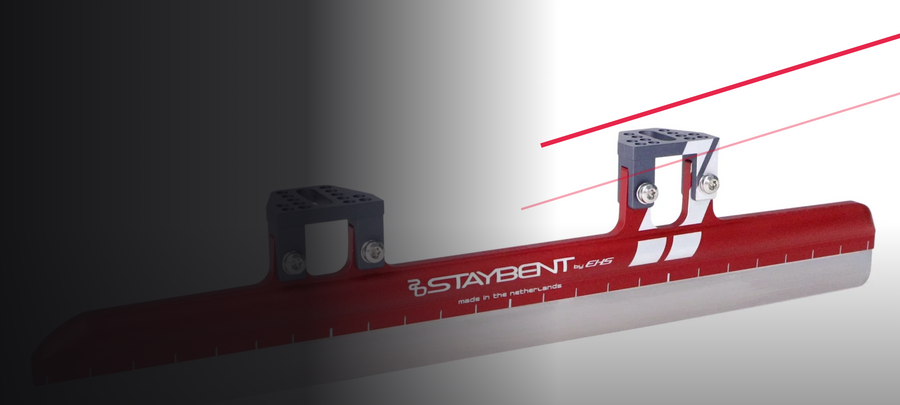
Flex matters too. The StayBent JaeBee is the most flexible blade in the StayBent range, with a tapered tube that gives the tips more give than the middle. Skaters who like to feel the blade load and release through the push tend to prefer that. The StayBent QCS sits a step firmer and gives a more direct push, and the StayBent XC Flex Weapon is built for skaters who want a stiff, responsive platform. None of these is right or wrong for the straight; they simply reward slightly different push styles. If you have a long, smooth push, a more flexible blade stores and returns some of that. If you have a sharp, powerful push, a firmer blade transfers it more directly.
If your blade feels like it is sliding out at the end of the push, or chattering on set down, that is usually a setup or edge problem rather than a technique one. Our post on blade setup symptoms walks through what each feeling is telling you.
How your boots change the straight
The push finishes at the ankle, so a boot that is not locked at the heel leaks power at the last moment. A heat moulded carbon boot like the EHS Short Track Boots holds the heel and supports the ankle through the full extension, which is exactly what a long straightaway push needs. If your heel lifts inside the boot at the end of each push, no amount of technique work will fix the leak. Lacing matters for the same reason, and a boot that is laced firmly over the instep and around the ankle will hold an edge far better than one laced evenly from toe to top.
Drills that improve the straightaway push
Slow motion laps
Skate easy laps at half speed with exaggerated glide. Hold each set down for a full second before pushing. This teaches patience in the glide phase and makes the outside to inside edge roll obvious.
One push straights
Exit the corner and take one full push only, then glide the rest of the straight on two feet. The aim is to make that single push as long and complete as possible. Then try two pushes, then three, keeping each one as full as the single push was.
Hands on back at speed
Skate race pace laps with the hands on the back. Without the arms to hide behind, any rocking or upper body push becomes obvious and the hips have to do the work.
Video from the front
Have a training partner film you head on from the far end of the straight. From this angle you can see whether the skate is landing under the hip, whether the push goes sideways, and whether the recovery is tight. Most skaters are surprised by how wide their recovery is.
Common faults and quick fixes
- Push goes backwards: think of pushing the ice away to the side and finishing with the leg long across the track, not behind you.
- Set down too wide: aim to land the skate under the hip. If it lands wide, you have already lost the outside edge phase.
- Short choppy strokes: hold the glide a fraction longer. Count strokes and try to take one fewer per straight.
- Shoulders rocking: skate with hands on the back and keep the eyes on a fixed point ahead.
- Heel lifting in the boot: relace with a locked heel, and consider a heat mould if the boot supports it.
- Blade pulling left on the glide: have the alignment and bend checked before blaming your technique.
Frequently asked questions
How many strokes should I take on a short track straight?
Most senior skaters take two or three full strokes at race speed, sometimes one more when accelerating. Fewer complete strokes beat more shallow ones.
Should I push backwards or sideways?
Sideways, and slightly back. The blade only grips across its width, so a backwards push mostly slides along the blade and wastes effort.
Does blade flex matter on the straight?
Yes. A more flexible blade such as the JaeBee loads and releases through a long push, while a firmer blade like the XC Flex Weapon transfers a sharp push more directly. Neither is wrong; match the blade to your push style.
Why does my skate slide out at the end of the push?
Usually a dull edge or a setup issue rather than technique. Check your sharpening and blade alignment first.
What is the single most useful straightaway drill?
One push straights. Making a single push as long and complete as possible teaches the whole stroke, and the habit carries over to full speed laps.
Browse blades, boots and everything else for the ice in the short track collection.