Every short track skater has had the session where the ice felt fine but the boots did not. Your toes go numb halfway through the warm up, a hot spot appears on the top of your foot, or your heel keeps lifting out of the pocket every time you push. It is easy to assume this is just what stiff carbon boots feel like and that you should toughen up. That is usually wrong. Short track boots are meant to feel firm and close, but they are not meant to hurt. Pain is information. Each type of discomfort points to a specific fit problem, and most of them have a fix that costs nothing more than a careful evening at home.
This guide walks through the pain patterns short track skaters actually report, explains what is happening inside the boot when you feel each one, and gives you a practical order of things to try. We will also cover the cases where the boot is not the problem at all, because a blade sitting in the wrong place under your foot can produce symptoms that feel exactly like a bad boot. Everything here is written skater to skater, and it applies to any stiff heat mouldable short track boot, including the EHS Short Track Boots we stock at LiveLica.
Why a Short Track Boot Feels Different to Every Other Skate
A short track boot has one job: send every bit of force from your leg straight into a long blade that is often mounted off centre under your foot. To do that, the shell has to be very stiff and it has to hold your foot without letting it move independently. There is almost no padding to hide behind. In a recreational skate, foam takes up the gaps and softens the pressure points. In a short track boot there is very little foam, so any mismatch between the shape of the shell and the shape of your foot shows up immediately as a concentrated pressure point.
This is why fit problems in short track boots feel sharper and more localised than in other skates. It is also why they are fixable. A pressure point is a small area of the shell sitting where your foot needs room. Move that area, or give your foot a better position inside the shell, and the pain usually disappears completely.
A quick map of the five pain zones and the fit problem behind each one.
Heel Lift: The Most Common Culprit of All
If you had to bet on one fit fault causing a skater grief, bet on heel lift. Your heel should stay locked into the back of the boot through the entire stroke. When it does not, the skin at the back of your heel rubs against the shell on every push, and you get burning, then redness, then a blister. Worse, the power you generate leaks away into that movement instead of going down the blade.
How to Test for Heel Lift in Thirty Seconds
Lace the boot as you normally would, stand up, and rise onto the ball of that foot as if you were about to push. Put a finger down the back of the boot at the same time if you can reach. If your heel visibly comes away from the base of the boot or you can slide a finger into a gap that was not there when you were flat footed, you have heel lift. Another simple check is to look at your sock after a session. A shiny worn patch or a rubbed heel is the boot telling you what it has been doing all evening.
Fixing It
Start with lacing before you blame the boot. Most heel lift comes from an ankle section that is not tight enough while the middle of the foot is cranked down hard. Loosen the middle, tighten the top two eyelets firmly, and use a lock lacing pattern at the ankle so the tension cannot creep back down the boot. If that is not enough, the next step is a heel lift pad or a thin wedge under the insole, which raises your heel slightly into the narrower part of the pocket. If neither works, the boot needs another heat moulding cycle with your heel pushed hard back into the shell while it cools.
The gap on the right is small, but it repeats on every stroke of every lap.
Lace Bite and Pressure Across the Instep
Lace bite is a sharp, burning line of pain across the top of your foot or the front of your ankle. It happens when the closing edges of the boot press directly onto the tendon that runs down the front of your ankle. Because that tendon moves every time you flex forward into basic position, the irritation builds through the session rather than appearing straight away.
The instinct is to tighten everything harder so the foot stops moving. That makes lace bite worse, not better. The correct response is to reduce direct pressure on the tendon. Skip an eyelet at the point where the pain sits, so the lace bridges over that spot rather than pulling down on it. A small pad of soft foam under the tongue, positioned just above the sore area, spreads the load and often removes the problem entirely. If your boot has a stiff tongue edge that digs in, a fresh heat moulding cycle can soften and reshape that area to match your ankle.
One more thing worth checking: how far forward you sit. Skaters who are still building ankle flexibility often force the shin against the front of the boot in an attempt to reach basic position. That is a technique problem showing up as a fit problem. Working on ankle mobility off the ice will do more for that pain than any padding will.
Numb Toes and Cold Feet
Numbness almost never means the boot is too small. In most cases it means the boot is closed too tightly across the forefoot, which squeezes the small blood vessels and nerves that run between the bones of the foot. You can confirm this quickly. If loosening the bottom two eyelets restores feeling within a couple of laps, tension is the cause. If your toes are still numb with the boot barely laced, the shell shape or length is genuinely wrong for your foot.
The fix for tension based numbness is a proper lacing map rather than uniform tightness. Short track boots are not meant to be pulled evenly tight from toe to top. The forefoot wants to be firm but relaxed, the instep wants moderate tension, and the ankle wants to be locked. Skaters who lace everything to the same crushing tightness get cold feet, numb toes and less control, not more.
Tension should increase as you move up the boot, not stay the same throughout.
Arch Ache and Foot Cramps
A deep ache under the arch, or a foot that cramps into a claw halfway through a session, usually means the midfoot is unsupported. Inside a stiff shell your arch is being asked to hold its own shape against high loads with nothing underneath it. The small muscles in your foot end up doing a job they were never meant to do for an hour at a time, and they protest.
A supportive insole is the usual answer. Many stock insoles are flat pieces of foam that do very little, and replacing that with something that actually contacts your arch spreads the load across a much larger area. Give it a few sessions before you judge the result, because your foot needs time to adapt to any change in support. If cramping only happens in one foot, look at your blade position too, which we come to below.
Ankle Bone Pressure and Bony Hot Spots
Some skaters get a sore, sometimes bruised spot right on the bony bump of the ankle. This is a straightforward shell mismatch: the boot is pressing exactly where your bone sticks out. Heat moulding is designed for this. When the shell is warm, a pad placed over the bony point before you put the boot on will push that area outward as the material cools, creating a small pocket. Punching out a bump this way is a normal part of setting up short track boots and does not weaken the shell when done sensibly.
If you would rather not remould, thin gel sleeves worn over the ankle can work as a temporary measure while you decide. They are a patch rather than a cure, but they get you through a competition week without losing training time.
When the Boot Is Not Actually the Problem
Here is the one that catches experienced skaters out. If your blade is mounted too far to one side under your foot, your foot will constantly work to keep the skate flat. That effort shows up as arch ache, outside foot pressure, or a strange sense that the boot is squeezing you sideways. The boot fits fine. The setup underneath it does not.
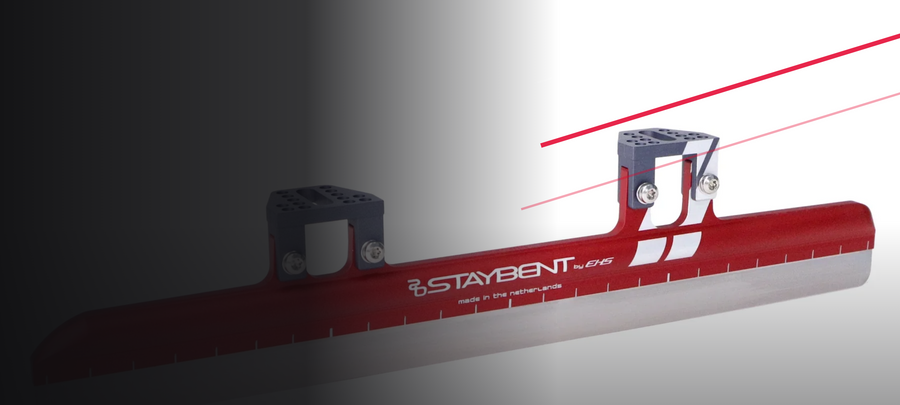
A quick clue is asymmetry. If one foot hurts and the other is comfortable in an identical pair of boots, look at the mounting before you look at the shell. Blade position is set by your mounting cups, so a careful look at your StayBent short track mounting cups and how they are positioned is often more useful than any amount of extra padding. Set the blade back towards neutral, skate a few sessions, and see whether the pain follows the change.
Looking down through the boot, a blade set too far off centre makes the foot work all session.
Socks Matter More Than People Think
Thick sports socks feel comfortable in normal shoes and are a poor choice inside a short track boot. Bulk creates folds, folds create pressure points, and the extra cushioning lets your foot move inside a shell that was moulded to hold it precisely. A thin, smooth, close fitting sock gives you a better connection to the boot and fewer hot spots. In short track there is the additional matter of protection, which is why many skaters use a cut resistant option such as the LiveLica Level 4 cut resistant ankle socks and get both a slim profile and ankle coverage in the same item.
A Simple Diagnosis Routine You Can Run Tonight
Work through this in order rather than changing five things at once, because if you change everything you will never know what fixed it.
- Put the boots on with thin socks and lace them using the three zone pattern above, then stand and flex forward for two minutes.
- Note exactly where any discomfort appears, and whether it is one foot or both.
- If it is one foot only, check blade position and mounting before touching the boot.
- If the pain is at the heel, tighten the ankle zone and loosen the instep, then retest.
- If the pain is across the instep or front of the ankle, skip an eyelet at that point and add a soft pad under the tongue.
- If your toes go numb, loosen the forefoot only and see if feeling returns within a lap or two.
- If the pain is on a bony point, plan a heat moulding session with a pad over that spot.
- Only after all of the above should you conclude the boot is the wrong size or shape for your foot.
Keep notes for a couple of weeks. Fit problems are much easier to solve when you can see a pattern rather than relying on memory after a hard session.
When It Really Is the Wrong Boot
Sometimes the honest answer is that the shell does not suit your foot. The clearest sign is a boot that hurts everywhere at once rather than in one identifiable spot, or a boot where your toes touch the end while your heel still moves. Length and volume problems cannot be solved by lacing or padding, and repeatedly remoulding a shell that is fundamentally the wrong shape will only frustrate you. If you are in that position, start again from proper measurement rather than shoe size, and browse the current stiff options in the EHS short track boots collection or the wider short track setup collection to see what is available before committing.
Frequently Asked Questions
Should short track boots hurt when they are new?
They should feel firm, close and unfamiliar, and your ankles may ache for the first few sessions while you adapt to the stiffness. Sharp, localised pain at a single point is different, and that is a fit issue worth solving rather than something to skate through.
How many times can I heat mould a boot?
Most heat mouldable shells tolerate being remoulded several times, and adjusting one area after a first fitting is completely normal. Follow the temperature and timing guidance for your specific boot, let the shell cool fully with your foot inside, and avoid remoulding repeatedly in a short period.
Can tighter lacing fix heel lift?
Tighter lacing at the ankle can, but tighter lacing everywhere cannot. Heel lift is caused by a loose ankle section, so tightening the middle of the boot only adds forefoot pressure and numbness without holding the heel down.
Why does only one foot hurt?
Asymmetric pain usually points to setup rather than the boot, most often blade position or a difference in how the two skates are mounted. Compare both skates carefully before deciding one boot is faulty.
Do thicker socks help with pressure points?
Rarely. Thicker socks fill space the boot was moulded to fill with your foot, which reduces control and can create new pressure points where the fabric folds. Thin, smooth socks are the better choice in a stiff short track boot.
Skate Comfortable, Skate Faster
A short track boot that fits properly disappears under you. You stop thinking about your feet and start thinking about your lap times, your entry into the corner and the skater ahead. Almost every fit complaint has a cause you can identify and a fix you can apply, and working through them methodically will do more for your skating this season than any equipment upgrade. Start with lacing, move to moulding, check your blade position, and treat pain as useful feedback rather than something to tolerate.