Short track lap splits are the most useful piece of information a club skater can collect, and almost nobody collects them. We know our finish times. We know whether we felt good. What we rarely know is which lap actually cost us the race, and that is the one thing that tells you what to train next week. A 1000m is nine laps, and a skater who loses two tenths on the first lap has a completely different problem from a skater who loses eight tenths on the last one, even if both finish with the same time on the board.
This guide walks through how to time your laps without any special equipment, how to read the shape your splits make, what each shape usually means, and which equipment faults to rule out before you blame your legs. It is written for skaters racing on a standard short track oval, where one lap is 111.12 metres, so the 500m is four and a half laps, the 1000m is nine laps and the 1500m is thirteen and a half laps.
Why splits tell you more than a finish time
A finish time is a single number that averages away everything interesting. Two skaters can run the same 1500m time with completely opposite races, one going out hard and fading, the other sitting in and closing. Both learn nothing from the total. The splits, on the other hand, say exactly where the time went.
Splits are also honest in a way that feeling is not. Most skaters believe their last lap is their weakness, because the last lap hurts the most. When they actually time it, a surprising number find their last lap is fine and the time was lost in laps three and four, where they relaxed without realising it. Pain and time loss are not the same thing, and only a stopwatch separates them.
How to time your laps without special equipment
You do not need a timing system. You need a phone and a plan.
The simplest method: film the whole effort
Set a phone on a bag at the barrier so it can see one fixed point on the ice, ideally the start line or a cone you place yourself. Film the entire effort from the first push to the finish. Afterwards, scrub through the video and note the timestamp every time you cross that fixed point. Subtract each from the next and you have your splits. It takes five minutes and costs nothing.
Filming from a corner rather than a straight is better than it sounds, because you get your lap times and a clear view of your corner line in the same clip. If you want to go further with the video itself, the method in our guide on reviewing your own skating on video applies directly.
Have somebody call the splits
If a parent, a training partner or a coach is at the barrier, a stopwatch with a lap button and a loud voice is better than video, because you hear the numbers while the effort is still in your legs. Hearing lap four come in slow while you are skating lap five teaches you more about pacing than any amount of analysis afterwards.
Make the test repeatable
Splits are only useful if you can compare them later, so fix the conditions. Same number of laps, same point on the oval, same position in the session, ideally the same ice. A six lap effort as the third item in a session after a full warm up is a perfectly good test. A six lap effort when you happened to feel good at the end of a session is not comparable to anything.
Four common split shapes from a six lap effort, and the training each one actually points to.
Reading the shape of your splits
Pattern one: a slow first lap, then everything even
This is the most common pattern in developing skaters and it is good news, because the start is the fastest thing in short track to improve. A slow opening lap means you spent too long converting running steps into gliding strides, or that your first four steps are not getting you to speed. It almost never means you are unfit.
The fix is block start repetitions, done fresh at the beginning of a session rather than tacked on at the end when your legs are gone. Four to six starts with a full recovery between them, with the first four steps as the only thing you are thinking about, will change this split within a few weeks.
Pattern two: even laps that drift slower to the end
A steady fade is a pacing problem or a race endurance problem, and the splits cannot tell you which on their own. The way to separate them is to repeat the test with a deliberately controlled first two laps. If the fade disappears and your total improves, it was pacing. If the fade still arrives in the same place, it is endurance and it responds to race pace repetitions of six to ten laps.
Worth noting that a fade in training with nobody around you is different from a fade in a race, where you are also managing traffic and position. If your training splits hold but your race splits fade, the problem is usually energy spent on positioning rather than fitness.
Pattern three: laps that jump around with no pattern
Inconsistent splits with no trend mean something is changing between laps that should not be. In a race it is usually traffic. Alone on the ice it is usually technique or equipment: a corner line that varies, a hand down that unsettles you, a crossover that sometimes catches, or a blade that slips on one particular edge.
This is the one pattern where you should stop and check the skates before you train anything, which is what the next section is about.
Pattern four: everything slow but very even
Even splits mean your pacing and your control are already good, and that your limiter is simply top speed. This skater needs maximum speed work and strength rather than more laps, which is the opposite of the instinct. More volume will make the splits even more even, and no faster.
Splitting the lap itself: corner against straight
Once whole lap splits stop telling you anything new, split the lap. Because close to half of every short track lap is spent inside a turn, the corners are where most of your time is made or lost, and a skater can hold a respectable lap time while making two clear mistakes that cancel out.
Put a cone or a visible mark at each of these four points and your lap time becomes a diagnosis instead of a score.
The practical version is to mark four points with cones or tape, film from the stands so all four are visible, and read segment times from the video. You are not chasing precision here. You are looking for which segment is consistently the slow one, and that is obvious even with rough numbers. If the corner entry to apex segment is your slow spot, our guide on short track cornering technique is the place to start.
Rule out the equipment before you blame the legs
Inconsistent or stubbornly slow splits are sometimes a skating problem wearing an equipment disguise. Three checks cover almost all of it, and all three take minutes.
Edges
A dull or unevenly ground edge makes the ice feel unpredictable, and a skater who does not trust the ice stops committing to the lean. That shows up as slow corner entries and saw tooth splits. Run a thumbnail along both edges, look for shine on the low points, and sharpen if there is any doubt. A good combination stone such as the Zandstra Foss combination sharpening stone plus a careful deburr is usually all that is needed between full sharpenings.
Be aware that sharpening also breaks the comparison between tests. If you sharpen between two split sessions, do not read the difference as fitness. Note it and compare the next pair instead.
Bend and rocker
A bend that is too aggressive for the ice you are on makes the blade bite hard at entry and wash out at exit, which is exactly the entry fast then exit slow pattern. A bend that is too flat makes the skate feel like it will not hold the arc at all. Blade character plays into this as well. A more forgiving blade such as the StayBent JaeBee gives a lot of feedback and lets a skater change line mid corner, while a stiffer, more even platform like the StayBent QCS rewards a skater who sets one line and loads it hard. Neither is faster on paper. One of them will make your splits more consistent.
Heel lift and boot hold
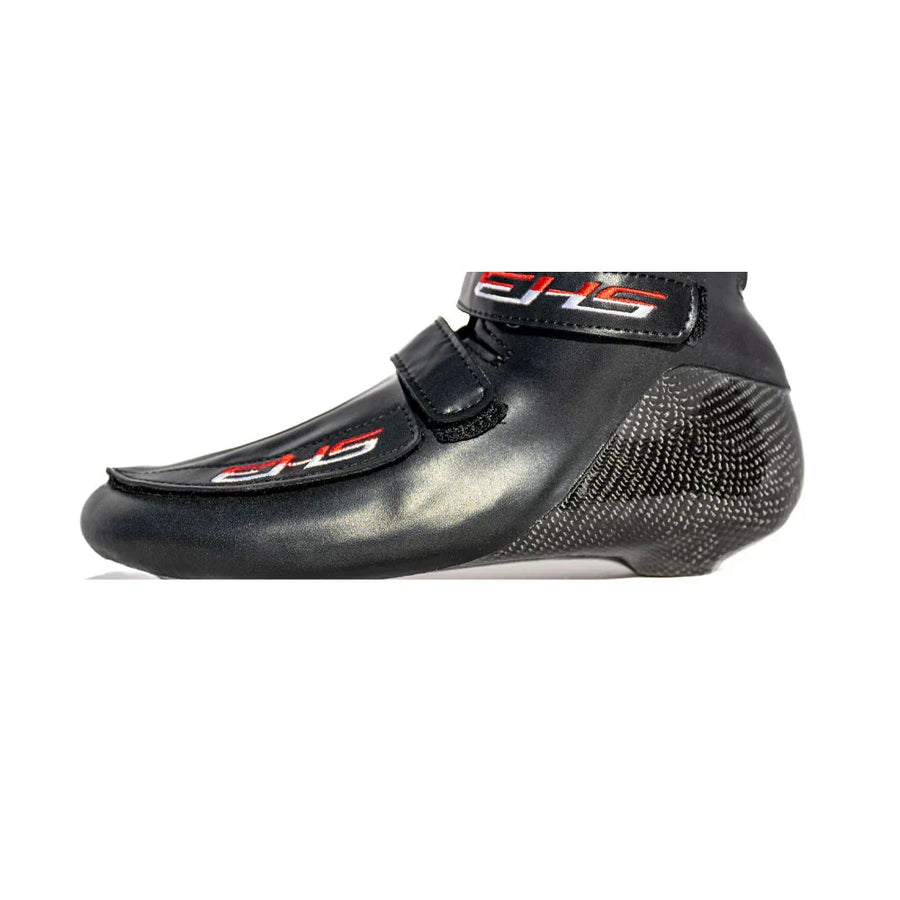
If your heel moves inside the boot on the first hard push, you lose power at exactly the moment the start split is measured. Rise onto your toes with the laces moderately tight and check that the heel stays down. A properly heat moulded boot such as the EHS Short Track Boots solves this at the source, and so does fixing the lacing pattern on a boot you already own. The rest of the kit that supports all of this sits in our short track accessories collection.
Turning splits into a session
A split test is only worth doing if it changes next week. Keep it simple.
- Test once every three or four weeks, not every session, and always with the same protocol.
- Write the splits down in a notebook or a phone note with the date, the rink and whether you had just sharpened.
- Pick the single worst segment and give it one dedicated drill block per week until the next test.
- Do not change your blades, your bend and your training in the same month, because then you will never know which one did it.
- Compare like with like. Fresh splits against fresh splits, end of session splits against end of session splits.
Two skaters, one opening pace, two very different races. Only the splits show it.
How this fits into a normal week
A split test is a hard effort, so treat it as one of your hard sessions rather than something extra. Warm up fully, do the test early in the session while you are fresh, then use the rest of the ice time for controlled technique work on whatever the last test told you to fix. If your club runs time trials already, you may not need a separate test at all. Just make sure somebody is calling or filming the laps rather than only recording the total.
Over a season the notebook becomes the most valuable thing you own, because it shows the trend. One test tells you where you are weak today. Six tests across a season tell you whether the work you chose actually did anything, which is the only question that matters.
Frequently asked questions
How do I measure lap times on my own with no coach?
Film the effort with a phone on your bag, fixed on one point of the ice, then read the timestamps as you cross that point. It is accurate enough to spot which lap is slow, which is all you need.
How many laps is each short track race?
On a standard 111.12 metre oval the 500m is four and a half laps, the 1000m is nine laps and the 1500m is thirteen and a half laps. Your test does not have to match a race distance, it just has to be repeatable.
Should my laps get faster or slower through a race?
In a time trial most skaters are fastest in the early laps once up to speed, and the aim is to limit how much the last laps drift. In a tactical race splits look completely different because the pace follows the pack, which is why you test alone and race separately.
My splits are inconsistent lap to lap. Is that fitness?
Usually not. Inconsistency points at technique, corner lines or equipment. Check edges, bend and heel hold first, then film a corner and look at whether your line is the same every time.
How often should I do a split test?
Every three or four weeks is plenty. Any more often and normal day to day variation drowns out the signal you are looking for.
Does sharpening between tests ruin the comparison?
Yes, in the sense that a fresh edge usually feels faster and more confident. Note the sharpening date next to the splits and compare tests that sit at a similar point in the sharpening cycle.
Putting it together
Short track lap splits turn a vague feeling into a decision. A slow first lap sends you to block starts. A steady fade sends you to race pace work and an honest opening plan. Laps that jump around send you to your blades and your boots before anything else. And laps that are even but slow send you to top speed work, which almost nobody guesses correctly without timing it.
Start this week. Film one six lap effort, read the splits, and write them down. If the pattern points at your edges or your setup rather than your training, we are happy to talk through blades, bend and boot fit with you, because there is no point training harder against a skate that is working against you.